
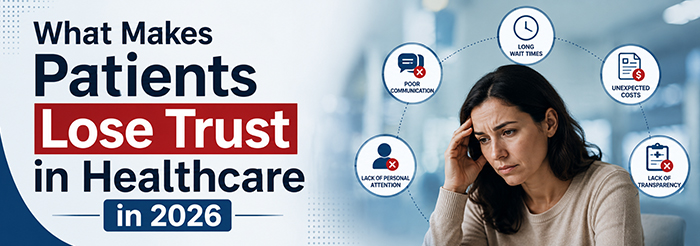
Affected person belief in healthcare is fragile and critically necessary. Belief in docs and hospitals fell from 71.5% in April 2020 to only 40.1% by January 2024. The belief disaster hasn’t resulted in 2026. Affected person distrust is fueled by misinformation generated by synthetic intelligence, insurance coverage opacity, a health care provider scarcity, and an more and more polarized Information atmosphere. Declining affected person belief within the healthcare system poses nice challenges.
For unbiased and group medical practices, it is a matter of enterprise survival. Sufferers who don’t belief their docs are suspending remedy, canceling remedy plans, leaving clinics, and warning others on-line. Let’s determine what makes sufferers lose belief in healthcare!
The Healthcare Belief Disaster of 2026
The numbers are stark. Belief in a single’s personal physician to make the best suggestions declined from 93% in 2023 to 85% in early 2025. IT marks a drop in what was beforehand essentially the most trusted relationship in healthcare.
The erosion is much more extreme. 68% of Individuals consider supplier organizations put their very own pursuits forward of their sufferers’. By 2025, the Edelman Belief Barometer discovered that in 9 of 11 international locations surveyed, a majority of individuals stated healthcare establishments have been actively undermining entry to care.
Sufferers distinguish sharply between the system and their particular person supplier. Most individuals nonetheless belief their private doctor. The disaster is structural. That creates a significant window of alternative for practices that talk and behave accordingly.

Why Do Sufferers Mistrust Docs in 2026? 10 Core Causes
1. Insurance coverage Denials and the Revenue-Over-Affected person Notion
When sufferers are denied protection, have their remedy delayed, or are slowed down in paperwork requiring pre-approval, they blame extra than simply their insurance coverage firm. They typically lose belief in all the system, together with their physician. The preliminary declare denial charge increased by 13 percentage factors between 2021 and 2025. In 2025 alone, hospitals spent nearly $18 billion reversing denial choices. Medicare Benefit insurers utilizing synthetic intelligence instruments doubled the denial charge for older sufferers. Roughly 75% of those denials have been overturned on enchantment. Nevertheless, lower than 1% of patients ever filed an enchantment. AMF Media Group and MGMA surveyed 2,400 US adults and located that the principle drivers of eroded belief have been insurance coverage firms, pharmaceutical firms, and the federal government, not COVID-19 or the docs themselves.
2. The Rise of AI Health Chatbots
Health–Information-trust/poll-1-in-3-adults-are-turning-to-ai-chatbots-for-Health–Information-equaling-the-share-who-use-social-media-for-Health/” goal=”_blank” rel=”nofollow”>One in three American adults now turns to AI-powered chatbots for Health recommendation. This determine now rivals social media as a supply of Health Information. Sufferers use AI as a result of they need quick solutions, can’t afford remedy, or can’t get an appointment. Health-chatbot-safety-2026/” goal=”_blank” rel=”nofollow”>About 1 in 5 adults who use AI for Health cite incapacity to afford care or incapacity to get an appointment as a significant purpose. Sufferers who adopted AI recommendation have been 5 occasions extra more likely to expertise Health hurt than those that didn’t. Health-misinformation.html/” goal=”_blank” rel=”nofollow”>Main AI language fashions typically repeat false medical claims if they’re phrased in clinical-sounding language.
3. Health Misinformation on Social Media
A peer-reviewed study published in Frontiers in Medicine discovered solely 31% of sufferers reported excessive belief within the healthcare system. Sufferers with low belief have been extra more likely to report that discussions about internet-found Health Information worsened their supplier interplay. The extra sufferers devour conflicting Health content material on-line — with out a robust main care relationship to filter IT — the tougher scientific encounters turn out to be.
4. Doctor Scarcity and Lack of Continuity
Belief is relational. When sufferers lose their common doctor, they lose the collected historical past and familiarity that makes scientific recommendation credible. 67% of federally qualified Health facilities misplaced between 5% and 25% of their workforce in a single six-month interval through the pandemic, with many positions nonetheless unfilled as we speak. Each appointment is a primary appointment. And you will need to rebuild belief from zero, typically in a 15-minute window.
5. Poor Communication and the Empathy Hole
Doctor empathy determines affected person belief. A study published in the journal Frontiers in Medicine discovered a big optimistic correlation between doctor empathy and belief, with affected person satisfaction performing as a partial mediator. Dashing throughout appointments, lack of eye contact because of digital medical report screens, and dismissive attitudes towards patient-reported signs erode belief. That is very true for girls, the aged, and sufferers from marginalized communities.

6. Politicization and Authorities Mistrust
Why do sufferers mistrust docs in 2026? The COVID-19 pandemic altered how a good portion of the inhabitants pertains to institutional Health steerage. Public Health measures turned tradition warfare flashpoints, and by affiliation, physicians absorbed a few of the ensuing suspicion. Health-tracking-poll-maha-and-the-midterms/” goal=”_blank” rel=”nofollow”>KFF’s 2026 Health Information and Belief information discovered most Individuals now mistrust pharmaceutical firms, meals and agriculture industries, and authorities Health businesses to behave within the public’s greatest curiosity.
7. Racial and Socioeconomic Inequities
Distrust in healthcare is erratically distributed. For Black, Latino, Indigenous, and low-income sufferers, the erosion of belief in healthcare establishments is compounded by preexisting distrust of drugs, rooted in documented disparities within the high quality of care and historic injustices. AJMC information confirmed that Health-care/” goal=”_blank” rel=”nofollow”>folks with the bottom incomes are half as more likely to have a private doctor as these with the best incomes. IT successfully deprives them of the elemental relationships upon which belief is constructed.
8. AI in Medical Resolution-Making With out Disclosure
Health/” goal=”_blank” rel=”nofollow”>Almost 66% of Individuals had low belief of their Health system to make use of AI responsibly. and practically 58% doubted their supplier would shield them from AI-caused hurt. Most sufferers in nationally consultant surveys stated they need to know when AI is used of their prognosis or remedy. But there’s at the moment no federal regulation requiring suppliers to reveal this. When sufferers are usually not knowledgeable about AI’s position of their care and really feel their information is being processed opaquely, IT triggers a deep and rational sense of vulnerability.
9. Weak On-line Popularity and Digital Absence
Belief is shaped earlier than the primary appointment. 72% of patients seek the advice of on-line evaluations earlier than deciding on a healthcare supplier.
Sufferers prioritize on-line evaluations over private referrals, with 61% favoring reviews over suggestions from family and friends. A apply with out a proactively managed digital presence is invisible to nearly all of potential sufferers.

10. Affected person Security Perceptions
Sufferers who charge their notion of security as “top-box” give the apply a rating of 85.3 on Probability to Suggest. IT is in comparison with a drop of greater than 50 factors for any decrease security score. When sufferers can’t visibly observe teamwork, coordination, and cautious communication, they conclude they is probably not secure. And a affected person who doesn’t really feel secure isn’t a trusting affected person.
Affected person Belief in Healthcare 2026: The ten Belief-Eroding Components
A abstract of the first drivers of declining affected person belief in 2026, with supporting information.
| # | Belief Driver | Key 2026 Information Level |
|---|---|---|
| 1 | Insurance coverage Denials & Opacity | Declare rejection charges rose by 13 factors; 68% consider suppliers put income first. |
| 2 | Health Misinformation (Social/AI) | Solely 31% of sufferers report excessive belief within the healthcare system (HINTS 7-2024 nationwide information). |
| 3 | AI With out Transparency | 66% of Individuals have low belief of their Health system to make use of AI responsibly. |
| 4 | Doctor Scarcity / Lack of Continuity | 67% of FQHCs misplaced 5–25% of their workforce in a single six-month interval through the pandemic. |
| 5 | Politicization of Healthcare | Edelman 2025: No establishment—authorities, enterprise, or NGO—is trusted to deal with Health wants. |
| 6 | Perceived Revenue-Over-Affected person Motive | In 9 of 11 Edelman international locations, a majority says establishments actively undermine entry to care. |
| 7 | Poor Communication & Empathy Deficit | Affected person satisfaction partially mediates the connection between doctor empathy and affected person belief (Frontiers in Drugs, 2025). |
| 8 | Racial & Socioeconomic Disparities | Decrease-income teams are 50% much less more likely to have a private physician in contrast with the highest-income group (AJMC). |
| 9 | Weak Digital Popularity | 87% of sufferers learn evaluations earlier than selecting a supplier, and 72% require a score of 4 stars or larger (Birdeye 2025). |
| 10 | Affected person Security Perceptions | A security-rated “high field” produces an LTR rating of 85.3; something much less drops the rating to 34.6 (Press Ganey 2025). |
Sources: MIEC (2026), KFF (2026), MGMA/AMF (2025), Edelman Belief Barometer (2025), Press Ganey (2025), Birdeye (2025), Frontiers in Drugs (2025), AJMC, STAT Information (2026)
The Actual-World Penalties of Declining Belief
The stakes prolong effectively past affected person satisfaction scores. STAT Information stories that sufferers who mistrust their healthcare suppliers usually tend to delay preventive screenings and discontinue medicines. These patterns are linked to larger charges of hospitalization and untimely loss of life. For practices, mistrust interprets into affected person attrition, diminished appointment compliance, and publicity to unfavorable on-line evaluations that compound the issue for potential sufferers.
The excellent news is that belief could be rebuilt. Particular person practices are well-positioned to rebuild belief. The belief disaster is directed primarily on the system, quite than on the particular person supplier. Practices that take deliberate, seen motion to distinguish themselves from the structural failures of insurance coverage, pharmaceutical affect, and authorities messaging strengthen the non-public physician-patient bond that continues to be essentially the most trusted relationship in healthcare.
How Practices Can Rebuild and Shield Affected person Belief in 2026
Proactively talk about insurance coverage and AI. Concise and sincere explanations shield the doctor-patient relationship from systemic issues.
Employees coaching, appointment pacing, and clear, empathetic communication sign belief. Dashing by means of the appointment is without doubt one of the most ceaselessly cited causes for distrust.
Handle your digital fame. Automate post-visit assessment requests, reply to all evaluations inside 48 hours, and guarantee your Google Enterprise Profile is correct and lively.
Guarantee continuity of care. In an period of doctor shortages and fixed doctor turnover in company healthcare, a clinic the place sufferers persistently see the identical specialist has an actual benefit.
Bilingual employees, translated supplies, and numerous doctor groups straight scale back the belief hole between racial and cultural teams and broaden your affected person base.
In the event you use AI instruments for prognosis, scheduling, or documentation, inform your sufferers. Transparency on this space builds belief.
Conclusion
Medical competence is a fundamental requirement. What retains sufferers, generates referrals, and withstands financial and aggressive pressures? IT’s affected person belief of their doctor. Sufferers who belief their docs adhere to remedy plans, return for preventive care, and advocate their doctor to others.
Since 1979, Apply Builders has supported the event of practically 16,000 healthcare establishments. Our healthcare advertising companies embrace fame administration, affected person communication methods, and digital presence optimization. We’re prepared to assist healthcare establishments construct the type of belief that trendy sufferers search. Go to practicebuilders.com to study extra.
👇Comply with extra 👇
👉 bdphone.com
👉 ultractivation.com
👉 trainingreferral.com
👉 shaplafood.com
👉 bangladeshi.help
👉 www.forexdhaka.com
👉 uncommunication.com
👉 ultra-sim.com
👉 forexdhaka.com
👉 ultrafxfund.com
👉 bdphoneonline.com
👉 dailyadvice.us