
Introduction
The Trump administration has made coverage modifications to limit immigration into the U.S., together with efforts to finish Short-term Protected Standing (TPS) designations for a lot of nations, pauses and restrictions on the issuance of recent visas, and considerably elevated immigration enforcement. These actions might have destructive implications for the U.S. workforce, which incorporates vital shares of immigrant employees, significantly in sure industries together with Health Care. Immigrant employees embody naturalized residents in addition to noncitizens, together with lawfully current and undocumented immigrants.
This subject transient supplies information on immigrants’ position within the U.S. workforce, together with in Health Care and different key industries, primarily based on KFF evaluation of Present Inhabitants Survey (CPS) primary month-to-month information and American Neighborhood Survey (ACS) one-year information for U.S. employees 18 years and older by citizenship standing. Key takeaways from this evaluation embody:
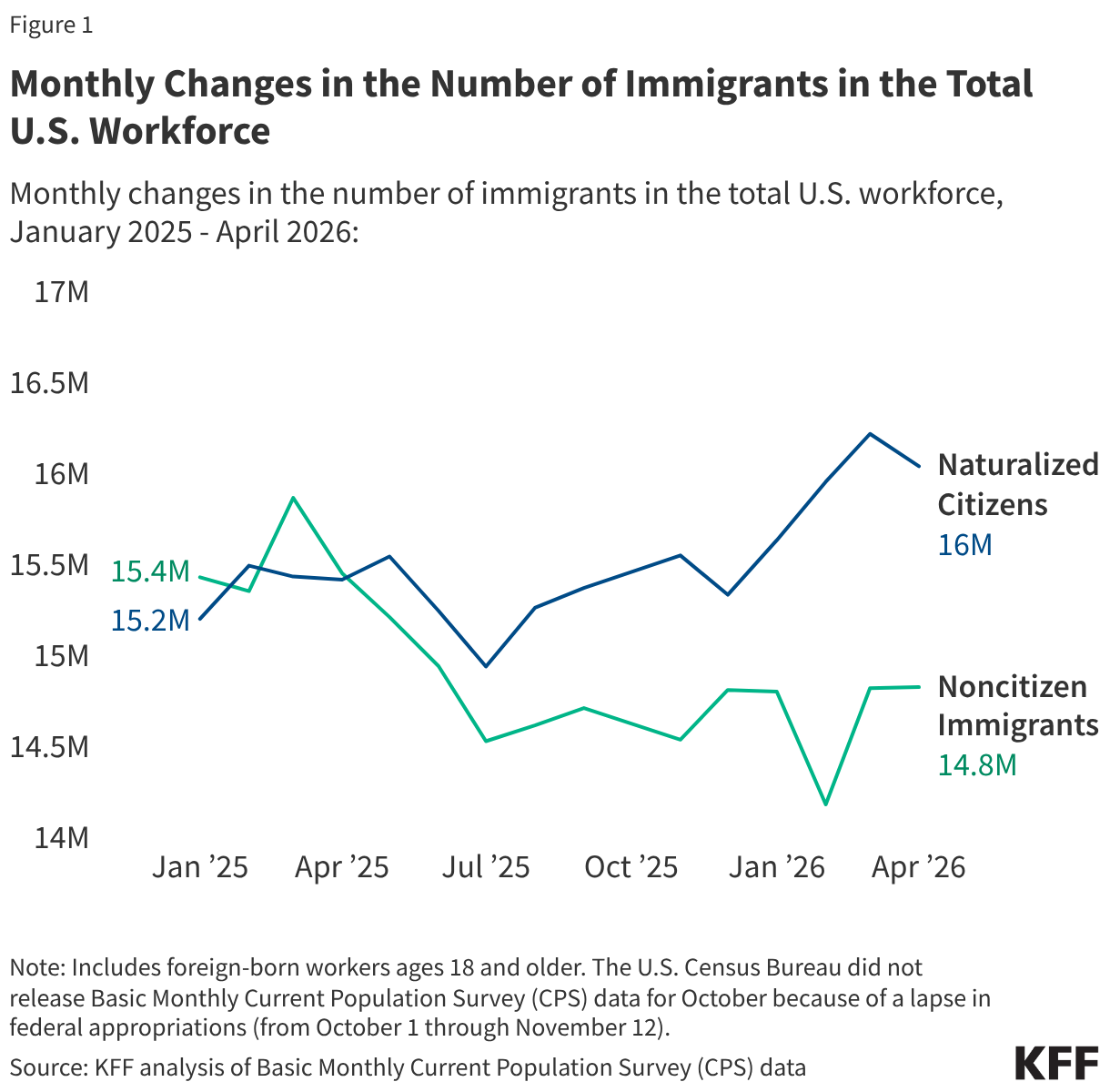
Whereas the entire variety of immigrant employees within the U.S. held largely regular between January 2025 and April 2026, the variety of noncitizen immigrant employees declined by about 600,000, or 4%, from 15.4 million to 14.8 million. This was offset by a rise within the variety of naturalized citizen employees of over 800,000, or about 6%, from about 15.2 to 16.0 million. The variety of U.S.-born employees elevated by about 1% between January 2025 and April 2026 (125.6 to 126.7 million). Throughout the Health Care business, there was an general improve of 1% or about 130,000 employees from 19.4 to 19.6 million, which mirrored will increase amongst U.S-born (16.0 to 16.1 million) and noncitizen immigrant employees (961,000 to 1.2 million) that offset a decline amongst naturalized citizen employees (2.5 million to 2.3 million).
Immigrants accounted for about one in 5 (19%) or near 31 million of the entire U.S. workforce as of 2024. Inside Health Care, immigrants accounted for 17% of the workforce, together with 28% of physicians and surgeons and 30% of direct care employees in long-term settings. In hospitals, immigrants accounted for comparable shares of scientific employees and non-clinical employees and performed a very giant position as physicians and surgeons (30%). Prime nations of origin for immigrant Health Care business employees embody Philippines (12%), Mexico (11%) and India (7%). In hospitals, immigrants additionally play an outsized position in sure non-clinical occupations, together with constructing cleansing and upkeep employees (29%). Immigrants, significantly noncitizen immigrants, additionally accounted for disproportionate shares of agriculture (33%); development (26%); and meals companies, upkeep, and private care service employees (23%).
Continued reductions within the variety of immigrants might influence the U.S. economic system and key industries, particularly because the 65 and older inhabitants within the U.S. grows and there are fewer substitute employees obtainable. Diminished immigrant participation within the Health Care workforce, together with the long-term care workforce, might exacerbate present employee Health-workforce/nchwa/workforce-projections”>shortages and negatively influence the Health and well-being of Individuals.
Current Tendencies within the Immigrant Workforce
Whereas the entire variety of immigrant employees within the U.S. held largely regular between January 2025 and April 2026, the variety of noncitizen immigrant employees declined by about 600,000 or 4% from 15.4 million to 14.8 million. This was offset by a rise within the variety of naturalized citizen employees of over 800,000, or about 6%, from about 15.2 to 16.0 million. The variety of U.S.-born employees elevated by about 1% between January 2025 and April 2026 (125.6 to 126.7 million). Throughout the Health Care business, there was an general improve of 1% or about 130,000 employees from 19.4 to 19.6 million, which mirrored will increase amongst U.S-born (16.0 to 16.1 million) and noncitizen immigrant employees (961,000 to 1.2 million) that offset a decline amongst naturalized citizen employees (2.5 million to 2.3 million).
Health-care-workforce”>Immigrants’ Position within the U.S. Health Care Workforce
Adjustments within the immigrant workforce could have vital implications given the position that immigrants play, significantly in sure industries together with Health Care.
Immigrants account for about one in 5 employees within the U.S. As of 2024, immigrants accounted for about 19%, or near 31 million, of the entire U.S. workforce over age 18 primarily based on KFF evaluation of ACS information. Naturalized residents accounted for roughly 10% of employees and noncitizen immigrants accounted for an additional 9% of complete employees.
Inside Health Care, immigrants make up about one in six employees general and account for even bigger shares of physicians and surgeons and direct care employees in long-term settings. Immigrants accounted for 17%, or about 3.3 million, of the Health Care workforce general and about three in ten physicians and surgeons (28%) and direct care employees in long-term care settings (30%) (Determine 2). Amongst physicians and surgeons, 22% have been naturalized residents and seven% have been noncitizen immigrants. Amongst direct long-term care employees, 18% have been naturalized residents and 12% have been noncitizen immigrants.
 Health Care Staff, Together with About Three in Ten Physicians and Surgeons and Direct Lengthy-Time period Care Staff (Stacked Bars)”/>
Three in ten immigrant Health Care employees are from Philippines (12%), Mexico (11%) or India (7%) (Determine 3). China, Jamaica, Cuba, and Haiti contribute one other 4% every of immigrant Health Care employees. Amongst immigrant physicians and surgeons, one in 5 (21%) are from India, 6% from China, 5% every from Canada and Pakistan, and 4% are from Philippines. Amongst immigrant direct long-term care employees, one in seven (14%) are from Mexico, 7% every are from Dominican Republic and Philippines, and 6% every are from Jamaica, China, and Haiti.
 Health Care Staff Are From Philippines, Mexico, or India (Pie Chart)”/>
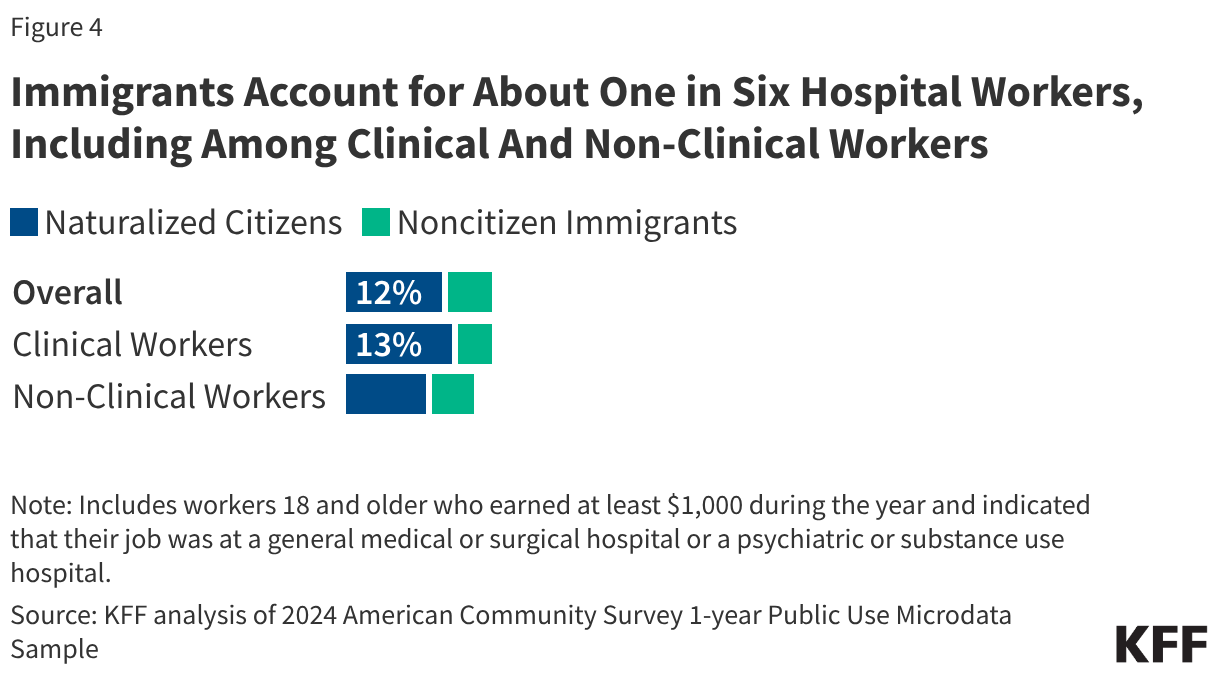
In hospitals, immigrants accounted for one in six (17%), or about 1.4 million, employees as of 2024. This consists of 12% of hospital employees who’re naturalized residents and 5% who’re noncitizen immigrants (Determine 4). Immigrants made up comparable shares of scientific (17%) and non-clinical (15%) employees in U.S. hospitals. Medical employees embody physicians, surgeons, nurses, and many others., and non-clinical employees embody workplace employees, meals service employees, cleansing and upkeep employees, and different non-clinical employees. Amongst immigrant hospital employees, 16% are from Philippines, 9% are from Mexico, 8% are from India, and 4% every are from China and Jamaica.
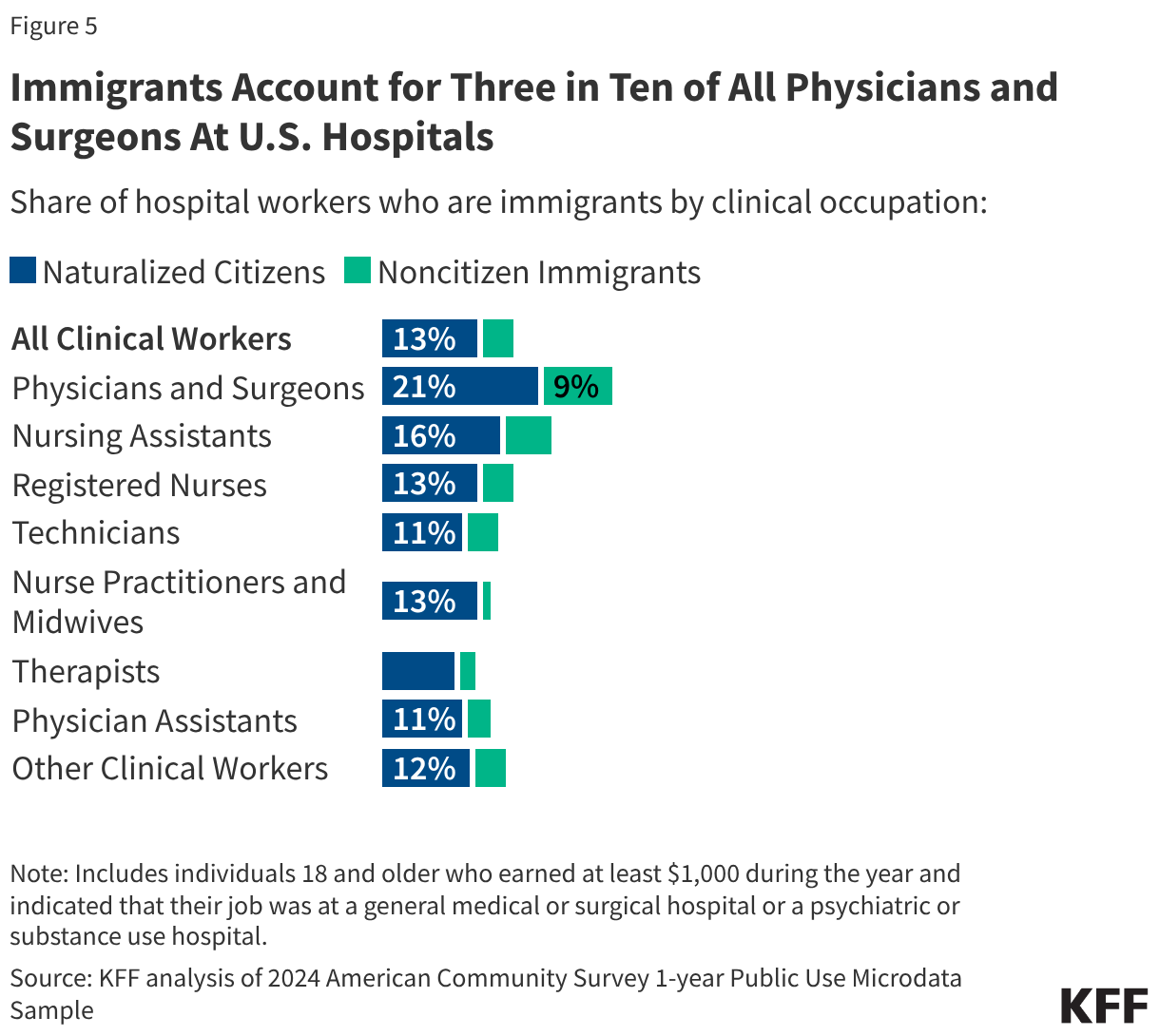
Inside hospitals, immigrants made up three in ten (30%) physicians (Determine 5). This consists of over one in 5 (21%) who’re naturalized residents and one other 9% who’re noncitizen immigrants. Immigrants additionally made up over one in 5 (22%) nursing assistants, about one in six registered nurses (17%), and about one in seven technicians (15%) and nurse practitioners and midwives (14%) at U.S. hospitals. Immigrants additionally play an outsized position in sure non-clinical occupations in hospitals, similar to constructing cleansing and upkeep employees.
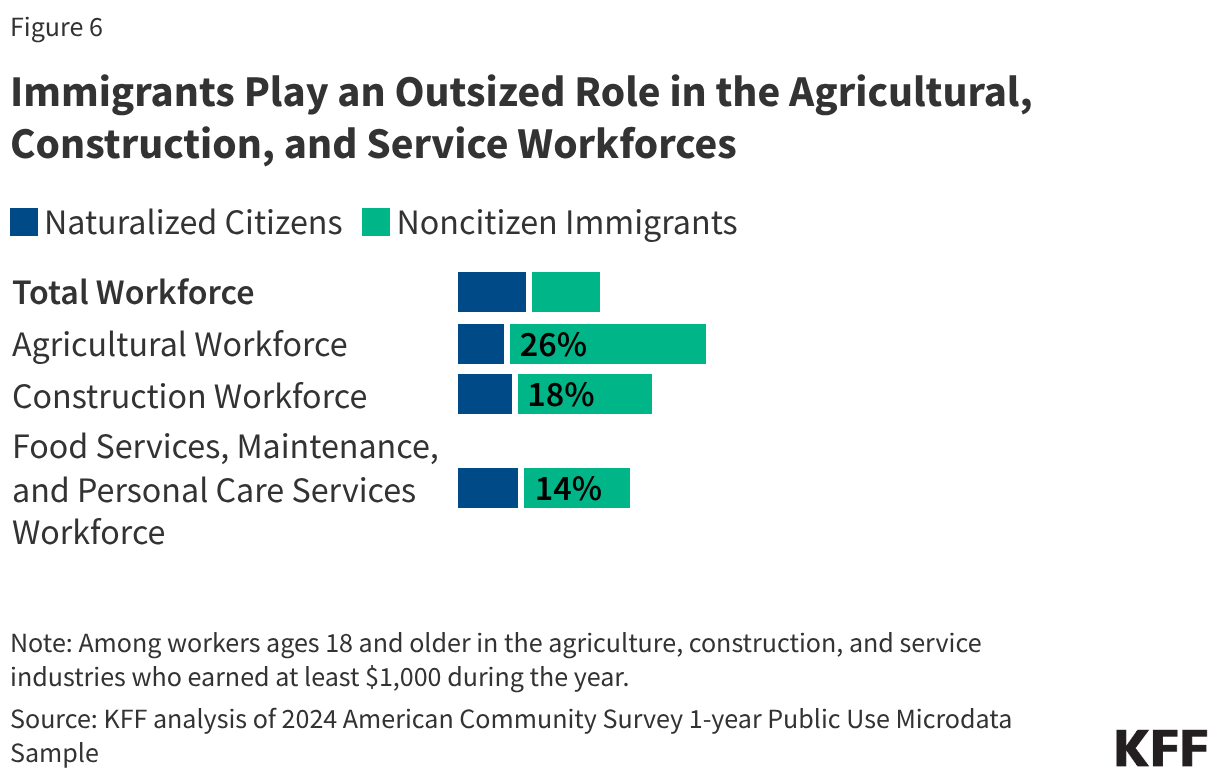
Immigrants, significantly noncitizen immigrants, additionally play an outsized position in different key industries together with agriculture, development, and repair. As of 2024, immigrants made up one in three (33%) agricultural employees, of whom 26% have been noncitizen immigrants and seven% have been naturalized residents; a couple of quarter of (26%) development employees, of whom 18% have been noncitizen immigrants and eight% have been naturalized residents; and a couple of quarter (23%) of meals companies, upkeep, and private care service employees, of whom 14% have been noncitizen immigrants and 9% have been naturalized residents (Determine 6).
Strategies
Knowledge sources: This transient relies on KFF evaluation of federal survey information, particularly the Basic Monthly Present Inhabitants Survey (CPS) and the American Community Survey 1-year Public Use Microdata Pattern. These surveys are nationally consultant family surveys carried out by the U.S. Census Bureau. Whereas Fundamental Month-to-month CPS information can be found on a month-to-month foundation, ACS PUMS information can be found on a yearly foundation. Fundamental Month-to-month CPS information have a considerably smaller pattern measurement than yearly ACS and yearly CPS information. As a result of smaller pattern measurement, outcomes could also be extra delicate to potential decreases in survey participation amongst immigrants resulting from immigration-related fears.
Figuring out citizenship standing: Naturalized residents are those that point out turning into a U.S. citizen by naturalization; and noncitizen immigrants are those that say that they aren’t a U.S. citizen. Noncitizen immigrants embody lawfully current and undocumented immigrants.
Figuring out employees throughout completely different industries: Health Care, agriculture, development, and repair employees are recognized as people 18 years of age or older who report working both full-time or part-time in one of many aforementioned industries and who earned no less than $1,000 through the 12 months. Industries are categorised primarily based on Census codes that correspond with the North American Trade Classification System (NAICS). Codes 0170 via 0290 correspond to the agriculture business; 0770 corresponds to the development business; 7970 via 8290 correspond to the Health Care business; and 8680 via 9070 correspond to the meals companies, upkeep, and private care companies industries.
Figuring out hospital and direct long-term care employees: Hospital employees are people 18 years or older who report working both full-time or part-time and point out that their job was at a normal medical or surgical hospital or a psychiatric or substance use hospital and who earned no less than $1,000 through the 12 months. Direct long-term care employees are people 18 years or older who report working both full-time or part-time, earned no less than $1,000 through the 12 months, and whose occupation is residence Health aide, private care aide, or nursing assistant and who point out working in residence Health Care, nursing care services, residential care services, or particular person and household companies.
👇Comply with extra 👇
👉 bdphone.com
👉 ultractivation.com
👉 trainingreferral.com
👉 shaplafood.com
👉 bangladeshi.help
👉 www.forexdhaka.com
👉 uncommunication.com
👉 ultra-sim.com
👉 forexdhaka.com
👉 ultrafxfund.com
👉 bdphoneonline.com
👉 dailyadvice.us