
The Supplemental Vitamin Help Program (SNAP), which is the first federal support program addressing meals insecurity amongst low-income households, has lengthy included work necessities as a situation for participation for sure people. Beginning January 1, 2027, or sooner at state choice, 44 states will even be required to situation Medicaid eligibility for adults within the Inexpensive Care Act (ACA) Medicaid enlargement group and enrollees in sure waiver applications on assembly work necessities. The regulation specifies obligatory exclusions from these necessities, together with for people who’re “medically frail,” if they’ve each a qualifying situation and display that the situation impairs their means to satisfy the work necessities. CMS not too long ago launched Information on an approach states can use to confirm medical frailty exclusions; nevertheless, states usually are not required to undertake this strategy, and IT stays unclear what processes states will use.
In mild of the uncertainty surrounding how states will confirm the Medicaid medical frailty exclusion, this challenge transient describes how SNAP has dealt with comparable administrative challenges. Just like the Medicaid medical frailty exclusion, people who’re deemed unable to work attributable to a bodily or psychological limitation are exempted from SNAP work necessities. Approaches to verifying means to work fluctuate amongst state SNAP companies however could also be altering in response to provisions within the reconciliation regulation that require states to pay a portion of SNAP profit prices primarily based on the state’s SNAP fee error fee. Whereas the SNAP program can supply some insights for the Medicaid program, variations in how eligibility is decided between the applications imply Medicaid verification processes are more likely to differ from SNAP processes in some key methods.
How have states traditionally decided means to work for the SNAP program?
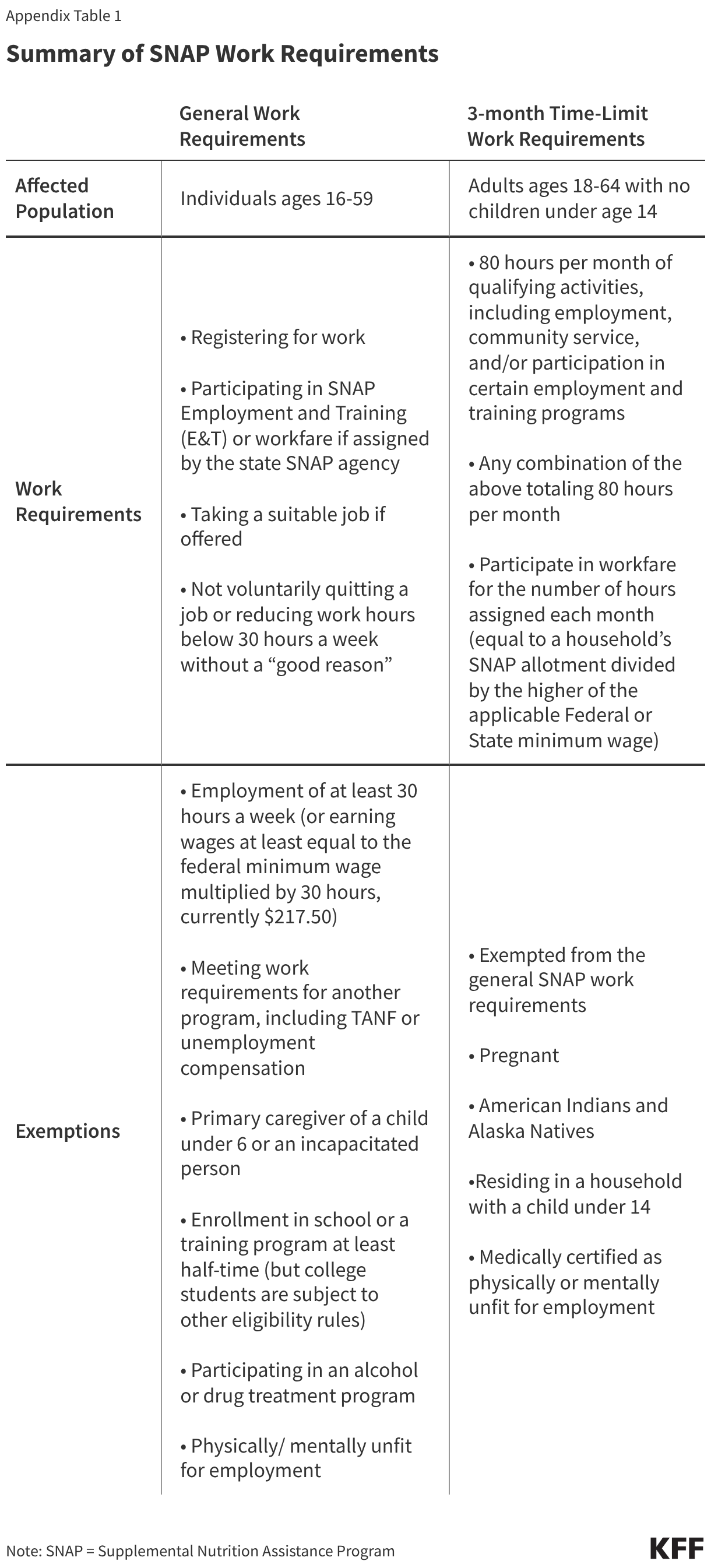
States have flexibility in how they outline the exemption for people who’re deemed “bodily or mentally unfit for employment.” Most adults below age 65 on SNAP should meet normal work necessities (which embody registering for work, taking an acceptable job if provided, collaborating in SNAP Employment and Coaching (E&T) or workfare if assigned by the state SNAP company, and never voluntarily quitting a job or lowering work hours beneath 30 hours every week and not using a “good motive”). As well as, “time-limited” work necessities apply to sure people who don’t qualify for an exemption, which means they need to work or take part in a piece program for no less than 80 hours per thirty days or take part for an assigned variety of hours in workfare to obtain SNAP advantages for greater than three months in a 36-month interval (Appendix Table 1).
Federal regulations depart IT to state companies to outline bodily and psychological health and set up procedures for verifying the SNAP normal work requirement exemption. Rules on time-limited work necessities are solely barely extra particular, clarifying a person is exempt in the event that they:
- “are receiving short-term or everlasting incapacity advantages issued by governmental or non-public sources;
- are clearly mentally or bodily unfit for employment as decided by the State company; or
- if the unfitness shouldn’t be apparent, present a press release from a doctor, doctor’s assistant, nurse, nurse practitioner, designated consultant of the doctor’s workplace, a licensed or licensed psychologist, a social employee, or every other medical personnel the State company determines applicable, that they’re bodily or mentally unfit for employment.”
Due to this discretion, definitions vary across states, and a few states have extra expansive definitions of “bodily or psychological limitations,” together with, for instance, people who find themselves chronically homeless, or survivors of domestic violence when these circumstances negatively impression their bodily or psychological situation. States should exempt people for receipt of any short-term or everlasting incapacity, together with Supplemental Safety Insurance coverage (SSI), Employee’s Compensation, Veteran’s Affairs, Railroad Retirement, Developmental Incapacity providers, or different non-public sources, although they might fluctuate in how the state paperwork and verifies the Information.
A compulsory element of the SNAP utility and recertification course of is a cellphone or in-person interview with an eligibility employee who screens enrollees for exemptions. As of 2023, most states report first screening for bodily or psychological limitations on the appliance, whereas some first ask about limitations within the interview performed by an eligibility employee that’s required previous to SNAP certification. Over half of state companies additionally reported permitting workers discretion over the sorts of bodily or psychological limitations that may very well be thought-about for exemptions. For instance, visible observations made by eligibility staff throughout interviews (e.g., noting a person is utilizing an oxygen tank) may very well be used as a foundation for exemption dedication.
When figuring out somebody is “clearly unfit,” some states all the time require documentation of a person’s bodily or psychological limitations, whereas many states settle for shopper statements or solely require verification when deemed vital by the eligibility employee. States that don’t all the time require documentation might specify that shopper statements are acceptable verification except eligibility staff discover the shopper’s scenario unclear or questionable. An evaluation of SNAP work requirement exemption processes reported that some eligibility staff felt that requiring documentation might scale back workers burden and their private accountability in making determinations by growing consistency and lowering the subjectivity of eligibility employee determinations. Nonetheless, usually requiring documentation would additionally probably enhance the executive burden for enrollees, suppliers, and eligibility staff (who have to course of the documentation and generally request further clarification). People are reevaluated for whether or not they meet an exemption at recertification each six to 12 months, and the same evaluation discovered that Information collected at recertification normally doesn’t differ from Information collected at utility.
When unfitness to work shouldn’t be “apparent” to eligibility staff, states should acquire a press release from a medical skilled to confirm exemption standing, although state procedures for amassing supplier attestation fluctuate. As famous above, some states go additional, requiring documentation (reminiscent of a kind from a supplier) for each particular person looking for an exemption. The Information requested from suppliers to doc an exemption varies. For instance:
- Wisconsin’s form asks suppliers solely to attest that somebody is unfit, with no requirement to offer particulars on the precise situation.
- Pennsylvania’s form asks suppliers to attest that somebody is unfit and to listing the situation a person has that contributes to this dedication.
- Maryland’s form asks suppliers to point whether or not a person is unable to do particular actions, reminiscent of sitting, standing, or strolling for prolonged lengths of time.
- Vermont’s form asks suppliers to listing the situation that limits the person’s means to work and to offer a time estimate of how lengthy this situation is anticipated to final.
States may additionally settle for different types of supplier documentation, reminiscent of a written assertion or a cellphone name to an eligibility employee. Suppliers usually are not normally given detailed steerage about the right way to assess health for work, so their determinations of who might qualify for an exemption probably fluctuate.
States might select to make adjustments to their SNAP verification processes in response to a brand new mandate from the reconciliation regulation that the majority states pay a portion of SNAP profit prices primarily based on their fee error fee (PER). Starting in October 2027, the reconciliation regulation requires states to pay a portion of SNAP profit prices if the state’s PER (a measure of over- and underpayments which can be primarily administrative errors, not fraud) is above 6%, with the share of the prices growing because the error fee will increase as much as a cap. Previous to the brand new necessities, state SNAP verification processes mirrored completely different state selections for the right way to stability documentation necessities to advertise program integrity and keep away from fiscal penalties primarily based on the state’s PER in opposition to the executive burden further documentation might create for people; states might rebalance these concerns in mild of recent, a lot bigger monetary prices tied to states’ PERs. For instance, to keep away from errors and related penalties, Arizona not too long ago started requiring additional documentation of Information the place the state beforehand had accepted shopper statements except IT was deemed questionable.
How might the Medicaid course of evaluate to SNAP?
In distinction to the SNAP course of, the Medicaid course of for verifying people who qualify for the medical frailty exclusion would require states to make use of accessible knowledge earlier than requesting documentation from people or suppliers. Medicaid has entry to claims knowledge that SNAP doesn’t. The interim final rule launched in June instructs states to make use of claims and encounter knowledge from the previous 12 months to try to confirm medical frailty standing robotically earlier than requesting Information from the person. CMS not too long ago launched further Information outlining a tiered medical frailty framework that may allow states to establish people as medically frail utilizing claims knowledge alone (tier 1), utilizing claims knowledge together with encounter or different knowledge (tier 2), or, in circumstances the place states don’t have any or inadequate knowledge on file, utilizing an individualized handbook course of that requires further documentation (tier 3). Whereas this tiered strategy will allow some people to be verified as medically frail utilizing knowledge alone, not all medical frailty determinations might be automated. Information limitations, reminiscent of lack of knowledge on file for brand spanking new candidates and up to date enrollees, or suppliers not persistently coding circumstances or not utilizing codes recognized by the state, imply that states will want further documentation for some people.
Just like SNAP, states will depend on suppliers to confirm people’ means to work and Medicaid medical frailty standing, notably in conditions the place claims or different knowledge usually are not accessible. As a result of Medicaid doesn’t enable interviews, eligibility staff will play a much less pronounced position within the Medicaid verification course of, although in states with collectively administered SNAP and Medicaid applications or with knowledge sharing between the applications, Medicaid could possibly use some Information collected by SNAP interviews and verification processes. When unable to confirm medical frailty standing utilizing accessible knowledge, states might have to depend on affirmation from treating suppliers to confirm medical frailty circumstances and skill to take part in group engagement actions. The interim closing rule presently affords little element on what Information states want to gather from suppliers. Absent further steerage, states will probably develop completely different kinds and acquire completely different Information, just like the variation seen in SNAP. States may additionally use the identical kind to gather Information from suppliers for the Medicaid and SNAP exemptions; North Carolina, for instance, has created a supplier attestation kind that can be utilized to find out eligibility for Medicaid or SNAP. As famous above with SNAP, counting on suppliers to find out whether or not a person is ready to work with out steerage can result in variation and inconsistency in assessments.
Beginning January 2028, states’ means to simply accept self-attestation in Medicaid can be extra restricted than is the case for SNAP. Whereas states fluctuate in how they use shopper statements in establishing unfitness for work for SNAP, federal guidelines require them to hunt further verification if that Information is questionable; nevertheless, federal guidelines don’t restrict states’ means to simply accept shopper statements altogether. In distinction, the Medicaid rule limits reliance on self-attestation beginning in January 2028. The rule permits states to simply accept self-attestation all through 2027 in circumstances the place there isn’t a dependable Information accessible to the state. Nonetheless, beginning January 1, 2028, states might solely settle for self-attestation of medical frailty standing one time throughout a person’s enrollment interval. States would then be anticipated to confirm medical frailty utilizing accessible knowledge or require documentation or different Information from people for future renewals, which can require a extra time-consuming verification course of. Previous to the publication of the interim closing rule, most states had expressed curiosity in utilizing self-attestation as a verification supply for the medical frailty exclusion.
State Medicaid medical frailty verification insurance policies will probably differ, and state choices could also be affected by threats of monetary penalties. With restricted federal steerage, states will undertake completely different approaches to operationalize the medical frailty exclusions. The Medicaid rule signifies that states can be thought-about noncompliant with the regulation if audits present frequent approval of people as medically frail with inadequate help that the situation impacts their means to work. With the potential for audits, states might wrestle to operationalize the medical frailty exclusion in a approach that protects them from monetary penalty and minimizes administrative burden, with out denying protection to people who ought to qualify for the exclusion. States are additionally implementing these advanced Medicaid eligibility and enrollment coverage adjustments on the similar time that they should put together for adjustments to the fee error fee measurement (PERM) program that can enhance monetary penalties of eligibility error charges above 3%. These PERM adjustments might affect how states stability the necessity to mitigate monetary threat in opposition to the executive burden of elevated documentation for all Medicaid eligibility determinations.
👇Comply with extra 👇
👉 bdphone.com
👉 ultractivation.com
👉 trainingreferral.com
👉 shaplafood.com
👉 bangladeshi.help
👉 www.forexdhaka.com
👉 uncommunication.com
👉 ultra-sim.com
👉 forexdhaka.com
👉 ultrafxfund.com
👉 bdphoneonline.com
👉 dailyadvice.us