
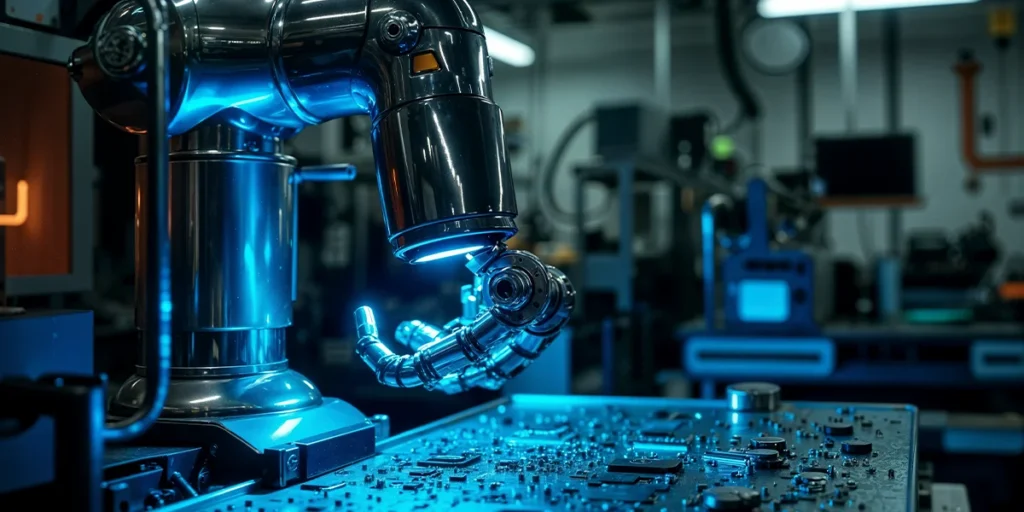
For robots to really substitute people in the actual world, they have to mimic the “mechanics” of the human physique. The anatomy of the human physique is nothing wanting a miracle. Will robots ever have the ability to replicate that 100%? We can’t say IT, however IT must be as actual as potential, and that’s as much as mechanical engineers to realize.
Robots have gotten smarter and extra succesful than ever, however behind each superior management system lies a fastidiously engineered mechanical construction. From light-weight cell robots to precision robotic arms, mechanical design determines how effectively a robotic performs, how effectively IT strikes, and the way reliably IT operates over time.
Whereas sensors and software program usually steal the highlight, a robotic’s mechanical design, which is its skeleton, varieties the true basis of efficiency. Getting that design proper means balancing three important elements: power, weight, and manufacturability.
Nevertheless, IT is so much simpler mentioned than accomplished. On this weblog, we’ll talk about what balanced design actually is in robotics options, and what one of the best ways is to strike that stability.
Understanding mechanical design for robots
Mechanical design is an indispensable half of assorted engineering fields. Nevertheless, the aims of mechanical design range. In robotics, the purpose is to transform digital intelligence into bodily movement. IT is analogous to the human physique, the place our mind sends nerve alerts that make our muscle groups transfer.
Here’s a temporary overview of the important thing elements concerned in mechanical design for robots:
1. Bodily forces and movement
Physics underpins every part in robotics and engineering on the whole. To design a robotic that strikes accurately, it’s good to perceive how forces have an effect on objects. And for that, it’s good to grasp Newton’s Legal guidelines.
These legal guidelines allow you to predict how the robotic will reply when IT applies pressure, when IT accelerates, when IT stops, or when IT collides.
2. Materials alternative
Mechanical engineers want to decide on the precise supplies to decide how sturdy, gentle, and sturdy the robotic will probably be. Due to this fact, metallurgical ideas like yield power, density, and hardness of supplies are thought of at each flip.
For instance, if a robotic is predicted to work in an out of doors, humid setting, corrosion-resistance metals like aluminum work finest.
3. Structural design
The human building employee doesn’t bend, break, or deform below bodily load. Effectively, not except pushed past their limits. Robots additionally want a great structural design to preserve their regular form whereas performing bodily taxing Jobs.
IT means that the engineer should design the robotic for power, stress, endurance, and stability.
4. CAD design
CAD (Pc-Aided Design) software program allows you to create correct digital fashions of your robotic earlier than you construct IT. This helps you visualize the design and simulate the robotic’s actions earlier than IT enters the actual world.
Furthermore, with applied sciences like digital thread and digital twin, you may make CAD designs a dwelling mannequin of your robotic with pinpoint accuracy.
5. Prototyping
As soon as you recognize what your robotic appears like on paper, it’s good to construct a prototype to verify in case your design works as anticipated. Prototypes take a look at actions, mechanical habits, and additionally focuses on the visible look and ergonomics of the robotic.
6. Manufacturability
Designing for manufacturability (DFM) is the ultimate step in robotics improvement. DFM implies that your robotic will probably be produced on a mass scale. Due to this fact, IT must be straightforward, cost-effective, and dependable to fabricate and assemble in factories.
A robotic that’s DFM has easy meeting, makes use of standardized parts, and has the proper form that fits the fabric.
The best way to obtain balanced mechanical design in robots
Balanced design is a core engineering idea. In civil engineering, IT means supporting parts like columns and girders should be stronger than the beams. In order that, if a beam breaks, the constructing can deal with IT. But when a column fails, complete flooring could collapse.
In robotics improvement, mechanical engineers be sure that the conversion of digital intelligence into bodily movement additionally occurs safely and effectively by designing frames, linkages, and enclosures that may face up to real-world forces and constraints.
Nevertheless, the problem lies in attaining the stability between the three important elements that we talked about within the intro:
- Power to deal with masses, vibrations, and impacts
- Lightness for improved mobility and lowered vitality consumption
- Manufacturability so designs will be constructed persistently and cost-effectively
Enhancing one issue normally harms one other. For instance, making your robotic stronger requires a tougher materials, however that hurts its DFM. To mitigate that, the fabric should be lighter; nonetheless, skinny constructions are weaker and are sometimes costly to manufacture. And in case you focus solely on making the robotic straightforward to fabricate, IT could not fulfill the opposite two standards.
So, you see, there are trade-offs in every single place. This three-way stability guides virtually each determination, from selecting supplies to deciding on fabrication strategies.
Power vs weight: Discovering the candy spot
There are lots of objects in mythology and fiction round that world that might shatter mountains, but had been as gentle as a feather, similar to Thor’s hammer or Poseidon’s trident. Sadly, such supplies aren’t identified to man so far as science is anxious.
A robotic’s body should be sturdy sufficient to help its parts and exterior masses, however each further gram can scale back vary, velocity, and effectivity. Due to this fact, engineers concentrate on getting one of the best “strength-to-weight ratio,” that means most toughness from the least quantity of fabric.
There are fairly just a few strategies on the market that you need to use to refine this ratio and discover that candy spot between power and weight.
- Finite Ingredient Evaluation (FEA) to simulate masses and establish stress factors
- Topology optimization to take away extra materials from low-stress areas
- Sheet steel ribs and folds to strengthen stiffness
- Composites or polymer inserts for light-weight, non-structural components
A well-balanced design can scale back weight by as much as 40% whereas sustaining rigidity — immediately bettering mobility, battery life, and efficiency.
Design for manufacturability: Turning ideas into actual robots
DFM will also be achieved with the precise strategies. Utilizing the strategies beneath or instruments avoids costly fixes later and makes the robotic prepared for industrial-scale manufacturing.
Here’s a desk displaying one of the best manufacturing strategies for DFM:
| Manufacturing methodology | Best for | Advantages |
| 3D Printing | Early-stage prototypes, complicated shapes | Speedy iteration and testing |
| CNC Machining | Precision components, motor mounts | Excessive power and accuracy |
| Sheet Metallic Fabrication | Structural frames, chassis | Sturdy, scalable, light-weight |
Materials choice: The spine of efficiency
Choosing the proper supplies on your robotic requires a separate information. In spite of everything, the selection of steel is actually essential to make these shiny robots transfer with precision. However we’ll talk about that in one other weblog.
For now, this desk will allow you to make a good choice:
| Materials | Benefits | Purposes |
| Aluminum Alloys | Light-weight, corrosion-resistant | Inside frames, brackets |
| Stainless Metal | Sturdy, sturdy | Load-bearing parts |
| ABS/Nylon Plastics | Light-weight, printable | Covers and non-structural shells |
| Carbon Fiber Composites | Extraordinarily stiff and lightweight | Excessive-performance cell robots |
Utilizing the correct mix of supplies ensures that every half contributes optimally to the robotic’s perform, value, and manufacturability.
Part placement and stability optimization
If a single bone in your foot is just not in its place, you gained’t have the ability to stroll because of discomfort. Robots are the identical as a result of even with one of the best supplies and fabrication, poor part structure can compromise efficiency. The batteries, motors, and sensors within the robotic should be positioned completely; in any other case, the robotic will lose its stability.
Optimizing the middle of gravity (CoG) improves stability and management, particularly in cell robots. IT prevents robots from tipping, particularly robots which can be meant for mobility, like healthcare robots that repeatedly monitor affected person motion.
These are among the finest practices you can apply to make your robotic secure and simpler to regulate:
- Putting heavier parts (like batteries and motors) close to the bottom
- Maintaining sensors and controllers accessible for upkeep
- Balancing the CoG between drive wheels or caster factors for regular navigation
CAD-based CoG simulations additionally permit engineers to foretell habits earlier than bodily meeting, making certain smoother operation and lowered pressure on actuators.
The prototype to manufacturing journey: Iterative robotics improvement
Mechanical design in robotics is an iterative cycle of digital modeling, prototyping, and real-world validation. Tesla’s Optimus humanoid robotic has undergone at the very least three main generations of iterative improvement since its announcement.
Observe this step-by-step iterative loop to make sure each structural aspect immediately permits the robotic’s objectives. This course of bridges design intent and useful actuality.
1. CAD modeling in SolidWorks
2. 3D printing for speedy prototyping
3. CNC machining and sheet steel fabrication for ultimate assemblies
4. System integration and testing with electronics and sensors
Conclusion
Mechanical engineering is arguably the single most essential self-discipline in deciding the way forward for robotics. We have electronics and software program that may make humanoid robots possible in the actual world. However they nonetheless fall quick of organic muscle groups in pressure density, bandwidth, and management, which limits their nuanced greedy or manipulation capabilities.
Nevertheless, nice progress has been made by main giants in robotics improvement to beat these mechanical challenges. The mechanical design rules and strategies that we mentioned on this article can assist you make a robotic that’s sturdy, gentle, and prepared for manufacturing.
At Xavor Company, our robotics group applies these design rules every day in creating autonomous cell robots for aged care and help. These robots are designed to navigate safely, work together intelligently, and help real-world caregiving environments.
With rising instruments like generative design and AI-driven simulation, mechanical engineers at Xavor are serving to form the subsequent era of clever robots — designed not simply to perform, however to serve humanity with care and precision.
To speak to our robotics group, drop us a message at [email protected], and we’ll get again to you in 24–48 hours.
👇Observe extra 👇
👉 bdphone.com
👉 ultractivation.com
👉 trainingreferral.com
👉 shaplafood.com
👉 bangladeshi.help
👉 www.forexdhaka.com
👉 uncommunication.com
👉 ultra-sim.com
👉 forexdhaka.com
👉 ultrafxfund.com
👉 bdphoneonline.com
👉 dailyadvice.us