
Affected person expertise is the perfect sort of advertising and marketing in healthcare. And to actually enhance affected person expertise, you will need to perceive the caregiving course of from the affected person’s perspective. That requires constructing a connection together with your sufferers to know what they actually need.
However patient-provider interactions have grown more and more complicated. This has taken away a number of the human parts from affected person care. Conversational AI in healthcare is strictly what a physician would order to diagnose this drawback. IT is a sensible answer that enables sufferers and healthcare staff to speak by way of chatbots and digital assistants.
Conversational AI options in healthcare may also help clinicians work together with sufferers utilizing human-like dialogue and rapport constructing, with out being current at all instances.
This piece will elaborate on this element by exhibiting how conversational AI in healthcare helps affected person scheduling, triage, and engagement.
The gaps in provider-patient communication
The Hippocratic Oath is a extensively recognized code of ethics for healthcare professionals. Whereas IT’s not relevant to trendy instances word-for-word, like swearing by the Greek gods for curing sufferers, IT remains to be essential within the medical discipline. With this pledge, a physician or nurse makes a private dedication to moral and dedicated care.
Nonetheless, this superb is commonly laborious to realize in actual life. And make no mistake, medical doctors do their finest to stick with their sufferers until the tip. However most medical doctors don’t actually grasp the deep emotional side of “staying” with a affected person. They don’t understand how a lot their presence and communication matter to sufferers. Significantly, throughout end-of-life look after sufferers with terminal illnesses.
A study from Seattle Most cancers Care Alliance proffered the identical, that terminally sick sufferers and their households typically felt deserted as a result of hole in communication with medical doctors. Sufferers want closure, and medical doctors unintentionally neglect their emotional wants. We will concur with this discovering as a result of our workforce’s work at NaviGait (Xavor’s spinoff for aged care robotics) is deeply tied to a concentrate on companionship and compassionate care.
Throughout NaviGait’s collaborations with senior residing services and analysis establishments within the US, we witnessed how a lot communication mattered for aged sufferers with situations like dementia and Alzheimer’s illness. With out efficient communication and companionship, such sufferers may be prisoners in their very own our bodies. That is the place improvements in AI in healthcare may also help, offering assist and connection when human presence is restricted.
How conversational AI in healthcare fills this hole
Now, we have now recognized the communication drawback in healthcare, however the massive query is: find out how to treatment IT? Conversational AI Technology in healthcare can very nicely be a panacea for these challenges. To grasp why, you must know what conversational AI actually is.
Conversational AI in a nutshell
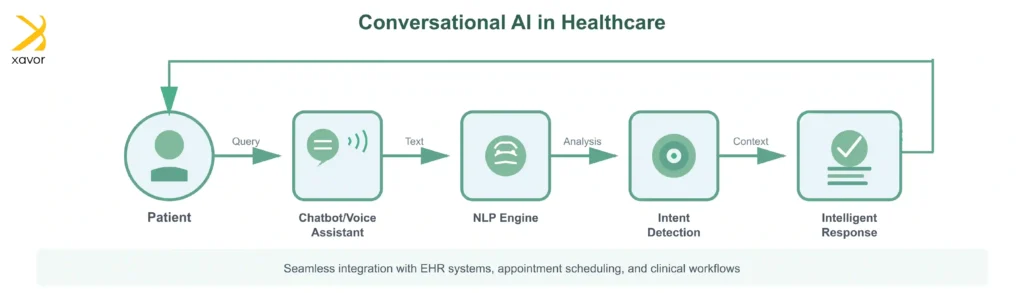
Because the identify suggests, conversational AI refers to a kind of synthetic intelligence that permits machines to have interaction in human-like conversations. IT consists of applied sciences, akin to:
- Chatbots
- Voice assistants
- Digital brokers
Consider Siri, Cortana, Alexa, and the like. These programs use pure language processing (NLP) to interpret what persons are saying and generate acceptable, human-like responses. In contrast to different agentic AI or GenAI, conversational AI is particularly designed for communication.
Advantages of conversational AI in healthcare
Conversational AI functions in healthcare aren’t simply restricted to sufferers. They’ll enhance a whole lot of issues for healthcare professionals and hospitals as nicely. One, IT can scale back the workload for medical doctors and nurses. Two, IT can scale back the operational prices of hospitals by eradicating inefficiencies.
However right here we solely wish to tackle conversational AI in healthcare in ways in which enhance affected person assist. And we picked these three affected person assist capabilities which might significantly profit from conversational AI functions in healthcare:
- Affected person scheduling
- Triage
- Affected person engagement
So, let’s study how conversational AI in healthcare improves every of those pillar affected person assist capabilities.
1. Utilizing conversational AI in affected person scheduling
In large-scale hospitals, IT is regular to take not less than an hour to e book a single surgical procedure. Sufferers within the UK typically must wait weeks and even months from referral to their surgical procedure date by the NHS. And this consists of a number of scheduling steps, not simply the operation itself.
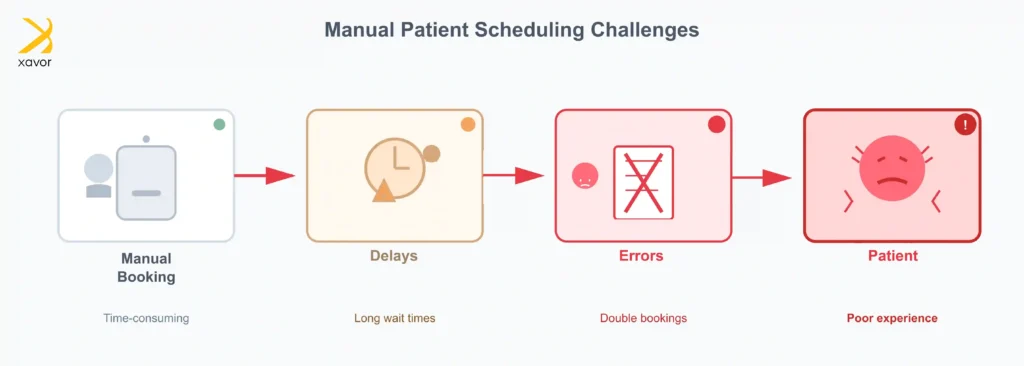
There are a number of causes for lengthy ready instances in affected person scheduling and appointments. Clearly, IT’s not that easy as reserving a flight or resort, as healthcare includes many intricate particulars and different checks earlier than making any dedication.
Here’s a desk exhibiting why you should still be on the ready listing on your subsequent checkup on the hospital:
| Situation | Why IT delays | Impression on sufferers |
| Errors in handbook scheduling | When employees manually enter appointments or depend on reminiscence, errors like double bookings or missed follow-ups can occur. | Sufferers might expertise frustration, or confusion, which reduces their belief and feeling of being valued. |
| Lengthy maintain instances | Sufferers typically wait on maintain or name a number of instances to e book an appointment, resulting in interruptions and gradual operations. | They really feel uncared for or unimportant as a consequence of lengthy wait instances, making the healthcare expertise really feel impersonal. |
| Restricted reserving hours | Guide programs require employees to be accessible, so appointments can’t be made outdoors of standard hours. | Essential sufferers who want care outdoors of regular hours get restricted entry to care for his or her particular wants. |
| Lack of real-time updates | Schedules might not replace instantly, particularly if managed manually or with primary instruments like Excel. | Final-minute modifications or surprising ready instances could cause sufferers really feel disregarded. |
| Inconsistent affected person communication | Guide processes might result in missed or inconsistent communications about appointments, reminders, or prep directions. | Sufferers might present up unprepared, rising their anxiousness and disrupting their expertise. |
Whereas medical affected person scheduling software program exists to mitigate many of those challenges, IT is predicated on fastened guidelines and can’t deal with particular conditions which can be all too widespread in affected person scheduling. Fashionable AI-enhanced healthcare workflows can automate scheduling, scale back errors, and guarantee sufferers get well timed care even in complicated eventualities.
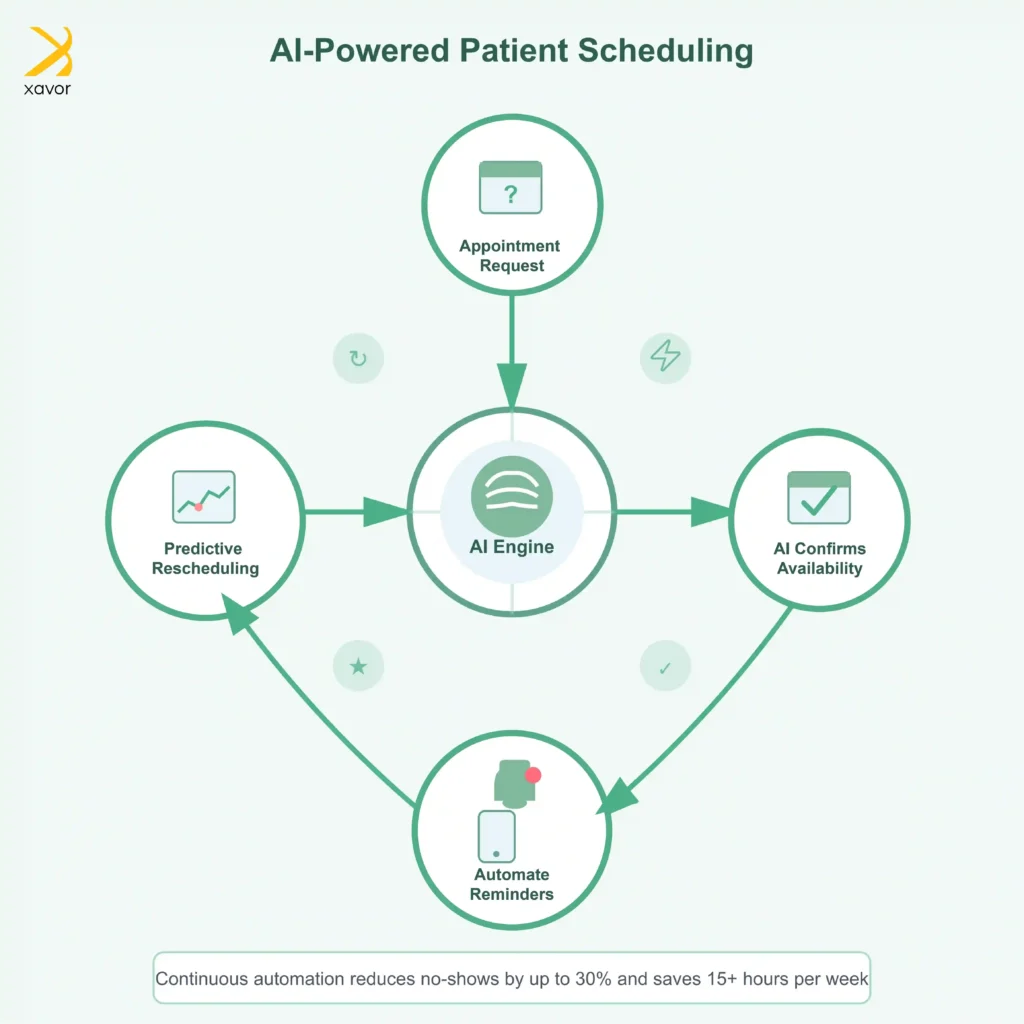
Conversational AI in healthcare can dynamically regulate schedules, course of appointments, and notify purchasers in actual time. Let’s take a look at the important areas the place conversational AI functions do the job higher than people in affected person scheduling.
1. Schedule administration
Affected person scheduling has frequent changes. Generally the affected person is likely to be busy, or the physician might have an excessive amount of on their plate to cater to them. Moreover, you can’t rule out issues like strikes, street closures, and climate that aren’t within the fingers of the affected person or the physician. So, modifications and cancellations are regular in affected person scheduling.
And AI excels in making instantaneous scheduling modifications at once. In contrast to human employees, who is likely to be busy with different duties or restricted by working hours, conversational AI in healthcare can replace schedules instantly. This ensures there are not any gaps between appointments and reduces any inefficiencies, which permits healthcare suppliers to supply well timed care.
2. Affected person question response
Sufferers now anticipate fast responses once they attain out for appointments. You have to inform them the perfect accessible slot as per their preferences right away. AI chatbots and voice assistants assist meet this demand by offering instantaneous solutions and assist.
Furthermore, chatbots can stay lively past normal working hours. This ensures there isn’t any communication hole between appointments and reduces any inefficiencies.
Conversational AI in healthcare automates these updates so sufferers are knowledgeable in actual time, which leads to fewer disruptions and a smoother expertise.
3. Automated follow-ups
No-shows may be extraordinarily irritating for each sufferers and healthcare suppliers. For the previous, lacking an appointment can worsen their state of affairs at worst. And for the latter, unused time slots are a waste of their treasured time and sources.
Conversational AI in healthcare can ship reminders through SMS, e-mail, or automated calls, which ensures sufferers are reminded about their appointments with out human intervention. This automation helps enhance attendance charges, reduces the psychological load on employees, and ensures higher affected person care continuity, whereas additionally releasing employees to concentrate on extra customized, compassionate care.
4. Predictive scheduling
AI’s capacity to study from knowledge is what makes IT completely different from customary automation instruments. Utilizing historic knowledge, conversational AI in healthcare can predict the perfect instances for appointments, perceive peak demand intervals, and even anticipate cancellations.
Hospitals can use this predictive functionality to cut back gaps in scheduling and permit healthcare suppliers to plan forward extra successfully.
5. Dealing with appointment at scale
Human employees are restricted by their capability to handle solely a sure variety of appointments at a time. However AI can deal with 1000’s of interactions concurrently. AI ensures that no request is left unanswered, even throughout busy instances. This scalability not solely helps meet excessive demand but additionally improves the general effectivity of the scheduling course of.
2. Conversational AI in healthcare for affected person triage
Triage is the method of prioritizing and sorting sufferers throughout emergencies and catastrophic situations, akin to:
- Earthquakes and different pure calamities
- Emergency departments in hospitals
- Struggle zones and conflicts
These situations demand rapidly deciding what wants consideration first when time or sources are restricted. Triage selections are sometimes made with incomplete Information, however the objective is to do your finest with what you’ve got proper now, to not be good. Furthermore, applied sciences like AI‑enhanced diagnostics and remedy are rising to assist clinicians in making quicker, extra correct selections, serving to establish high-acuity sufferers and streamline care pathways.

Conventional triage strategies normally contain lengthy cellphone calls or in-person visits to emergency facilities. Medical professionals must spend a good little bit of time on preliminary assessments to resolve whether or not the affected person wants instant care. And as you already know, human error can by no means be dominated out in these conditions.
For instance, one affected person might need a very seen symptom like a pores and skin burn, so they may get admitted into emergency care regardless that IT could also be a non-urgent situation. Alternatively, a affected person with a really essential however not visibly obvious situation may not obtain well timed consideration.
Conversational AI in healthcare removes such inefficiencies within the triage course of utilizing AI chatbots and digital assistants. IT may very nicely make digital triage the norm versus a distinct segment, which IT is in the meanwhile.
Let’s take a look at some methods to again up this declare.
1. Easier and cheaper affected person triage
Conversational AI Technology in healthcare and digital triage helps sufferers get to the precise sort of care quicker, 24/7, and with out pointless steps.
An AI chatbot can let sufferers describe their signs after which information them to probably the most acceptable possibility, akin to self-care, a digital go to, or an in-person appointment. This permits sufferers to self-triage as an alternative of instantly calling hospitals or going to the emergency room.
IT is a win-win state of affairs for each sufferers and healthcare staff. Steering sufferers away from high-cost settings once they aren’t wanted reduces avoidable emergency and pressing care visits, which results in significant price financial savings. On the identical time, sufferers who really want pressing or high-acuity care are recognized earlier and directed appropriately, serving to stop situations from worsening and changing into dearer to deal with later.
The general impact of conversational AI in healthcare, on this case, is healthier use of healthcare sources and decrease complete prices, with out delaying needed care.
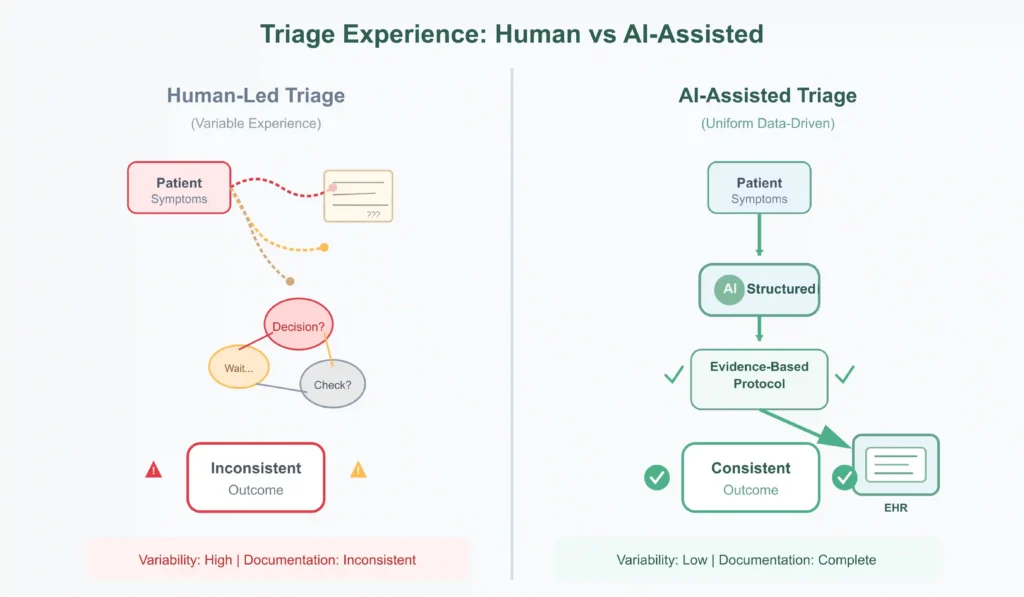
2. Uniform triage expertise primarily based on knowledge
Docs and nurses can interpret signs in another way. IT just isn’t an issue per se as a result of they’ll have completely different experiences and workloads, so they may come to completely different conclusions. And typically IT is usually a boon, as one physician may level out one thing that the opposite might miss.
Nonetheless, for sufferers and their members of the family, IT can add pointless stress. They arrive anticipating a pinpoint prognosis. Conversational AI in healthcare ensures that each affected person goes by way of the identical structured triage course of, irrespective of when or the place they search care. Every affected person is requested the identical fastidiously designed set of questions, which reduces variation and helps stop essential particulars from being missed. Rising predictive digital twin Technology can additional improve this course of by simulating affected person states and anticipating care wants, enabling clinicians to make data-driven selections quicker.
Furthermore, the Information collected by an AI chatbot may be mechanically added to the affected person’s digital Health file (EHR). This offers clinicians entry to a transparent, organized abstract of signs and historical past earlier than they see the affected person, which may be lifesaving for sufferers.
3. Lowering employees workload and burnout
Healthcare programs proceed to face employees shortages and excessive ranges of burnout. Conversational AI in healthcare helps scale back employees workload by automating preliminary evaluation duties within the triage course of, akin to:
- Symptom consumption
- Fundamental Questions
- Scheduling

For healthcare organizations, this implies their medical employees can function extra effectively. IT additionally helps handle affected person stream, so clinicians can spend their time on complicated and high-acuity instances, reasonably than on administrative work.
Such conversational AI functions in healthcare assist AI-based triage to ease burnout and enable healthcare professionals to concentrate on delivering higher-quality care.
3. Conversational AI in healthcare for affected person engagement
Affected person engagement means actively involving sufferers in their very own care, reasonably than treating them as passive recipients of remedy. Sufferers are consulted, knowledgeable, and supplied decisions about their care at each second.
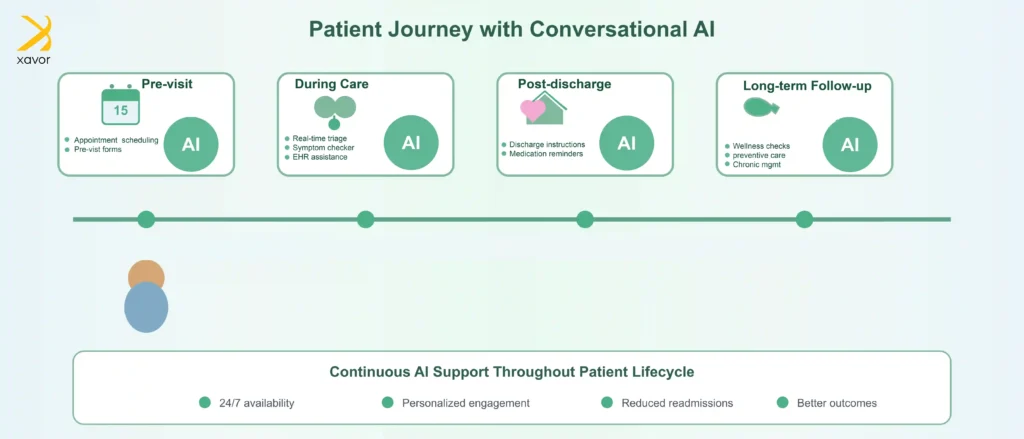
Hospice nurses know the significance of affected person engagement in a greater approach than every other healthcare skilled. They supply consolation and assist to sufferers within the final moments of their lives. That’s the reason they should interact their sufferers and their households to construct belief throughout an emotionally troublesome time.
At present, healthcare staff depend on strategies like surveys, questionnaires, and face-to-face conversations to encourage sufferers to speak about their wants and considerations. When communication is evident, empathetic, and constant, sufferers really feel secure, revered, and concerned. This makes them extra prone to share trustworthy suggestions and comply with care plans.
Listed below are some methods conversational AI in healthcare drives sturdy affected person engagement:
1. Compassionate, customized care
Sufferers and their households typically expertise worry and uncertainty when coping with Health points. That’s the reason they want to really feel heard and revered, which inspires openness and honesty.
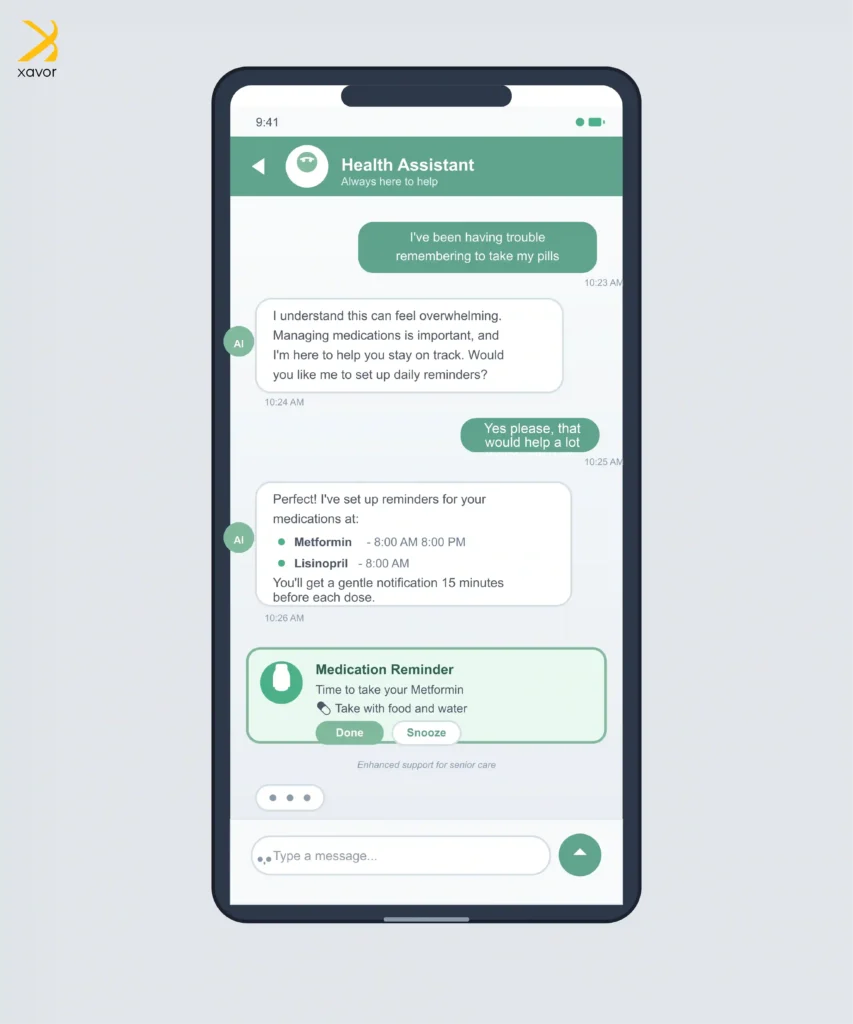
Conversational AI in healthcare builds this belief by way of:
- AI chatbots with empathetic, supportive language to acknowledge affected person considerations.
- Adapting responses primarily based on affected person historical past, preferences, and prior interactions.
- Permitting sufferers to share considerations privately and at their very own tempo.
Sufferers are extra keen to ask questions and keep concerned of their care when interactions really feel caring and private.
2. Respecting affected person autonomy
If you wish to interact sufferers, actively contain them in selections about their Health. This consists of respecting their preferences and private objectives as nicely. When sufferers perceive what’s taking place and why, they really feel extra assured and engaged of their care.
Nonetheless, clinicians typically have very restricted time to elucidate all the things to sufferers. Moreover, sufferers might also not totally grasp each element as a consequence of technicalities or psychological stress.
In such conditions, AI chatbots can present on-demand, repeatable explanations in plain language, which permits sufferers to study at their very own tempo and revisit Information anytime. IT additionally breaks complicated subjects into smaller, easier-to-understand steps with none medical jargon.
3. Help past clinics
Affected person engagement doesn’t finish after the ultimate appointment. Even after a affected person is discharged, they want ongoing communication and steerage to point out that they aren’t deserted as soon as they go away the hospital doorways.
Conversational AI in healthcare is the logical approach of dealing with post-visit queries and relationships. A digital assistant can supply 24/7 entry to Information and reply widespread follow-up questions instantly.
And let’s be trustworthy, discharge directions are sometimes forgotten or ignored by a whole lot of sufferers. Conversational AI Technology in healthcare can reinforce discharge directions in easy, step-by-step language. Our elder care robotic, Rui, does precisely this by giving sufferers reminders about their drugs, warning indicators, and follow-up actions.
Conclusion
Healthcare has by no means lacked experience, knowledge, or Technology. What IT more and more lacks is time; time to hear, to elucidate, to reassure, and to remain current when sufferers want IT most. Conversational AI in healthcare doesn’t substitute clinicians or diminish the sanctity of care. And IT most likely by no means can as a result of healthcare is deeply human.
As a substitute, IT absorbs the friction that stands between sufferers and suppliers, quietly dealing with the repetitive, the executive, and the scalable, so human caregivers can concentrate on what solely people can do.
Scheduling turns into a second of comfort reasonably than frustration. Triage turns into a structured pathway as an alternative of a traumatic guessing recreation. Engagement turns into a steady relationship reasonably than a sequence of disconnected encounters. Collectively, these shifts change how care feels, not simply how IT capabilities.
The true influence of conversational AI in healthcare is in continuity. IT ensures that sufferers are usually not left alone between visits, not unheard throughout uncertainty, and never forgotten as soon as they go away the clinic. Over time, this continuity reshapes belief and outcomes in ways in which no advertising and marketing marketing campaign ever may.
In search of a Technology accomplice by your facet for an AI-first healthcare world? Xavor designs, deploys, and scales conversational AI options that elevate affected person expertise whereas decreasing operational pressure.
Drop us a line at [email protected] to construct healthcare-ready conversational AI that works together with your programs and care philosophy.
Concerning the Creator

Umair Falak is the search engine optimisation Lead at Xavor Company, driving natural development by way of data-driven search methods and high-impact content material optimization. With hands-on expertise in technical search engine optimisation and efficiency analytics, he turns search insights into measurable enterprise outcomes.
FAQs
Conversational AI in healthcare makes use of applied sciences like chatbots and digital assistants to speak with sufferers by way of pure, human-like conversations. IT helps healthcare organizations automate duties akin to appointment scheduling, symptom consumption, and affected person follow-ups whereas bettering accessibility and affected person expertise.
Conversational AI helps with affected person scheduling by permitting sufferers to e book, reschedule, or cancel appointments immediately by way of chat or voice, 24/7. IT reduces wait instances, minimizes no-shows with automated reminders, and adjusts schedules in actual time with out handbook employees intervention.
Sure, conversational AI may be safely used for affected person triage when designed with medical tips and data-driven workflows. IT collects signs by way of structured questions, guides sufferers to the acceptable stage of care, and shares Information with clinicians, serving to prioritize pressing instances with out changing medical judgment.
👇Observe extra 👇
👉 bdphone.com
👉 ultractivation.com
👉 trainingreferral.com
👉 shaplafood.com
👉 bangladeshi.help
👉 www.forexdhaka.com
👉 uncommunication.com
👉 ultra-sim.com
👉 forexdhaka.com
👉 ultrafxfund.com
👉 bdphoneonline.com
👉 dailyadvice.us