

 
Writer: Maryam Shahvaiz, Options Author
Anti-migrant actions in numerous developed international locations just like the US, UK and components of Europe are taking a brand new shift. Many people who oppose globalisation argue that migration insurance policies have created unfair labour circumstances, widened world inequalities and contributed to political instability in underdeveloped international locations. But the opposite aspect of the story is equally sturdy. Migration has certainly enabled hundreds of thousands of households to outlive, construct resilience and even prosper.
Remittances, the cash migrants ship again to their dwelling international locations, are actually thought-about some of the essential sources of exterior financing for growing economies. The truth is, in lots of international locations, remittances have surpassed international direct funding (FDI). As per the World Financial institution’s World Remittance Report, there stays a big knowledge hole between formally recorded flows and precise remittances, as migrants usually depend on each formal and casual switch methods.
The World Improvement Report 2023 notes that round 184 million individuals migrated globally in 2023 as a consequence of financial, home and political causes. Not less than 77 international locations now depend on remittances for greater than three % of their GDP, and in about 30 international locations, remittances account for over 10 % of GDP. For low- and middle-income international locations (LMICs), remittance inflows exceeded $650bn in 2023, a determine increased than FDI for a lot of economies. By 2026, the worldwide remittance market is predicted to exceed $800bn, underscoring its essential position in financial improvement. Migration patterns, fintech innovation and geopolitics are shaping this enormous market, making IT extra dynamic than ever earlier than.
Remittance drivers
From shopper manufacturers to tech giants like Procter & Gamble, Apple, Amazon, Alibaba, Google and Microsoft, outsourcing and hiring throughout borders is now a part of enterprise fashions. Developed economies with excessive GDP are additionally confronting structural challenges like getting old populations, low start charges and chronic labour shortages. Nations like Japan, Germany, Italy and the UK more and more depend on international employees to maintain their industries. On the similar time, poor infrastructure and low wages in dwelling international locations proceed to push people emigrate in the hunt for higher alternatives.
Whereas anti-migrant campaigns and rising nationalism search to restrict immigration, the worldwide demand for labour exhibits no signal of slowing down in 2026. This continued demand sustains the movement of migrant employees and, with IT, the movement of remittances. One other dimension is local weather change, which is turning into a central driver of migration. By 2050, hundreds of thousands of individuals are projected to be displaced as a consequence of excessive climate circumstances, world warming and disruptions to agriculture. By 2026, these elements are already accelerating migration patterns.
The World Meteorological Organisation highlights that there’s a 48 % likelihood that world temperatures will exceed 1.4°C above pre-industrial ranges within the subsequent 5 years. Areas like Southwest America and Southern Europe are anticipated to be drier, whereas components of Africa, Brazil and Australia will face heavier rainfall and flooding.
These climate disruptions are reshaping mobility. Expert employees in Alaska or Canada, going through harsh winters, might search alternatives elsewhere. Likewise, excessive warmth in Brazil is prone to push employees towards international locations providing each higher pay and extra beneficial climates. Whatever the financial necessity, political instability, or local weather disruption, migrants constantly ship funds again dwelling. These cross-border money flows not solely safe the livelihoods of households but in addition stimulate native economies. Using remittances can also be evolving. Historically, funds had been directed towards family consumption akin to meals, lease or training. Migrants are leveraging their earnings for funding alternatives of their dwelling international locations, financing small companies, buying property or supporting neighborhood initiatives.
This shift means remittances are not merely instruments of survival but in addition drivers of entrepreneurship and financial diversification. Each sending and receiving international locations profit from this the place migrants strengthen their monetary safety overseas whereas concurrently stimulating financial progress again dwelling.
A fintech makeover
Earlier than the technological increase, sending and receiving cash throughout borders was expensive, gradual and sometimes inaccessible. In response to the World Financial institution’s 2020 knowledge, the worldwide common value of sending $200 was between six and 7 %, far increased than the UN Sustainable Improvement Aim (SDG) goal of three %. In Africa, prices usually exceeded 10 %, making remittances particularly burdensome for low-income migrants. The fintech revolution has reworked this panorama. Instantaneous cash transfers are actually potential because of digital platforms that full transactions in seconds quite than days. Migrants not want to face in lengthy queues at remittance centres; with the faucet of a cellular app, they’ll ship funds dwelling virtually immediately. This comfort has redefined the expertise of sending and receiving cash throughout borders. Equally transformative has been the rise of cellular cash companies. Platforms akin to M-Pesa in Kenya, Easypaisa in Pakistan, and bKash in Bangladesh have given hundreds of thousands of individuals entry to monetary companies for the primary time. By permitting recipients to obtain funds immediately on their cell phones, these methods remove the necessity for financial institution accounts, which stay inaccessible for a lot of in rural or underserved areas.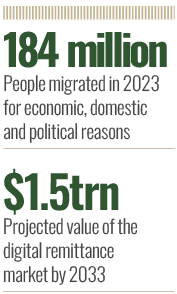
The dominance of cellular cash is about to increase additional. By 2026, analysts predict that cellular cash functions will grow to be the first channel for remittances in lots of growing international locations. In areas the place conventional banking infrastructure is restricted, these digital platforms are rising because the spine of monetary inclusion, guaranteeing that remittances attain households shortly, securely and at a fraction of the earlier value.
Cryptocurrencies and stablecoins have added a brand new dimension to remittances. Stablecoins, backed by property just like the US greenback, provide a much less unstable method to switch funds. Whereas cryptocurrencies stay riskier, they’re more and more widespread in areas with weak monetary methods. On the similar time, central banks are experimenting with Central Financial institution Digital Currencies (CBDCs).
Though nonetheless of their early levels, CBDCs might grow to be a safe and low-cost remittance channel inside just a few years. Safety is one other frontier the place fintech has made advances. Digital wallets now incorporate biometrics, facial recognition and multi-factor authentication, decreasing the chance of fraud. Furthermore, by shifting migrants into the formal monetary system, these improvements enable governments to gather knowledge, enhance transparency and even broaden their tax base. The consequence? By 2026, digital transformation can have made remittances not solely cheaper and quicker but in addition extra built-in into on a regular basis monetary life.
The geopolitical lower
Remittance channels are deeply influenced by geopolitics. Altering alliances, sanctions and rivalries will form how cash strikes throughout borders in 2026. Nations underneath heavy sanctions usually expertise diminished remittance flows, as migrants resort to casual networks akin to hawala or unregulated crypto transfers. These options undermine transparency and weaken oversight. On the similar time, shifts in world monetary energy are producing new dynamics. For instance, Russia and China are working to develop regional fee methods to cut back dependence on western platforms, probably redrawing the worldwide remittance map. Governments are additionally searching for to raised monitor remittances and encourage the usage of formal methods. India, as an illustration, has launched diaspora bonds, enabling its massive migrant inhabitants to take a position immediately in infrastructure initiatives. Different international locations are introducing insurance policies to incentivise banking channels over unlawful transfers. By 2026, the emphasis will likely be on making remittances not simply clear and safe, but in addition strategically aligned with nationwide improvement objectives.
Is the $800bn milestone sufficient to grasp the way forward for remittances? The reply is extra complicated. In international locations akin to India, Bangladesh, the Philippines, and throughout Latin America and all through Sub-Saharan Africa, remittance inflows are increasing at double-digit charges. These areas rely closely on migrant earnings, and the regular improve highlights the resilience of remittances even in instances of world uncertainty.
The digital remittance market has already surpassed $800bn as of 2024, and projections counsel IT will proceed to develop quickly. With a compound annual progress fee of round 8.5 % forecast from 2026 to 2033, the sector might attain as a lot as $1.5trn by 2033. This scale not solely displays rising migration but in addition the pace at which digital platforms are remodeling the business. But challenges persist. Economies with weak digital infrastructure danger falling behind on this transformation. In a number of components of Sub-Saharan Africa, restricted web connectivity, insufficient regulation and gaps in monetary literacy hinder the widespread adoption of digital channels. With out focused funding and coverage assist, these international locations might not absolutely seize the advantages of the digital remittance increase. Whereas digital channels are shortly dominating, conventional cash switch operators stay related in sure areas. Nations like Nigeria and a few components of Latin America proceed to depend on standard platforms as a consequence of low digital penetration. But, specialists estimate that inside just a few years, greater than 50 % of world remittances will likely be digitalised. Remittances carry each alternatives and dangers. On the chance aspect, they enhance family welfare, Finance training, and stimulate entrepreneurship. Governments can channel these funds into improvement initiatives akin to infrastructure, healthcare and small and medium enterprise (SME) assist.
The fast rise of fintech affords one other alternative: digital channels convey hundreds of thousands of beforehand unbanked individuals into the monetary system. By 2026, fintech platforms might present constant financial progress and the monetary safety that growing economies urgently require. But dangers stay. Heavy dependence on remittances could make economies susceptible to downturns in host international locations. If a number economic system faces recession or imposes restrictive insurance policies, remittance flows might decline sharply. Moreover, strict rules or heavy taxation might drive migrants again towards casual switch methods, undermining transparency. Geopolitical conflicts and sanctions additionally stay a relentless menace to the graceful movement of funds. The way forward for remittances is promising, however IT isn’t with out pitfalls. The important thing lies in making them reasonably priced, clear and resilient.
The street to 2026
Remittances are way over monetary transfers. They’re lifelines for households, catalysts for fintech innovation, and drivers of financial progress in each host and residential international locations. By 2026, the worldwide remittance market is not going to simply be a narrative of cash shifting throughout borders however of resilience, alternative, and transformation. Predictions from world analysts counsel regular progress properly into the subsequent decade. But, the important thing query stays: can governments, monetary establishments and fintechs preserve remittances reasonably priced, clear and impactful? If they’ll, remittances will evolve from survival instruments into engines of prosperity; a bridge not simply between international locations, however between current wants and future alternatives. n
👇Comply with extra 👇
👉 bdphone.com
👉 ultractivation.com
👉 trainingreferral.com
👉 shaplafood.com
👉 bangladeshi.help
👉 www.forexdhaka.com
👉 uncommunication.com
👉 ultra-sim.com
👉 forexdhaka.com
👉 ultrafxfund.com
👉 bdphoneonline.com
👉 dailyadvice.us