
Lengthy-standing workforce challenges in Medicaid residence care, also referred to as home- and community-based providers (HCBS), have an effect on take care of the greater than 5 million individuals who use these providers. Shortages and excessive turnover charges among the many direct care workforce mirror demanding work and low wages, significantly amongst residence care employees (who’re direct care employees that present HCBS). This subject transient describes states’ ongoing efforts to reply to shortages of residence care employees and the way they pay these employees, discovering that elevated cost charges are a key part of states’ efforts to deal with workforce shortages.
Workforce shortages could worsen in future years due to a lowering pool of accessible employees on account of modifications in immigration coverage, modifications in federal coverage from the 2025 reconciliation regulation, and new strain on states to chop Medicaid spending. Practically one in three residence care employees are immigrants, and the Trump Administration’s intensified immigration enforcement and restrictive insurance policies are deepening anxiousness and worry amongst immigrants of all statuses, with survey knowledge discovering that some immigrants are avoiding work on account of these modifications. States may face strain to scale back Medicaid spending as state fiscal situations tighten due to slower income progress, elevated spending pressures, and substantial reductions in federal Medicaid spending from the 2025 reconciliation regulation.
Nevertheless, states’ targets to scale back Medicaid spending could also be at odds with new administrative necessities that probably restrict states’ talents to scale back cost charges for residence care employees. Throughout a public webinar that the Facilities for Medicare and Medicaid Companies (CMS) hosted to share extra Information on cost transparency necessities within the 2024 Access Rule (see Appendix Field 1 for extra particulars), CMS famous that proposed price reductions for residence care employees won’t be authorized if they’d trigger greater than a 4 p.c lower in Medicaid expenditures for any service class. CMS didn’t specify the rationale for this situation, although IT might be to take care of entry to providers. Modifications in federal coverage surrounding program integrity, together with points associated to provider revalidation, may additionally additional pressure the house care workforce.
Amidst this evolving panorama, this subject transient describes Medicaid cost charges for residence care and different workforce helps which are in place in 2026, and the way KFF’s knowledge on cost charges examine to the information states at the moment are required to report below cost reporting necessities within the Medicaid Entry rule. The information come from the 24th KFF survey of officers administering Medicaid residence care packages in all 50 states and the District of Columbia (hereafter known as a state), which states accomplished between April and August 2026. The survey was despatched to every state official answerable for overseeing residence care advantages (together with residence Health, private care, and waiver providers for particular populations, resembling folks with bodily disabilities). All states besides Florida and South Carolina responded to the 2026 survey, however response charges for sure questions had been decrease. South Carolina’s cost price knowledge from the 2025 survey was additionally included with their permission to supply a extra complete nationwide image of cost charges to Medicaid residence care suppliers.
Key takeaways embody:
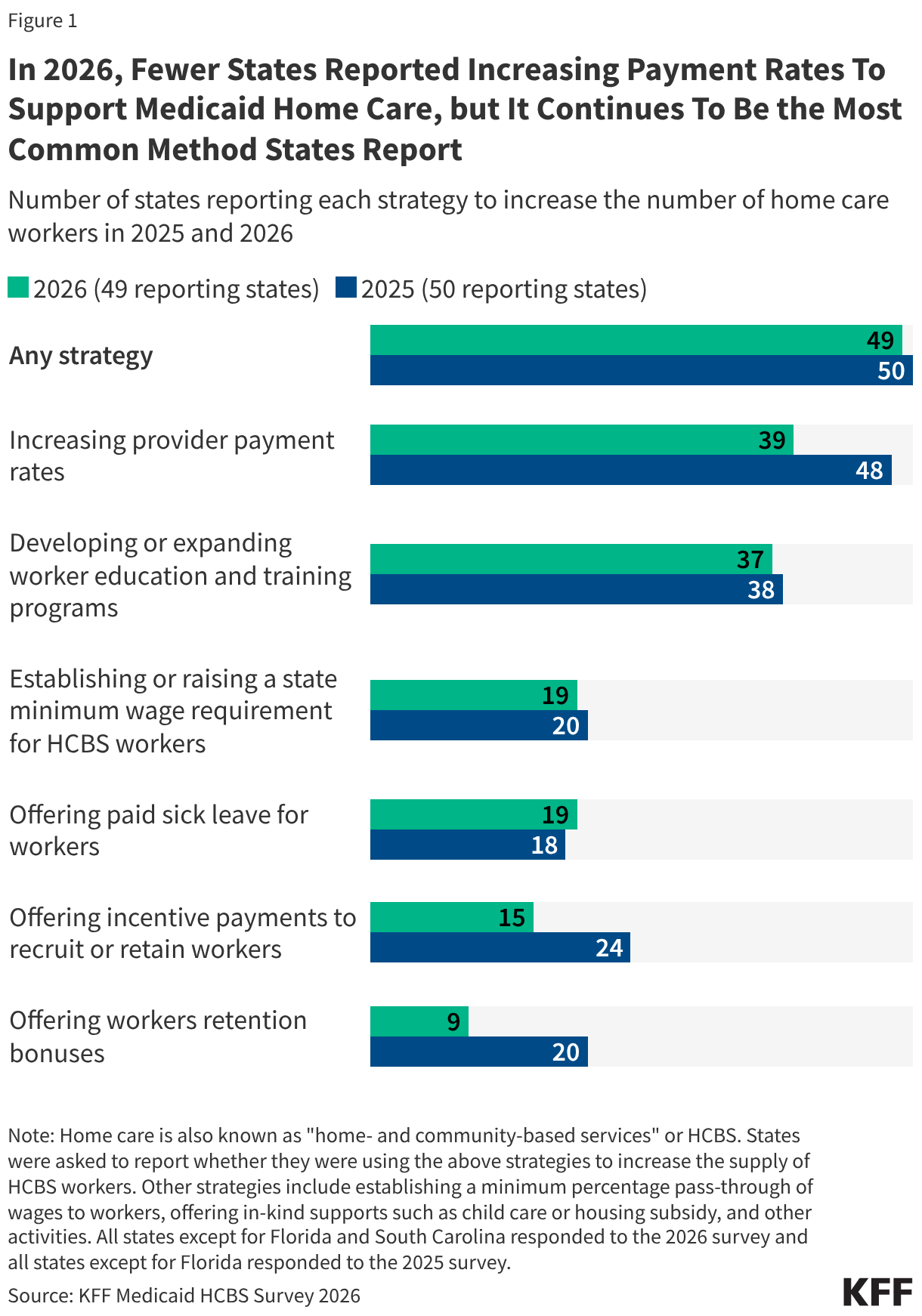
- All responding states reported taking actions to deal with workforce shortages, although fewer states reported rising supplier compensation in comparison with 2025 (Determine 1).
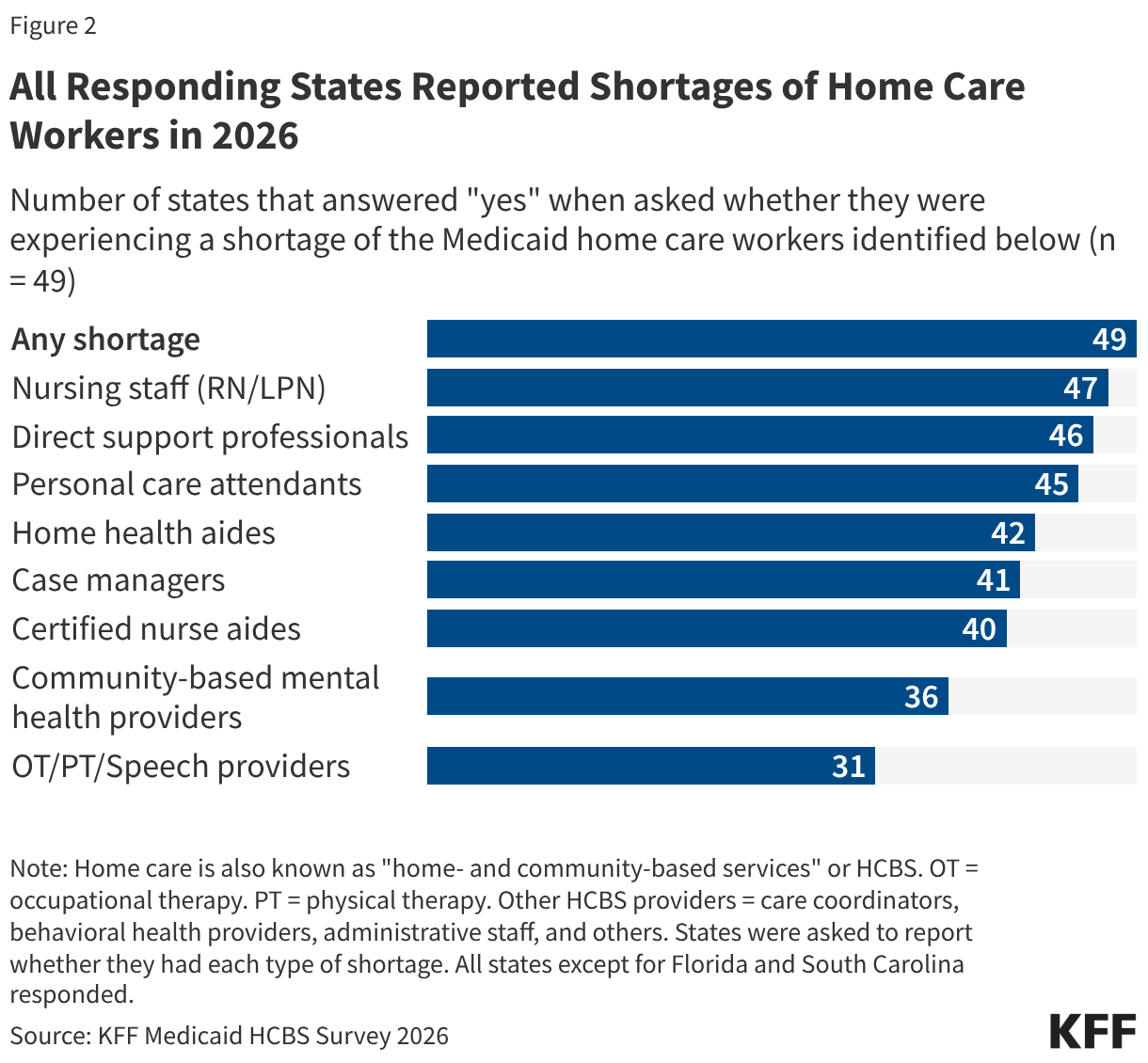
- All responding states reported shortages of residence care employees, most often amongst nursing employees, direct help professionals, private care attendants, residence Health aides, and case managers (Determine 2).
- States reported that top turnover, low wages, and elevated demand for residence care had been the most typical components contributing to rising workforce shortages.
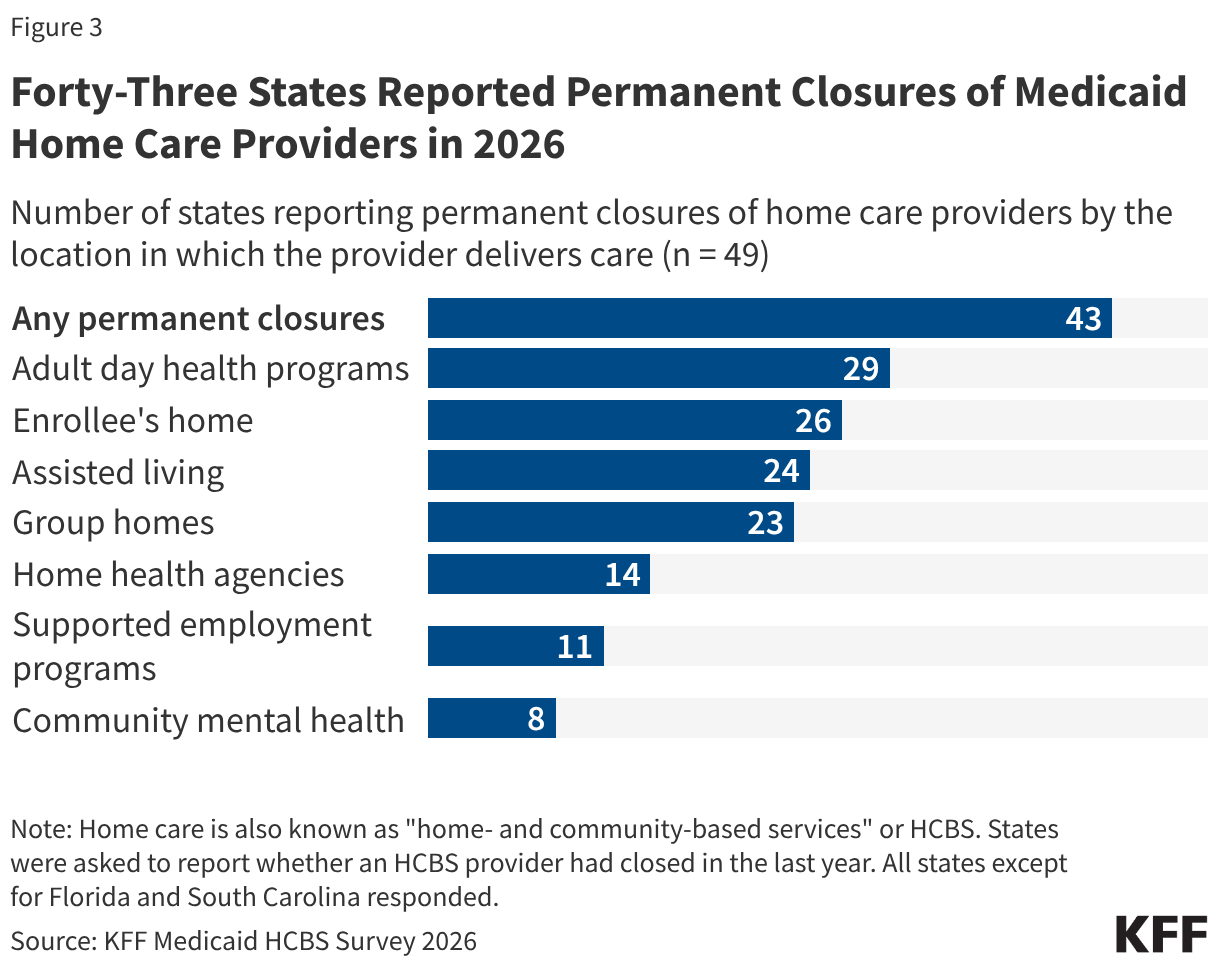
- Most (43) states reported everlasting closures of residence care suppliers inside the final yr (Determine 3).
- States at the moment are reporting detailed cost charges for residence care on-line, however the knowledge are tough to match throughout states. In distinction, KFF knowledge characterize statewide common cost charges, that are much less detailed however facilitate comparisons throughout states.
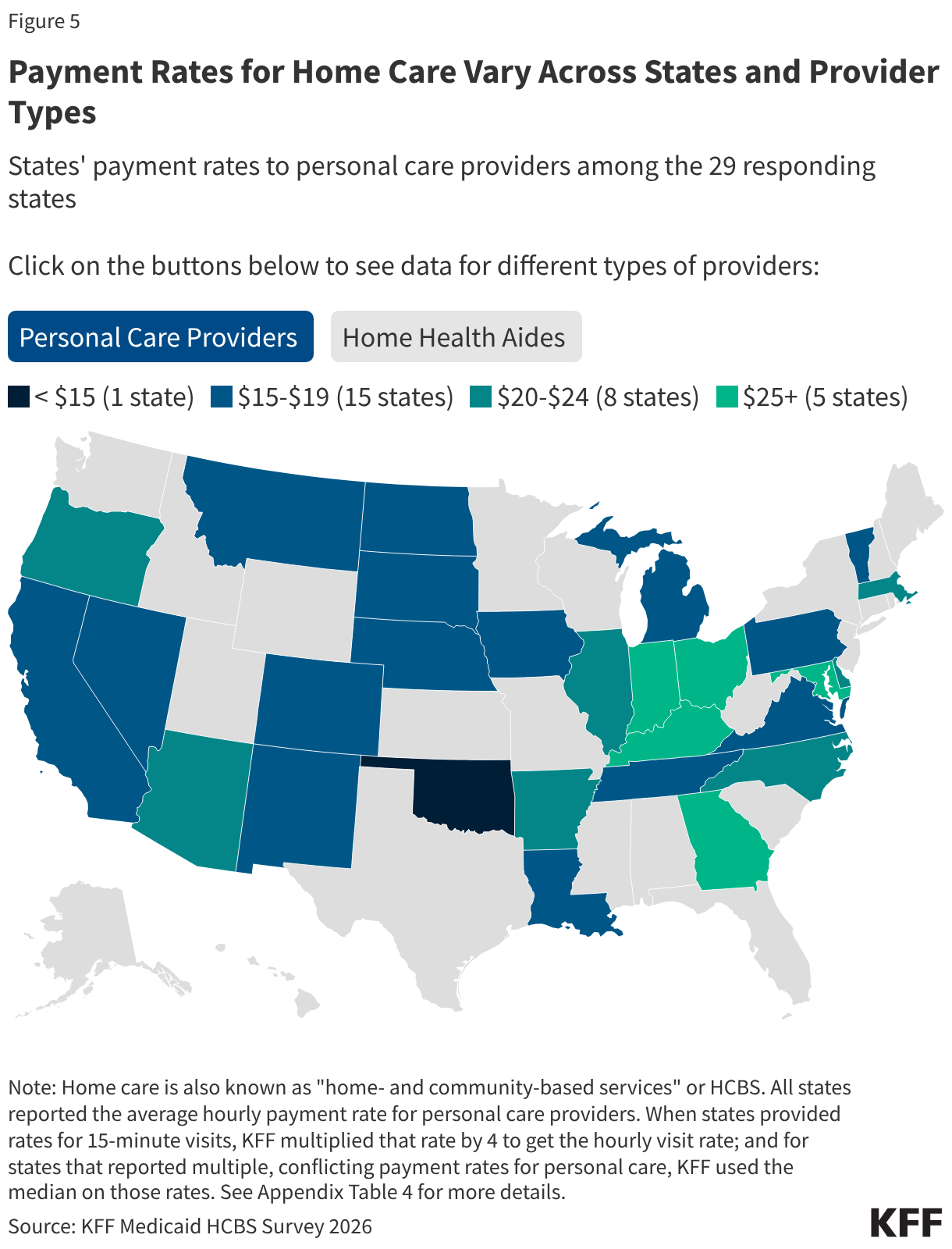
- Among the many 29 states that reported time-based cost charges for private care suppliers, greater than half pay lower than $20 per hour (Determine 5).
How Are States Addressing the Workforce Challenges in House Care?
All responding states reported workforce shortages in 2026, with the most typical shortages being amongst nursing employees (47 states), direct help professionals (46 states), and private care attendants (45 states) (Determine 2, Appendix Desk 2). States had been requested if that they had shortages of every kind of supplier however weren’t supplied with a definition of “scarcity.” Most states additionally reported shortages of residence Health aides (42 states), case managers (41 states), licensed nurse aides (40 states), community-based psychological Health suppliers (36 states), and occupational, bodily, and speech remedy suppliers (31 states). In some instances, states could not have reported a scarcity of a selected kind of supplier as a result of that kind of service just isn’t provided via their residence care program. Practically all responding states (48) reported shortages for a couple of kind of supplier, and 45 states reported shortages amongst 5 or extra supplier sorts.
Most states (43) reported rising shortages of residence care employees in 2026 relative to 2025, with excessive turnover (38 states), low wages (36 states), and elevated demand for residence care providers (30 states) ranked as the most typical components contributing to elevated shortages. States had been requested whether or not they skilled rising shortages of residence care employees within the final yr and, if sure, what components could also be contributing to the worsening shortages. 4 states acknowledged the identical degree of shortages because the earlier yr (Ohio, Tennessee, Texas, and Utah), whereas two states (New Hampshire and Virginia) famous that the pattern was unknown. When ranked by precedence, low wages relative to different sectors was the highest issue contributing to the shortages. States reported different challenges to constructing the house care workforce, together with modifications in immigration enforcement, lack of advantages, rising job obligations, an growing old workforce exiting the labor pool, and supplier shortages in rural areas. Some state officers supplied feedback that underscored workforce challenges:
“With inflation rising and low reimbursement charges for suppliers, IT is tough for [agencies] to supply aggressive salaries for employees to retain certified skilled employees.”
“[There is] excessive HCBS worker workforce turnover price, starting from 29%–48% for direct help employees alone. [There is also a] lack of advantages, with roughly solely 1 / 4 of suppliers providing advantages to their staff, and salaries not conserving tempo with inflation.”
“There usually are not sufficient employees curious about offering self-directed providers to satisfy the rising wants of households.”
Inside the final yr, 43 states reported everlasting closures of residence care suppliers, which had been most typical amongst grownup day Health packages (29 states), enrollees’ properties (26 states), assisted residing amenities (24 states), and group properties (23 states) (Determine 3, Appendix Desk 3). States had been requested if there have been any everlasting closures of suppliers that supply providers for Medicaid enrollees based mostly on the situation wherein the suppliers ship care. For a setting resembling an assisted residing facility or group residence, a closure may mirror both the closure of an assisted residing facility or the closure of a house care company that despatched employees into amenities and group properties. States weren’t requested to supply a purpose for the closures. Some states reported closures of residence Health businesses (14 states), supported employment suppliers (11 states), and group psychological Health suppliers (8 states). Most states (38) reported closures amongst a couple of kind of supplier, and 30 states reported closures amongst three or extra supplier sorts.
All responding states reported taking actions to deal with supplier shortages, with 39 states rising supplier cost charges and 37 states creating or increasing employee training and coaching packages (Determine 1). Smaller numbers of states reported establishing or elevating a state minimal wage requirement for HCBS employees (19 states), providing paid sick depart (19 states), providing incentive funds to recruit or retain employees (15 states), and providing employees retention bonuses (9 states).
In contrast with 2025, fewer states reported rising supplier compensation in 2026 (Determine 1). The variety of states that reported rising supplier cost charges dropped from 48 in 2025 to 39 in 2026, whereas the variety of states that reported providing incentive funds to recruit or retain employees dropped from 24 to fifteen, and the variety of states that reported providing retention bonuses dropped from 20 to 9. There have been minimal modifications within the variety of states that reported different initiatives between 2025 and 2026, suggesting that the decreased variety of states providing greater compensation (which is a direct price enhance for the states) could mirror states’ extra tenuous fiscal local weather.
All however 11 states use managed care to supply at the very least some residence care, and in 15 of the states with managed care, fee-for-service cost charges influence the cost charges that managed care plans pay residence care suppliers. Out of the 40 states that use managed care to supply at the very least some residence care, 14 states reported that the fee-for-service cost charges characterize the minimal quantity that plans should pay suppliers, 1 state (Wisconsin) reported that the speed represents the utmost cost price for managed care plans, 9 states reported that the fee-for-service charges don’t have an effect on funds by non-public plans, and a pair of states responded that the reply was unknown or didn’t reply to the query.
How A lot Do States Pay for Medicaid House Care?
The paragraphs on this part present Information on the cost charges collected from KFF’s survey of Medicaid residence care packages. States at the moment are required to report some Medicaid residence care cost charges on state web sites, per the provisions within the 2024 Medicaid Access Rule. Whereas the publicly reported knowledge are way more detailed than KFF’s survey knowledge (usually together with cost charges by process code, sub-state geography, or inhabitants kind), the information are tough to match cost charges throughout providers, employee sorts, and states. See Appendix Field 1 for extra Information on these necessities and the way the publicly reported knowledge differ from knowledge reported to KFF.
KFF requested states to report their common hourly price paid to 2 sorts of residence care supplier businesses (private care businesses and residential Health businesses) and three sorts of particular residence care suppliers (private care suppliers, residence Health aides, and registered nurses), however many states had been unable to report all charges (Appendix Desk 4). The variety of states that responded to the KFF survey however didn’t present hourly cost charges or reported that cost charges had been unknown was 2 for private care businesses and 29 for residence Health businesses. Many states additionally didn’t present cost charges for particular supplier sorts: For registered nurses and residential Health aides, greater than half of states didn’t present hourly cost price Information or reported that cost charges had been unknown. Among the many states that had been in a position to report cost charges within the KFF survey, solely 15 may report cost charges for private care businesses, residence Health businesses, private care suppliers, and residential Health aides. These 15 states embody states that reported a mixture of hourly and non-hourly charges for these providers.
States reported many the reason why IT was tough to report cost charges, together with the next:
- Some states reported that providers had been bundled collectively in numerous methods, and due to this fact the cost charges weren’t distinguishable.
- Amongst states with managed care, some states responded that they didn’t know the cost charges for businesses as a result of the providers had been paid for by managed care plans and they didn’t have entry to these cost charges.
- Different states responded that they knew the cost charges for businesses however not what the businesses paid their residence care employees.
Along with having issue reporting cost charges, many states reported completely different cost charges for private care throughout completely different waivers, and the waiver cost charges usually differ from the cost charges for private care supplied via the state plan. When states reported a number of cost charges for private care, KFF used the median of these cost charges within the evaluation.
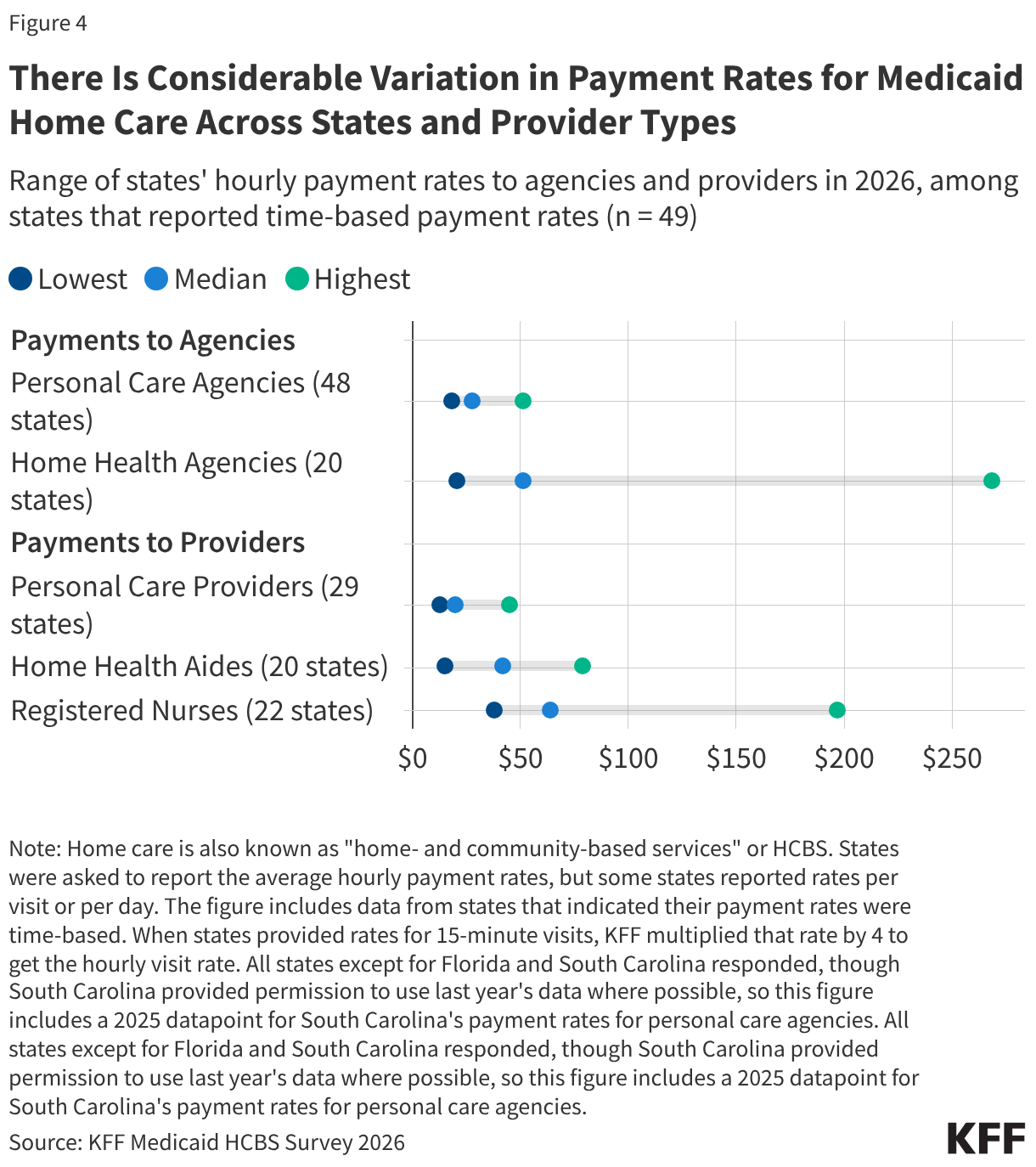
The cost charges to residence care suppliers present appreciable variation and are considerably greater than these reported by different organizations, which can mirror variations in reporting and supplier categorization (Determine 4). KFF’s survey estimates that median cost charges to suppliers are $19 per hour for private care suppliers, $42 for residence Health aides, and $64 for registered nurses. IT is tough to match these numbers to different sources of information for the next causes:
- Different organizations group courses of suppliers collectively in a different way. The Health-aides-and-personal-care-aides.htm#tab-1″>Bureau of Labor Statistics studies $17 per hour for residence Health and private care aides in 2025.
- Different organizations embody cost charges for employees whatever the supply of cost, whereas KFF charges solely mirror the Medicaid charges. Medicaid usually covers extra intensive private care providers than different payers, which can contribute to the upper charges.
Fee charges to residence Health businesses are usually greater than these to private care businesses, however there’s appreciable variation in each (Determine 4). Amongst states reporting hourly charges, the charges for residence Health businesses vary from $20 to $268, whereas these for private care businesses vary from $18 to $51. These states reported that the median hourly cost to residence Health businesses was $51 and $27 for private care businesses. Between 2025 and 2026, the median cost charges for private care businesses and residential Health aides elevated marginally ($26 to $27 and $41 to $42), whereas median cost charges for private care suppliers and residential Health businesses stayed the identical ($19 and $51, respectively) and median cost charges for registered nurses decreased ($70 to $64).
Amongst states in a position to report any cost price knowledge, funds for private care employees vary from beneath $15 to over $25 per hour (Determine 5, Appendix Desk 4). Charges for residence Health aides are considerably greater than these of non-public care employees, reflecting the extra coaching necessities for such employees. Among the many states with cost charges for residence Health aides within the highest class, some states reported that the charges had been per go to or per day (which is famous in Appendix Desk 4). There have been different states with significantly excessive cost charges that didn’t report offering charges per go to or per day, however the charges should mirror a non-hourly cost foundation.
👇Comply with extra 👇
👉 bdphone.com
👉 ultractivation.com
👉 trainingreferral.com
👉 shaplafood.com
👉 bangladeshi.help
👉 www.forexdhaka.com
👉 uncommunication.com
👉 ultra-sim.com
👉 forexdhaka.com
👉 ultrafxfund.com
👉 bdphoneonline.com
👉 dailyadvice.us