
A Salesforce admin opens a report, adjustments a subject, and saves IT. A couple of seconds later, the sector adjustments again. The report historical past reveals a number of updates, and no one can instantly clarify which automation brought about them. Issues like these typically start when too many impartial flows run on the identical object. Salesforce Stream Builder provides directors the instruments to handle this complexity, however the automation wants a transparent construction. Salesforce administration companies assist organizations evaluate current flows, resolve overlapping logic, and preserve dependable CRM operations.
Why too many Salesforce flows on one object trigger issues
A number of record-triggered flows may cause upkeep issues after they replace the identical fields, repeat enterprise guidelines, or depend upon each other. Salesforce helps a number of flows on an object and permits admins to configure their execution order. Nevertheless, every extra circulation creates one other place the place directors should verify for conflicting situations and sudden updates.
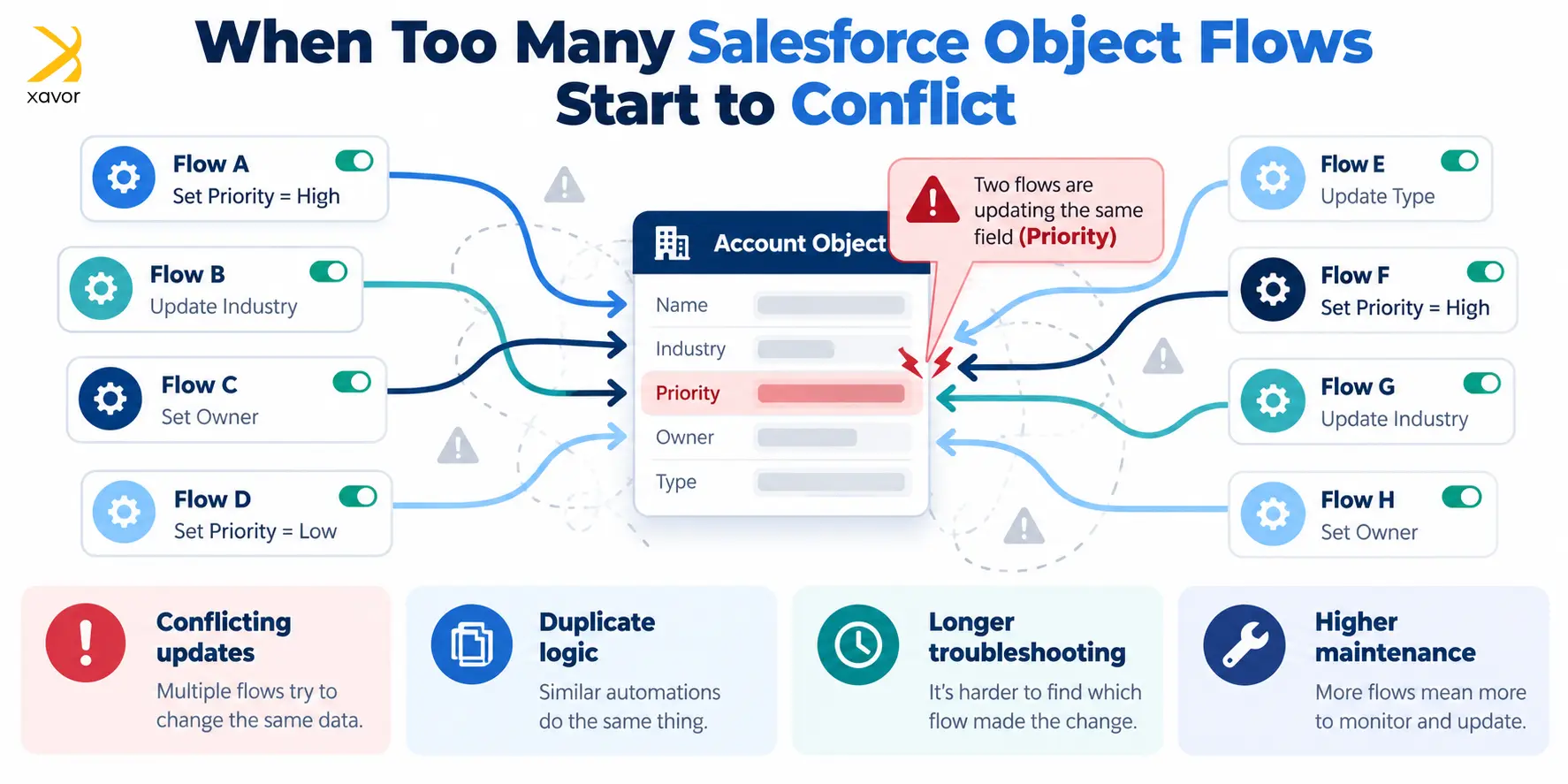
Contemplate an Account object with 11 energetic record-triggered flows. One assigns an account proprietor, one other checks the shopper class, and several other others handle notifications or replace associated information.
A brand new requirement arrives, so an administrator creates one other circulation to replace the account’s precedence. Sadly, an current circulation additionally adjustments that subject below barely completely different situations.
Now, a person adjustments the precedence manually, and the automation reverses the change throughout processing.
The issue turns into tougher to diagnose as a result of a number of flows could run throughout the identical transaction. Widespread penalties embrace:
- Conflicting updates when completely different flows modify the identical subject.
- Duplicate processing when related enterprise guidelines exist in a number of flows.
- Longer troubleshooting as a result of directors should examine a number of automation paths.
- Better upkeep effort when altering one rule requires updates in a number of locations.
Salesforce gives Flow Trigger Explorer to assist directors examine and handle these flows. IT additionally helps configuring their execution order, so a number of flows should not inherently unpredictable.
Nevertheless, controlling the run order alone could go away duplicate enterprise logic scattered throughout the thing.
Organizing Salesforce Stream Builder round 4 foremost flows
A four-flow structure separates report creation from report updates and divides every operation into before-save and after-save processing. Every foremost circulation handles a selected operation kind. Earlier than-save flows handle adjustments to the triggering report, whereas after-save flows coordinate work involving associated information or different supported actions.
For an Account object, the construction can appear to be this:
| Most important circulation | Accountability | Instance |
| Account – Create – Earlier than Save | Set fields throughout report creation | Populate an preliminary buyer class |
| Account – Create – After Save | Carry out actions after making a report | Create associated onboarding duties |
| Account – Replace – Earlier than Save | Replace fields on an current report | Recalculate precedence when account particulars change |
| Account – Replace – After Save | Run actions following report updates | Notify the account crew after reassignment |
This construction means an administrator reviewing Account updates can start with two foremost flows as an alternative of looking out via quite a few impartial flows.
The four-flow method is an architectural conference, not a Salesforce platform requirement. Some objects want fewer flows, whereas others profit from separate flows with explicitly configured set off order.
Earlier than-save vs after-save flows differ
Earlier than-save flows run throughout report processing and are designed to replace fields on the report that triggered the automation. Since these adjustments change into a part of the prevailing save operation, Salesforce doesn’t want a further report replace for these assignments.
For instance, an admin can configure a before-save circulation to calculate an Account’s precedence primarily based on its buyer class and assign the ensuing worth to the triggering report.
After-save flows assist a broader vary of actions. They’ll replace associated information, launch supported subflows, or provoke follow-up processing.
Salesforce paperwork the factor restrictions for these circulation varieties in its Flow Types reference.
| Functionality | Earlier than-save circulation | After-save circulation |
| Change triggering-record fields | Sure, utilizing assignments | Sure, via a further replace |
| Replace associated information | No | Sure |
| Name subflows | No | Sure |
| Supported components | Task, Resolution, Get Data, Loop | Broader motion and information factor assist |
| Typical function | Discipline calculations and same-record adjustments | Associated-record processing and follow-up actions |
Salesforce admins ought to typically deal with simple same-record subject adjustments earlier than the save. Updating the identical report once more from an after-save circulation creates additional database work and will begin one other automation cycle.
The function of foremost flows and reusable subflows
Most important flows decide when enterprise logic ought to execute, whereas subflows include the steps required to finish particular person operations. This association permits directors to reuse enterprise logic throughout completely different automation paths and preserve IT in a single place.
For instance, suppose an Account requires extra processing when its buyer standing turns into Lively.
Workflow automation also can prolong past Salesforce information. In a single mission, Xavor linked Salesforce with Slack to simplify approvals and hold groups knowledgeable about report adjustments. Learn the Salesforce and Slack integration case examine to see how this labored in follow.
The Account – Replace – After Save circulation can first verify whether or not the standing has modified. If the situation is met, IT calls a customer-processing subflow.
That subflow would possibly retrieve related account particulars, verify whether or not an onboarding activity already exists, and create the duty when required.
The primary circulation stays accountable for the triggering situation and the order of execution. The subflow handles the customer-processing steps.
When ought to directors create reusable subflows?
Subflows are significantly helpful when the identical operation is required by a number of processes.
For instance, customer-processing logic would possibly run after creating a brand new Account and once more when an current Account reaches a qualifying standing.
An administrator can name the identical autolaunched subflow from each after-save flows, offered the subflow receives the inputs required for every state of affairs.
Good subflow design additionally requires clearly outlined inputs and outputs. If the subflow expects an Account ID, the calling circulation ought to provide IT explicitly. Directors ought to doc how the subflow handles lacking information and errors.
Earlier than-save flows can’t name subflows, so their choice logic and subject assignments should stay throughout the supported components.
Understanding Salesforce circulation set off order
Salesforce circulation set off order determines the sequence through which eligible before-save or after-save record-triggered flows run for a similar object and triggering occasion. Directors can set the order in Stream Builder or handle IT via Stream Set off Explorer. The configured sequence nonetheless follows Salesforce’s total order of execution.
In line with Salesforce’s trigger-order documentation, directors can assign a set off order worth between 1 and a couple of,000.
Salesforce applies the sequence as follows:
- Flows assigned values from 1 to 1,000 run in ascending order.
- Flows with out specified set off order values run afterward, in line with their activation dates.
- Flows assigned values from 1,001 to 2,000 run final, once more in ascending order.
Flows that share the identical set off order worth run alphabetically by API title inside their ordering group.
Nevertheless, these values can’t change Salesforce’s broader execution guidelines. An after-save circulation can’t run earlier than a before-save circulation just because its configured worth is decrease.
With the four-flow construction, directors can outline the sequence of operations inside every foremost circulation. They have to nonetheless account for Apex triggers and every other automation that participates within the transaction.
This distinction issues when a number of Salesforce automation instruments function on the identical object.
Salesforce circulation limits and efficiency concerns
Salesforce circulation limits govern the sources consumed whereas automation executes, together with database queries and report updates. A record-triggered circulation can share a transaction with different flows and Apex code, so directors want to contemplate the mixed useful resource utilization when designing automation.
For instance, a subflow that repeatedly retrieves associated information inside a loop could devour pointless queries throughout a bulk import.
Salesforce admins can scale back that workload by retrieving information as soon as when attainable and performing collection-based updates outdoors loops.
Different Salesforce circulation greatest practices embrace setting exact entry situations, checking whether or not related fields modified earlier than performing updates, and utilizing asynchronous processing when the requirement helps IT.
Consolidating flows could make useful resource utilization simpler to examine, though IT doesn’t routinely scale back consumption. The ensuing automation should nonetheless function inside Salesforce’s transaction limits.
Methods to consolidate current record-triggered flows safely
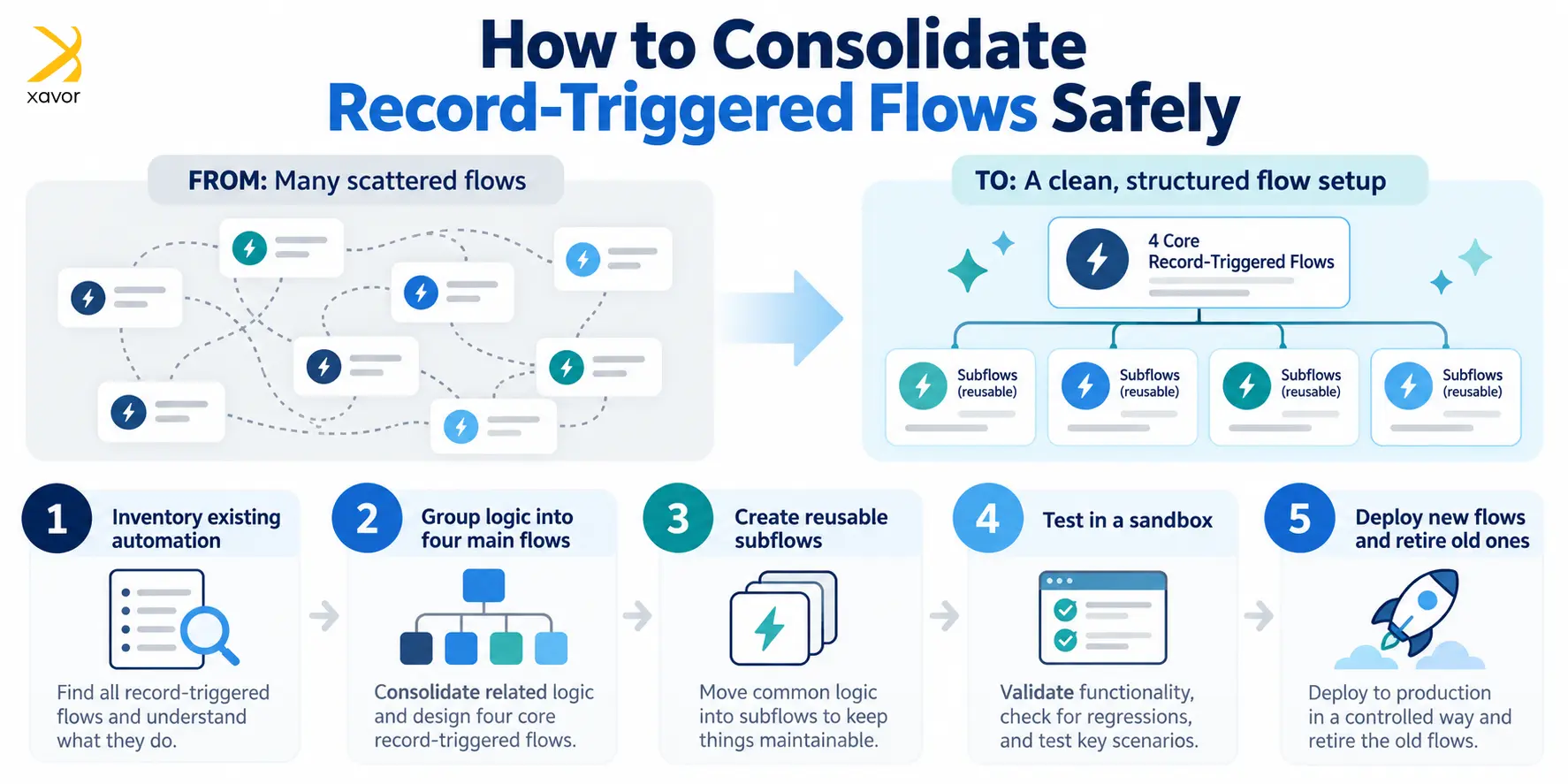
Consolidating record-triggered flows requires directors to know current conduct earlier than changing IT. The most secure method is to stock present automation, outline the place every enterprise rule belongs, rebuild in a sandbox, and take a look at the substitute towards documented necessities. Earlier than restructuring automation, directors also needs to think about how their Salesforce implementation aligns with enterprise processes, for the reason that current flows could mirror necessities which have modified over time.
1. Stock the prevailing automation
Begin by opening Stream Set off Explorer and choosing the thing you need to evaluate.
Document each energetic circulation, together with its set off situations, fields modified, and dependencies. Additionally examine Apex triggers and any remaining legacy automation.
Pay specific consideration to enterprise guidelines that modify the identical fields.
2. Group the logic into the 4 foremost flows
Classify every requirement in line with when IT runs and what information IT wants to change.
For instance, assign a same-record precedence calculation to the suitable before-save circulation. Transfer related-record creation to an after-save circulation.
Throughout this evaluate, establish duplicated checks and enterprise guidelines that now not apply.
3. Create subflows for repeated operations
Extract reusable enterprise operations into autolaunched subflows.
Give every subflow a descriptive title and doc its anticipated inputs. Preserve the principle after-save flows targeted on deciding which operation ought to run.
4. Check the substitute in a sandbox
Salesforce recommends utilizing sandboxes for circulation testing so directors can examine conduct with out unintentionally altering manufacturing information.
Check new information, updates that meet entry situations, and updates that ought to produce no extra actions. Embrace bulk imports, integration-driven adjustments, permissions, and error dealing with.
Salesforce’s flow testing documentation describes take a look at situations, assertions, and troubleshooting choices.
5. Deploy the brand new flows and retire the previous ones
Plan the cutover so previous and substitute automation don’t carry out the identical operation concurrently.
Validate manufacturing conduct after deployment and retain recoverable variations in the course of the agreed rollback interval. As soon as the brand new configuration is secure, retire out of date flows in line with your group’s change-management coverage.
When circulation consolidation is sensible
Stream consolidation is value contemplating when directors continuously examine conflicting subject updates, preserve duplicated enterprise guidelines, or spend extreme time understanding dependencies between flows.
Nevertheless, an object containing two simple flows could have already got an applicable construction.
Salesforce additionally permits directors to keep up a number of ordered record-triggered flows. That may be helpful when separate enterprise capabilities have clearly outlined possession and impartial necessities.
The choice ought to due to this fact depend upon maintainability, execution dependencies, and testing effort relatively than a set circulation depend.
For extra steerage on sustaining CRM automation, see Xavor’s article on Salesforce workflow greatest practices.
Preserve Salesforce Stream Builder manageable as automation grows
A constant method to Salesforce Stream Builder makes IT simpler for admins to know which automation runs, the place a enterprise rule belongs, and the way a change would possibly have an effect on current processes.
The four-flow structure described above gives one approach to arrange that accountability, significantly for objects with many overlapping record-triggered flows.
In case your Salesforce admins are spending an excessive amount of time investigating automation conflicts, Xavor might help assess the present configuration and establish alternatives for consolidation. Discover our Salesforce growth companies or contact [email protected] to debate an automation evaluate.
Concerning the Writer

Salman is a Salesforce CRM Guide and Structure Lead at Xavor with over 14 years {of professional} IT expertise. Licensed in Salesforce and Azure IoT, he designs advanced software program architectures and delivers high-impact cloud options for demanding world hi-tech purchasers.
FAQs
Salesforce admins ought to use exact entry situations, deal with same-record subject adjustments in before-save flows when applicable, and preserve reusable logic via subflows. They need to additionally doc execution dependencies and take a look at automation earlier than deployment.
A record-triggered circulation is an automation that runs when a Salesforce report is created, up to date, or deleted, relying on its configured set off. IT executes supported actions when the required situations are glad.
Salesforce circulation limits are restrictions on the sources automation can devour, together with database operations and transaction processing. The relevant limits depend upon the execution context and sources shared with different automation.
👇Comply with extra 👇
👉 bdphone.com
👉 ultractivation.com
👉 trainingreferral.com
👉 shaplafood.com
👉 bangladeshi.help
👉 www.forexdhaka.com
👉 uncommunication.com
👉 ultra-sim.com
👉 forexdhaka.com
👉 ultrafxfund.com
👉 bdphoneonline.com
👉 dailyadvice.us