
Enterprise intelligence has historically helped organizations perceive previous efficiency via dashboards and studies. Nonetheless, companies more and more must anticipate future outcomes and make knowledgeable choices. Predictive enterprise intelligence makes use of historic knowledge, statistical fashions, and machine studying to forecast demand, determine dangers, and assist planning. With enterprise intelligence and knowledge analytics providers, organizations can join current reporting capabilities with superior analytics to enhance decision-making.
What are the constraints of conventional enterprise intelligence reporting?
Conventional enterprise intelligence reporting primarily analyzes historic and present enterprise knowledge. IT helps organizations measure efficiency via key efficiency indicators (KPIs), determine tendencies, and examine adjustments throughout departments. Nonetheless, historic reporting has restricted capability to estimate future outcomes or assess how totally different enterprise choices may have an effect on efficiency.
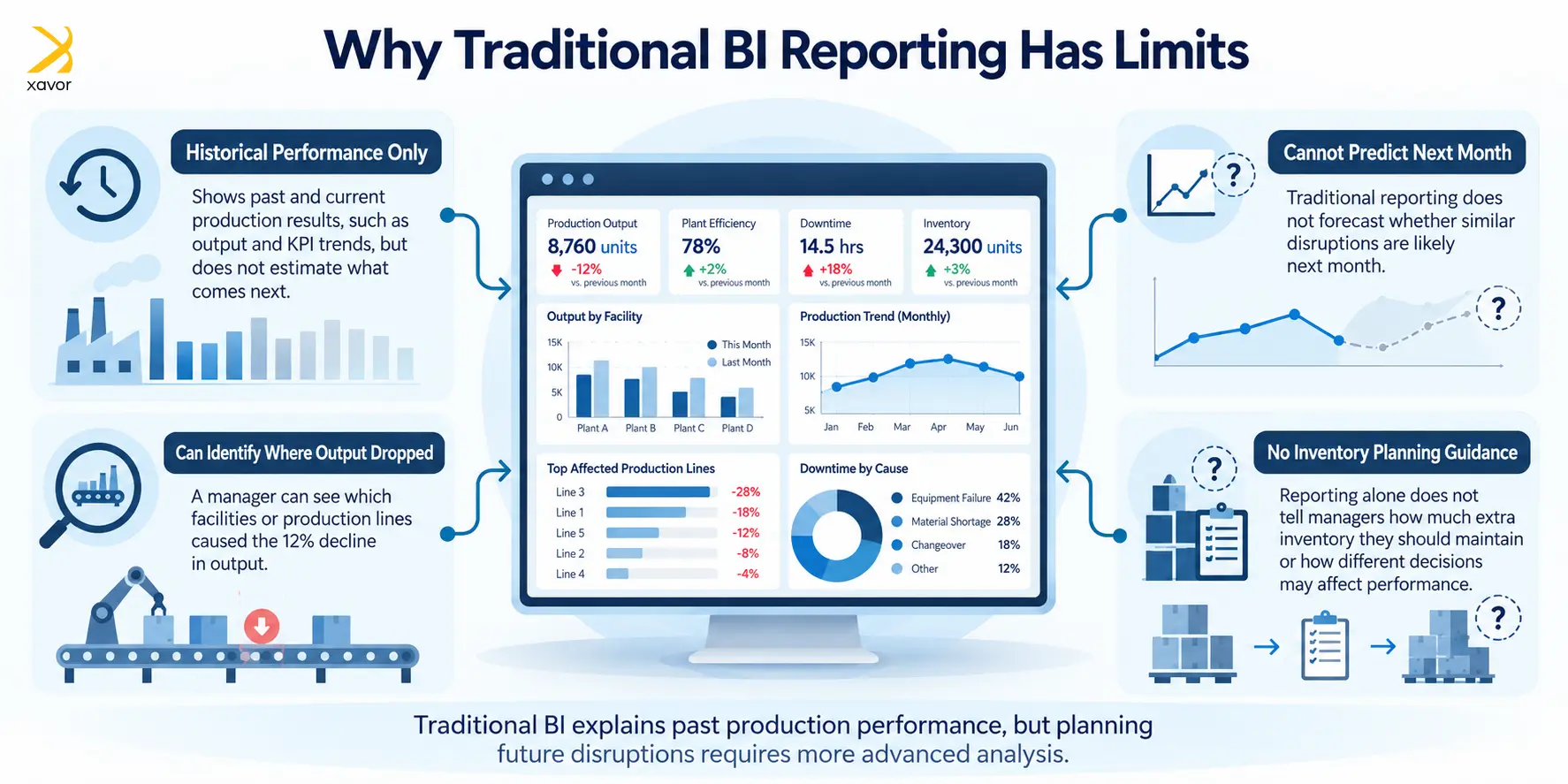
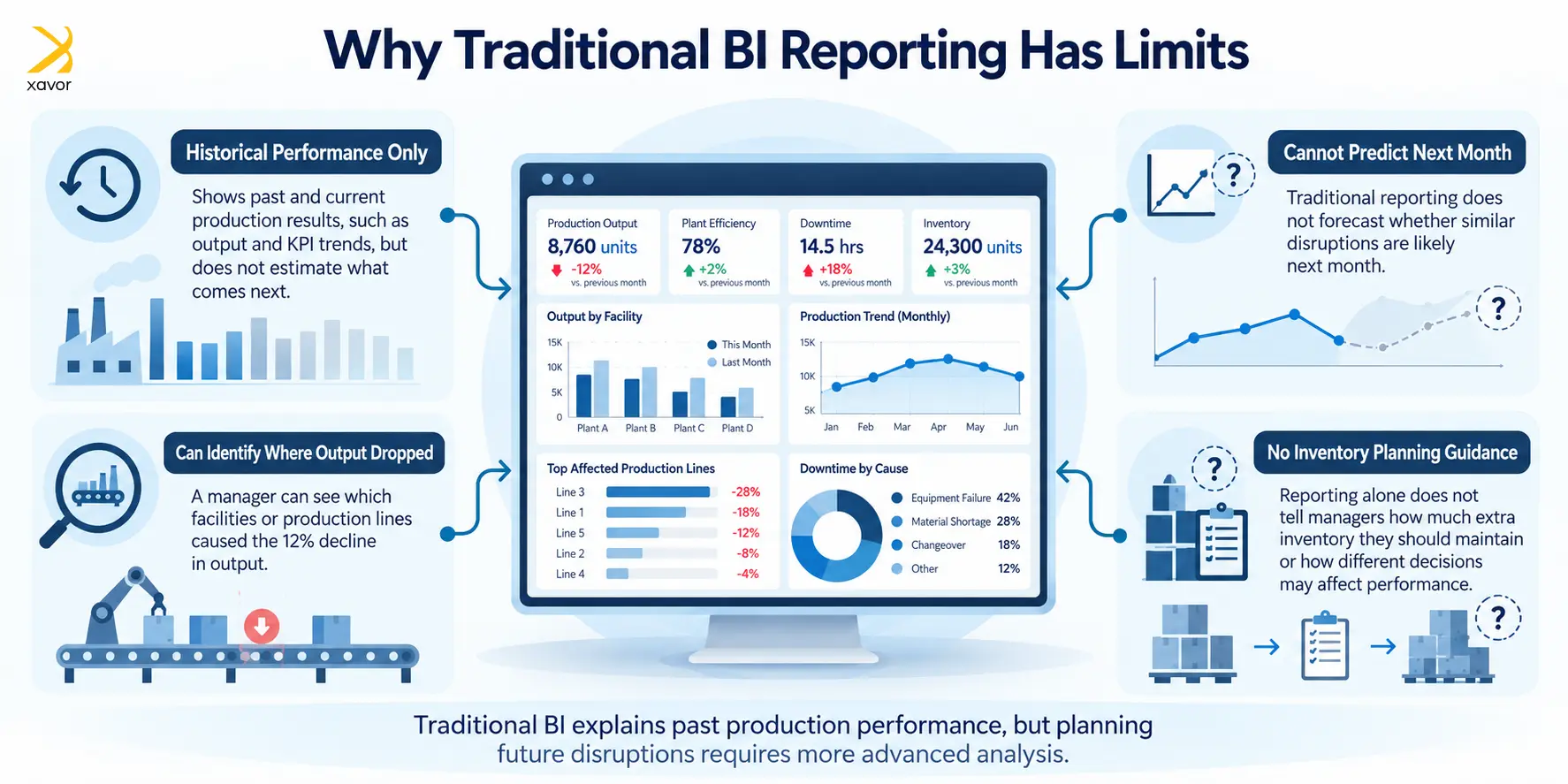
Contemplate a producing firm reviewing its month-to-month manufacturing dashboard.
The report exhibits that manufacturing output decreased by 12% in contrast with the earlier month. A supervisor can examine which amenities skilled the biggest decline and determine the manufacturing strains accountable.
Nonetheless, the supervisor should still want to find out whether or not comparable disruptions are possible subsequent month or how a lot extra stock the corporate ought to keep.
These questions require extra superior analytical strategies.
Conventional BI stays helpful as a result of companies want correct historic Information to judge efficiency. The problem arises when organizations count on reporting instruments to reply questions that require forecasting or statistical evaluation.
How has enterprise intelligence analytics developed over time?
Enterprise intelligence analytics consists of a number of strategies that tackle totally different enterprise questions. These strategies are generally grouped into descriptive, diagnostic, predictive, and prescriptive analytics. Every gives a unique degree of research, and organizations continuously use them collectively inside the similar reporting surroundings.
| Analytics kind | Principal query | Frequent methods | Enterprise instance |
| Descriptive | What occurred? | Dashboards, KPI studies, pattern evaluation | Reviewing month-to-month income |
| Diagnostic | Why did IT occur? | Drill-downs, segmentation, variance evaluation | Investigating declining gross sales |
| Predictive | What’s prone to occur? | Statistical forecasting, machine studying | Estimating subsequent quarter’s demand |
| Prescriptive | What ought to we contemplate doing? | Optimization, simulation, situation evaluation | Evaluating stock allocation choices |
Descriptive and diagnostic analytics
Descriptive analytics establishes a historic view of enterprise efficiency. For instance, a retail firm might observe income by product class, retailer location, or buyer phase.
Diagnostic analytics examines the elements related to these outcomes.
Suppose gross sales decline in a selected area. An analyst can evaluate transaction volumes, buyer exercise, and product availability to research potential causes.
Options corresponding to drill-through reporting and interactive filters make these investigations simpler. Xavor’s article on how Energy BI manages knowledge complexity explains how report designers can current detailed Information with out overwhelming enterprise customers.
Predictive and prescriptive analytics
Predictive analytics makes use of patterns in current knowledge to estimate future outcomes. Frequent strategies embrace time-series forecasting, regression evaluation, and machine studying fashions.
For instance, a producer may mix historic orders with seasonal demand patterns to estimate manufacturing necessities.
Prescriptive analytics provides determination evaluation. If forecasts recommend a rise in demand, optimization fashions can consider totally different procurement schedules or manufacturing allocations.
In response to IBM’s March 2026 explanation of predictive forecasting, forecasting strategies use historic Information and statistical methods to assist choices about future enterprise efficiency.
How does predictive enterprise intelligence work?
Predictive enterprise intelligence combines enterprise knowledge with statistical or machine studying fashions to estimate future occasions. Organizations put together historic data, determine related variables, prepare forecasting fashions, and consider their accuracy. The ensuing estimates can then seem in BI dashboards alongside historic efficiency measures.
Contemplate a retailer forecasting weekly stock demand.
First, the corporate collects historic gross sales transactions, inventory availability, and product Information. Analysts may embrace promotions or seasonal differences when these elements have an effect on buying conduct.
Subsequent, the corporate prepares the information by correcting inconsistent data and figuring out lacking values. A forecasting mannequin then examines historic relationships to estimate future demand.
Earlier than deployment, analysts check the mannequin in opposition to historic durations that have been excluded from coaching. This course of helps decide whether or not its predictions are dependable.
Lastly, the enterprise can show the forecasts in its current reporting surroundings so buying managers can evaluate anticipated demand with present stock.
Forecasting accuracy needs to be monitored after deployment as a result of buyer conduct and working circumstances can change.
The place can organizations apply predictive BI?
Predictive enterprise intelligence helps planning throughout industries the place historic Information may also help estimate future circumstances. Essentially the most helpful purposes typically tackle a selected determination that enterprise customers make repeatedly.
| Trade | Utility | Resolution supported |
| Manufacturing | Gear failure forecasting | When to schedule upkeep |
| Retail | Product demand forecasting | How a lot stock to buy |
| Healthcare | Affected person quantity forecasting | Easy methods to plan staffing and capability |
| Monetary providers | Credit score threat estimation | Easy methods to assess lending purposes |
| SaaS | Buyer churn prediction | Which accounts want retention consideration |
For instance, a SaaS firm might already monitor buyer retention via month-to-month BI reporting.
By introducing churn prediction, the corporate can analyze buyer exercise, assist historical past, and subscription Information to estimate which accounts face a better probability of cancellation.
Account managers can then examine these prospects and determine whether or not intervention is suitable.
The prediction gives a further enter into the choice. Human judgment stays crucial, notably when the underlying knowledge can’t clarify each issue influencing buyer conduct.
How is AI-powered enterprise intelligence altering reporting and analytics?
AI-powered enterprise intelligence applies machine studying and different AI methods to assist reporting, forecasting, and knowledge exploration. Relying on the platform, these capabilities might embrace natural-language queries, automated anomaly detection, or generated explanations of enterprise metrics. Their reliability depends upon the underlying knowledge and the way the instruments are configured.
For instance, Microsoft Energy BI helps anomaly detection in sure time-series line charts. The characteristic identifies uncommon knowledge factors and might recommend potential explanations utilizing accessible report dimensions.
Nonetheless, Microsoft’s documentation identifies particular limitations, together with chart configuration necessities and unsupported connection eventualities.
Introduce one other helpful functionality. Enterprise customers might be able to ask questions on income or operational efficiency with out manually developing each report.
Nonetheless, AI-generated responses nonetheless require verification, notably when organizations use the Information for monetary or operational choices.
Analysts stay accountable for defining enterprise measures, deciphering uncommon outcomes, and evaluating whether or not the accessible proof helps a conclusion.
Why does the BI semantic layer matter for correct analytics?
A BI semantic layer defines enterprise measures, relationships, and terminology over underlying knowledge. IT helps totally different studies calculate metrics constantly and provides analytical instruments a typical illustration of enterprise Information. This turns into particularly helpful when organizations mix standard reporting with machine studying or natural-language analytics.
Contemplate an organization with a number of definitions of income.
The Finance division calculates income utilizing invoiced transactions, whereas gross sales studies use booked orders. Each measures could also be helpful, however they reply totally different questions.
With out clearly outlined metrics, a forecasting mannequin skilled on one definition might produce outcomes that customers evaluate incorrectly with one other.
A semantic mannequin reduces this threat by defining how calculations work and which knowledge relationships apply.
Microsoft’s Power BI documentation explains how semantic fashions arrange enterprise logic and reusable calculations to assist constant reporting and AI-based queries.
Semantic fashions additionally require upkeep. Modifications to supply techniques, reporting definitions, or enterprise processes can have an effect on downstream analytics.
How can companies introduce predictive analytics into current BI techniques?
Organizations can introduce superior analytics progressively by bettering current knowledge processes and choosing a selected forecasting use case. They need to start with a measurable enterprise downside, assess the accessible Information, validate an acceptable mannequin, and join its outcomes to the reporting instruments workers already use.
A sensible implementation follows 5 steps:
- Assess knowledge readiness. Evaluation knowledge completeness, refresh frequency, and consistency throughout supply techniques.
- Standardize enterprise measures. Set up shared definitions for the KPIs utilized in reporting and forecasting.
- Choose one forecasting use case. Select a recurring determination the place improved estimates may cut back prices or assist planning.
- Check the mannequin. Examine predictions with precise historic outcomes and a easy baseline forecast.
- Monitor manufacturing efficiency. Monitor forecast errors and assessment whether or not workers use the outcomes appropriately.
As an example, a company utilizing Microsoft Energy BI might retain its current dashboards whereas creating a separate forecasting mannequin.
Relying on the technical necessities, mannequin outputs might be saved in a database or analytical platform and consumed by Energy BI studies.
Organizations contemplating broader infrastructure adjustments can even assessment Xavor’s article on how cloud BI impacts enterprise decision-making.
The implementation also needs to account for knowledge entry controls, mannequin possession, and ongoing upkeep.
What ought to organizations measure to judge predictive BI?
The effectiveness of predictive BI depends upon each technical efficiency and enterprise outcomes.
Forecast accuracy is one helpful measure. Organizations might observe imply absolute error (MAE) or weighted absolute proportion error (WAPE), relying on the traits of the information.
Nonetheless, a technically correct forecast should still have restricted enterprise worth if workers obtain IT too late or can’t join IT to an operational determination.
Due to this fact, organizations also needs to measure whether or not forecasting improves planning outcomes, corresponding to stock availability, staffing choices, or upkeep scheduling.
These measures assist decide whether or not additional funding within the analytical system is justified.
Predictive enterprise intelligence offers organizations one other approach to make use of their current Information. Historic dashboards set up efficiency, whereas forecasting fashions assist decision-makers put together for potential future circumstances.
At Xavor, we develop enterprise intelligence and knowledge analytics options that join knowledge preparation, semantic modeling, interactive reporting, and superior analytics. In case your group desires to introduce forecasting into an current BI surroundings or enhance the reliability of its enterprise intelligence reporting and analytics, contact us at [email protected].
Concerning the Creator

Usama is a Principal Software program Engineer within the Knowledge Science group at Xavor, specializing in cloud-based knowledge platforms and analytics. He leads scalable knowledge and BI options on GCP, with experience in huge knowledge transformation, machine studying, and delivering insight-driven techniques for world enterprise shoppers.
FAQs
BI reporting sometimes presents historic and present efficiency via dashboards and KPIs. Predictive analytics applies statistical fashions to estimate future outcomes utilizing patterns in accessible knowledge.
AI-powered enterprise intelligence can assist automated anomaly detection, natural-language questions, and forecasting. These capabilities assist customers examine Information, though mannequin outputs nonetheless require acceptable validation.
A BI semantic layer defines enterprise measures and relationships constantly throughout studies. IT reduces conflicting calculations and helps analytical instruments interpret enterprise knowledge accurately.
👇Comply with extra 👇
👉 bdphone.com
👉 ultractivation.com
👉 trainingreferral.com
👉 shaplafood.com
👉 bangladeshi.help
👉 www.forexdhaka.com
👉 uncommunication.com
👉 ultra-sim.com
👉 forexdhaka.com
👉 ultrafxfund.com
👉 bdphoneonline.com
👉 dailyadvice.us