
Selecting an enterprise content material administration system is a choice you’ll reside with for years. IT shapes your safety posture, your builders’ velocity, your advertising workforce’s independence, and a big chunk of your complete value of possession. For organizations evaluating platforms as a part of broader enterprise CMS improvement companies, the CMS alternative additionally impacts how simply the web site can scale, combine with present techniques, and adapt over time.
Two names come up consistently in that dialog: Umbraco and WordPress. Each are mature, extensively deployed, and able to working severe web sites. However they arrive from totally different worlds, and the fitting alternative relies upon much more on your workforce, stack, and governance necessities than on any headline function listing.
This information breaks down how Umbraco and WordPress evaluate for enterprise use in 2026 — throughout structure, safety, scalability, value, and the day-to-day realities of working every at scale.
TL; DR The brief reply
WordPress and Umbraco are constructed for differing types of customers. WordPress is designed to be accessible to bloggers, entrepreneurs, and companies, with developer assist wanted just for extra superior duties.
Umbraco is extra developer-focused and normally requires technical experience for setup, customization, and ongoing modifications. In case your group is constructed on the Microsoft / .NET stack, values strict content material governance, and wishes a CMS that behaves predictably underneath enterprise safety and compliance necessities, Umbraco is normally the stronger match.
But when you must launch quick on a restricted finances, lean on a large plugin and expertise ecosystem, and provides advertising groups most self-service, WordPress stays onerous to beat.
The remainder of this text explains why — and the place the nuances disguise.
Umbraco and WordPress at a look
| Issue | Umbraco | WordPress |
| Underlying Technology | ASP.NET Core / C# (.NET) | PHP / MySQL |
| Licensing | Open supply (MIT) | Open supply (GPL) |
| Market place | ~1% of CMS market, robust in .NET enterprises | ~40%+ of all web sites |
| Content material modeling | Structured, developer-defined by design | Versatile, plugin-assisted |
| Ecosystem | Curated, smaller | Monumental plugin/theme market |
| Best workforce | .NET / C# builders | PHP builders, generalists |
| Internet hosting | Umbraco Cloud or Azure/self-hosted | Virtually any host |
Market share figures transfer over time — confirm the most recent numbers earlier than publishing, since these are illustrative.
1. Structure and Technology stack
Umbraco is constructed on ASP.NET Core and C#. That’s the deciding issue for a lot of enterprises: in case your groups already work in .NET, Umbraco slots into your present abilities, CI/CD pipelines, Azure infrastructure, and safety tooling with minimal friction. Its content material modeling is structured by default — builders outline doc varieties and templates, which enforces consistency and makes massive content material architectures simpler to keep.
WordPress runs on PHP and MySQL, essentially the most extensively deployed net stack on this planet. That ubiquity is its superpower: internet hosting is reasonable and common, expertise is in all places, and there’s a plugin for virtually something. The trade-off is that WordPress’s flexibility is usually plugin-assisted fairly than structural — highly effective, however simpler to let sprawl over time with out disciplined governance.
Enterprise takeaway: Match the CMS to your engineering org. A .NET store pays an actual tax adopting WordPress; a PHP or agency-driven workforce will transfer sooner on WordPress.
2. Safety and compliance
Safety is the place enterprise conversations get severe.
WordPress’s recognition makes IT the most-targeted CMS on the web. Core WordPress in all fairness safe, however the majority of real-world vulnerabilities come from third-party plugins and themes. At enterprise scale, meaning lively plugin governance, patch administration, and vetting are non-negotiable operational obligations. For bigger WordPress environments, this could additionally lengthen into identification and entry design, together with approaches resembling zero belief structure for WordPress.
Umbraco’s smaller, extra curated ecosystem and structured structure typically current a smaller assault floor. As a result of IT’s a .NET utility, IT inherits the safety tooling, authentication patterns (together with simple Azure AD / Entra ID integration), and replace self-discipline that enterprise .NET groups already use.
Enterprise takeaway: Neither is “insecure.” However WordPress safety is largely a plugin-governance drawback you will need to actively handle, whereas Umbraco’s threat profile is extra contained out of the field.
3. Scalability and efficiency
Each platforms run high-traffic websites — the differentiator is the way you get there. On Umbraco particularly, points resembling caching, database calls, internet hosting configuration, and media dealing with can have a big impact on efficiency, which we cowl in our information to optimizing Umbraco web site efficiency.
WordPress scales nicely with the fitting stack: managed enterprise internet hosting, aggressive caching, a CDN, and database optimization. Enterprise WordPress hosts have made this largely a solved drawback, although heavy plugin masses can undermine efficiency if left unchecked.
Umbraco scales cleanly on Azure, advantages from .NET’s efficiency traits, and pairs naturally with cloud-native patterns. Its structured content material mannequin additionally tends to maintain massive websites extra maintainable as they develop.
Enterprise takeaway: Each scale. Finances for correct internet hosting, caching, and a CDN no matter which you select — the CMS alone doesn’t assure efficiency.
4. Headless and composable structure
In 2026, many enterprises need the possibility to go headless — decoupling the content material again finish from entrance ends inbuilt React, Subsequent.js, or cell apps.
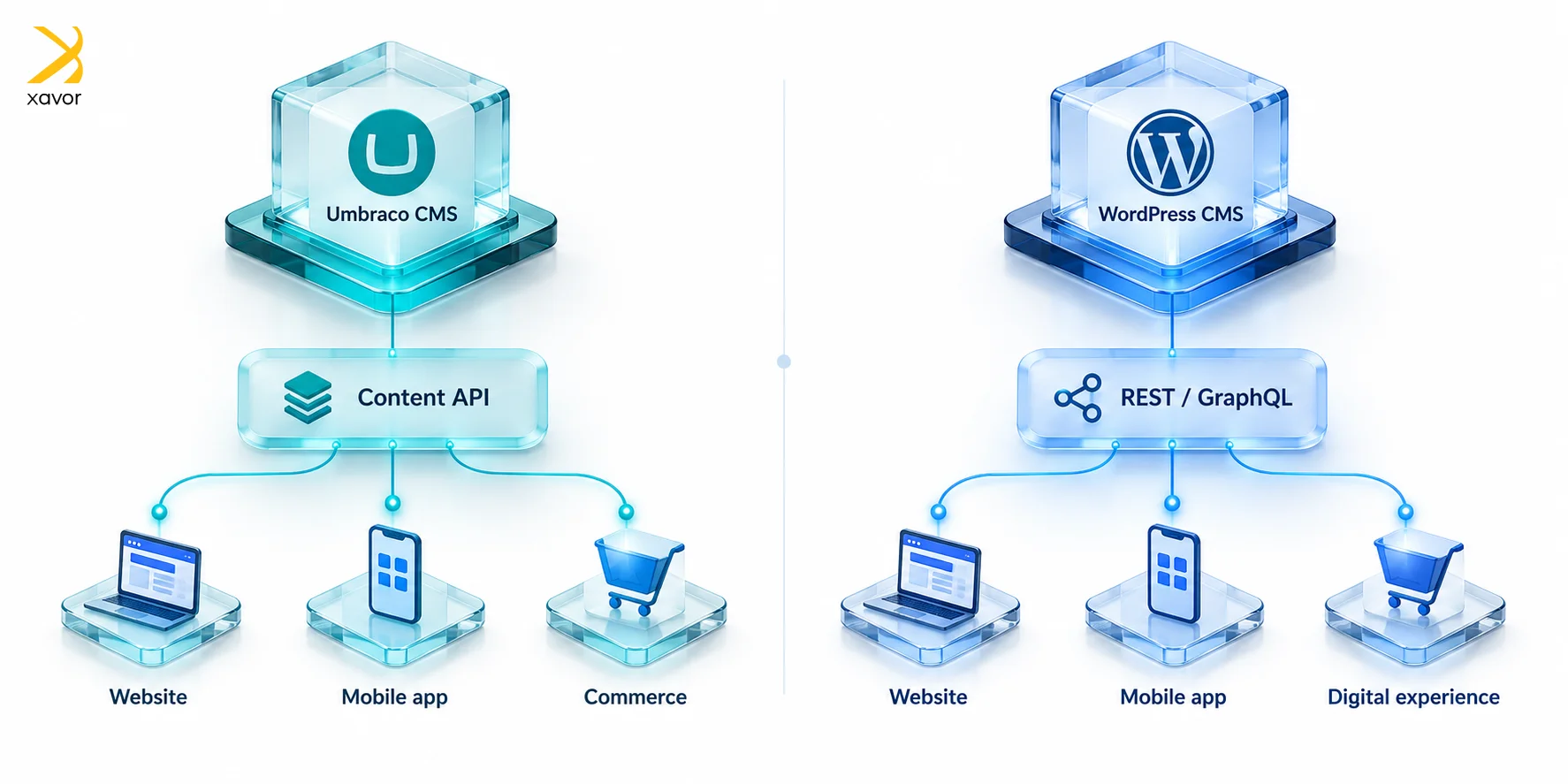
Umbraco gives a first-class headless product (Umbraco Heartcore) plus a local Content material Supply API, making IT a robust match for composable and omnichannel methods.
WordPress helps headless via its REST API and GraphQL (through WPGraphQL), and there’s a big group doing precisely this — although headless WordPress is extra of an assembled sample than a packaged product. Groups contemplating this structure may see our sensible information to utilizing WordPress as a headless CMS.
Enterprise takeaway: Each can go headless. Umbraco’s strategy is extra turnkey; WordPress’s is extra DIY however well-trodden.
5. Whole value of possession (TCO)
Each platforms are open supply with no license payment for the core, so the actual value lives elsewhere:
- Expertise: PHP/WordPress builders are extra plentiful and infrequently inexpensive; senior .NET builders command increased charges however carry enterprise engineering self-discipline.
- Internet hosting: WordPress internet hosting is cheaper and extra common; Umbraco sometimes runs on Azure or Umbraco Cloud (a paid managed platform).
- Upkeep: WordPress’s ongoing plugin patching and governance is an actual recurring value; Umbraco’s tighter ecosystem can imply decrease upkeep overhead however increased per-developer value.
- Construct pace: WordPress typically wins on time-to-launch, which lowers preliminary value.
Enterprise takeaway: WordPress normally wins on upfront value. Umbraco can win on long-term value of possession in a ruled, .NET-aligned enterprise. Mannequin the complete 3–5 yr image, not simply the construct.
6. Content material workforce expertise and governance
WordPress’s enhancing expertise (Gutenberg block editor) is acquainted and marketer-friendly, which lowers coaching overhead and provides content material groups lots of independence.
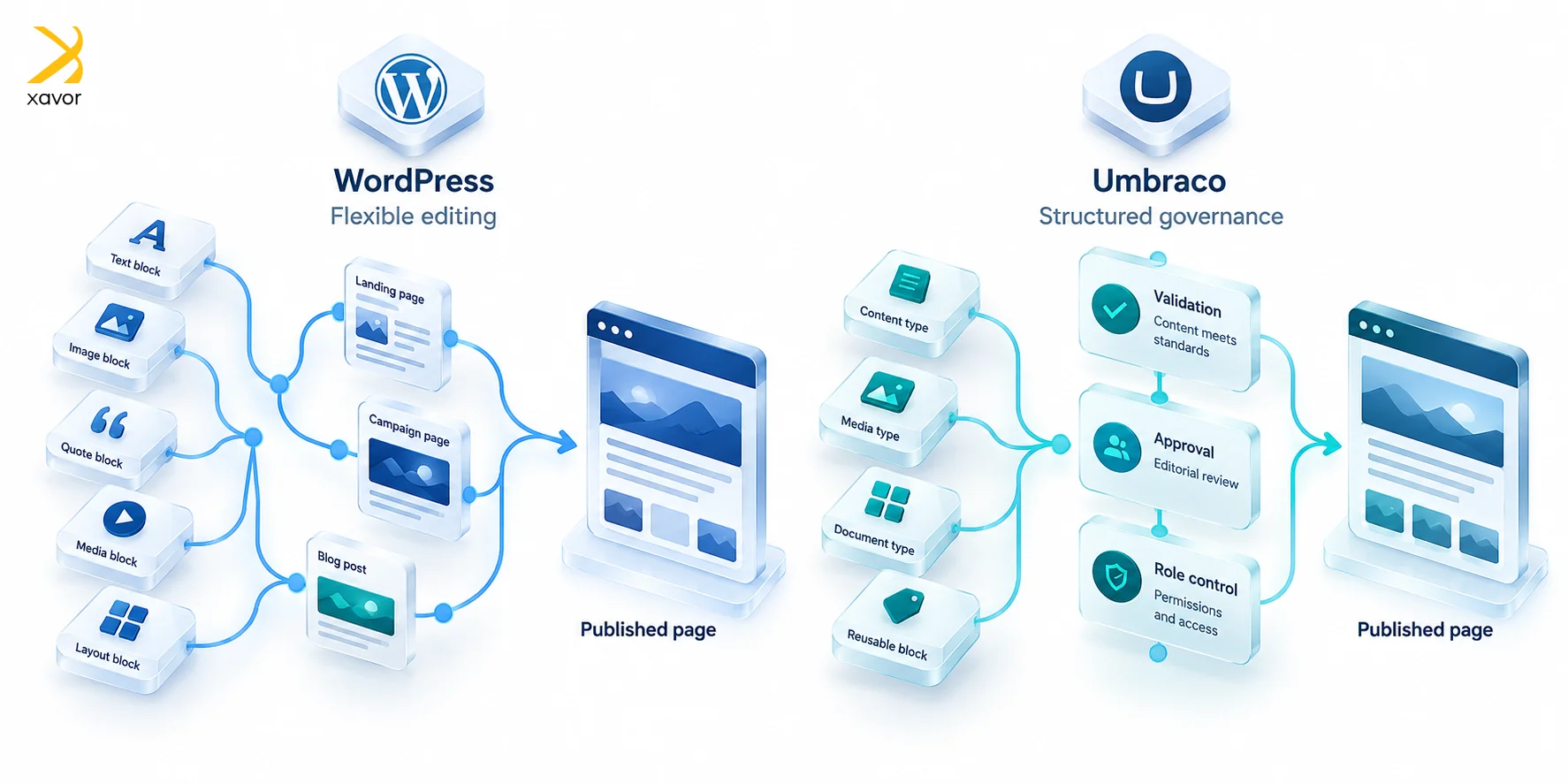
Umbraco’s editor is clear and well-regarded, and its structured content material mannequin offers governance-conscious organizations tighter management over what editors can and can’t do — helpful when model consistency and compliance matter greater than editorial free rein.
Enterprise takeaway: WordPress leans towards editor freedom; Umbraco leans towards editorial management. Decide based mostly on how a lot governance your model and compliance groups require.
7. web optimization options and capabilities
WordPress is typically simpler for web optimization, particularly for non-technical groups. IT gives robust built-in fundamentals and a big plugin ecosystem that simplifies frequent web optimization duties.
Umbraco may carry out nicely in search, however IT normally wants extra developer setup. Its benefit is larger technical management, which might go well with groups that desire a extra custom-made web optimization construction.
Enterprise takeaway: WordPress gives robust web optimization fundamentals, that are sooner and extra accessible to execute. Umbraco gives deeper web optimization developer management however requires extra effort.
8. Group and assist
Umbraco additionally has an lively, dedicated group and gives business enterprise assist, however its ecosystem and developer pool are smaller and extra concentrated in Europe.
WordPress, then again, has a a lot bigger international group, with intensive tutorials, boards, occasions, businesses, and builders accessible worldwide. This makes assist and hiring comparatively straightforward.
Enterprise takeaway: WordPress gives a broader international assist ecosystem and expertise pool.
9. Extensions and integrations
WordPress has a a lot bigger plugin ecosystem, with instruments accessible for web optimization, safety, eCommerce, advertising, memberships, and plenty of different wants. This typically reduces customized improvement and quickens implementation.
Umbraco gives a smaller extension market, so extra specialised options might require customized .NET improvement. Its power is tighter alignment with Microsoft applied sciences resembling Azure, Dynamics 365, and Lively Listing.
Enterprise takeaway: WordPress gives better extensibility and sooner deployment, whereas Umbraco fits enterprises that prioritize customized improvement.
10. Multilingual, multisite content material administration
Massive enterprises typically must handle a number of web sites, manufacturers, areas, and languages from the identical CMS.
WordPress helps multisite via WordPress Multisite and multilingual publishing via plugins and enterprise setups. IT gives appreciable flexibility, however managing permissions, translations, plugins, and content material throughout a big community can change into complicated with out robust governance.
Umbraco is nicely suited to structured multisite and multilingual implementations, permitting enterprises to outline shared content material fashions whereas controlling variations throughout markets, languages, and types. IT can require extra improvement upfront, however this construction could make massive international ecosystems simpler to manipulate.
Enterprise takeaway: Umbraco gives stronger structural management for complicated, multilingual enterprise environments.
The way to determine: a fast framework
Select Umbraco should you:
- Run on the Microsoft / .NET / Azure stack
- Want robust content material governance and a smaller, extra managed assault floor
- Need a turnkey headless and composable path
- Are optimizing for long-term maintainability over quickest launch
Select WordPress should you:
- Must launch rapidly and cost-effectively
- Need the biggest potential ecosystem of plugins, themes, and expertise
- Prioritize advertising self-service and a well-known enhancing expertise
- Have (or will construct) disciplined plugin governance
CMS choices change into extra complicated when enterprises are managing a number of websites, publishing groups, migrations, and long-term scalability necessities. See how Xavor addressed related challenges via enterprise CMS modernization, bettering publishing pace, web site launches, and scalability throughout a big digital ecosystem.
Conclusion
There’s no common winner in Umbraco vs. WordPress. Solely the fitting match for your enterprise. The perfect resolution comes from actually assessing your present tech stack, your workforce’s abilities, your safety and compliance obligations, and your true long-term finances.
If you’re weighing the 2 for a particular challenge or contemplating a migration between them, a brief discovery dialog with Xavor can save months of rework.
Contact us at [email protected] to speak to our workforce about your enterprise CMS technique.
Concerning the Writer

Umair Tariq is the Enterprise Options Architect and Director of Skilled Companies at Xavor. He designs cloud-enabled, AI-driven platforms throughout healthcare and retail, translating complicated enterprise challenges into scalable, production-ready options. He makes a speciality of high-performing engineering management and HIPAA-compliant, large-scale integrations.
FAQs
WordPress is usually higher for sooner deployment, marketer autonomy, and plugin-driven flexibility. Umbraco is a stronger match for .NET-led enterprises that prioritize structured content material, governance, and Microsoft ecosystem integration.
Both migration is feasible, however complexity depends upon content material quantity, customized performance, integrations, URLs, and web optimization necessities. A correct migration plan ought to protect content material construction, redirects, metadata, and important person journeys.
WordPress normally has a decrease upfront value due to its bigger expertise pool, internet hosting choices, and plugin ecosystem. Umbraco might be more cost effective long run for enterprises already invested in .NET and Azure.
👇Observe extra 👇
👉 bdphone.com
👉 ultractivation.com
👉 trainingreferral.com
👉 shaplafood.com
👉 bangladeshi.help
👉 www.forexdhaka.com
👉 uncommunication.com
👉 ultra-sim.com
👉 forexdhaka.com
👉 ultrafxfund.com
👉 bdphoneonline.com
👉 dailyadvice.us