
Constructing enterprise AI options requires making sense of giant quantities of knowledge. Snowflake vs Databricks is a standard alternative that corporations must make on this house. They’re two main cloud knowledge analytics platforms that knowledge analytics companies use to simplify messy knowledge.
Xavor has spent the final decade working with Snowflake and Databricks for a number of initiatives. In our opinion, Databricks provides you extra management. In case you are doing heavy knowledge processing or machine studying, you’ll be able to configure the computing setting extra exactly. That flexibility might be helpful, however IT additionally means there may be extra to be taught.
Snowflake, conversely, is usually simpler to make use of. Lots of the infrastructure and configuration is dealt with for you, so you’ll be able to focus extra on working with the info quite than managing the computing setup.
However Snowflake and Databricks are progressively shifting in direction of one another.
Snowflake vs Databricks at a look
TL; DR
Databricks provides the mixed options of knowledge warehouses and knowledge lakes. Each of that are indispensable for cloud analytics. Snowflake’s proposition lies in its SaaS-based knowledge platform, which requires far much less upkeep.
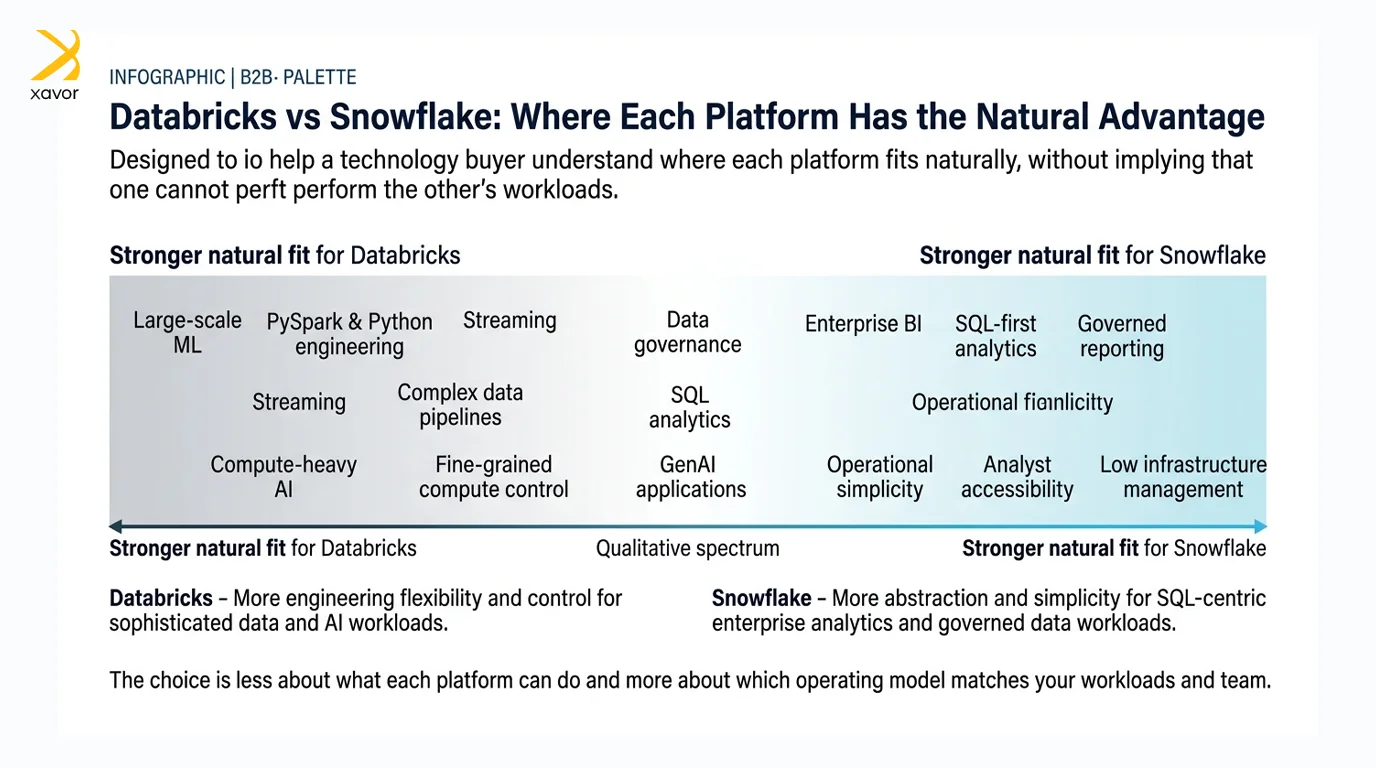
Listed here are some operational and structural variations between Databricks and Snowflake that make them distinct knowledge platforms.
| Side | Databricks | Snowflake |
| Origins | Massive-data platform that advanced right into a lakehouse | Cloud knowledge warehouse constructed round SQL analytics |
| Structure | Serverless constructed on high of Apache Spark | Hybrid of shared disk and shared nothing architectures |
| Question Interface | SQL, Spark Dataframe, Koalas | SQL |
| Information Engineering and ETL | Conventional energy. Spark, notebooks, Jobs and distributed processing are deeply built-in | Robust SQL-based transformation plus Snowpark, Python and different engineering capabilities |
| Streaming and Actual-Time Information | Core energy. Streaming is deeply tied into the Spark/lakehouse mannequin | Robust and enhancing, together with Snowpipe Streaming and streaming into Iceberg tables |
| Machine Studying | Very robust ML heritage, with MLflow, mannequin lifecycle administration and AI workloads built-in with the lakehouse | Snowflake ML now helps function engineering, mannequin coaching, function shops, mannequin registries, CPU/GPU compute and inference |
| Ease of Use | Extra ideas and configuration can include the extra flexibility | Usually easier, particularly for SQL analysts, BI groups and organizations that don’t need to handle infrastructure particulars |
| Python | Wonderful match for Python, PySpark, Spark and notebook-based engineering | Python is nicely supported via Snowpark, notebooks and Snowflake ML, however Snowflake’s conceptual middle stays SQL/knowledge |
| Infrastructure Administration | Serverless Databricks additionally removes appreciable administration, whereas basic compute exposes extra configuration | Extremely managed. Snowflake handles a lot of the underlying infrastructure |
Databricks vs Snowflake: Additionally see the outcomes of Gartner’s peer community poll
Evaluating Snowflake vs Databricks within the realm of AI
Evaluating Databricks and Snowflake for AI can get complicated shortly as a result of each distributors now supply overlapping AI capabilities. So, selecting the info platform with the longer function listing isn’t a great way to vet them.
The extra prudent means is to see how naturally every platform helps the compute patterns behind the AI options you really intend to construct.
1. Databricks vs Snowflake: Structure
The resemblance between Databricks and Snowflake wanes when you study their foundations.
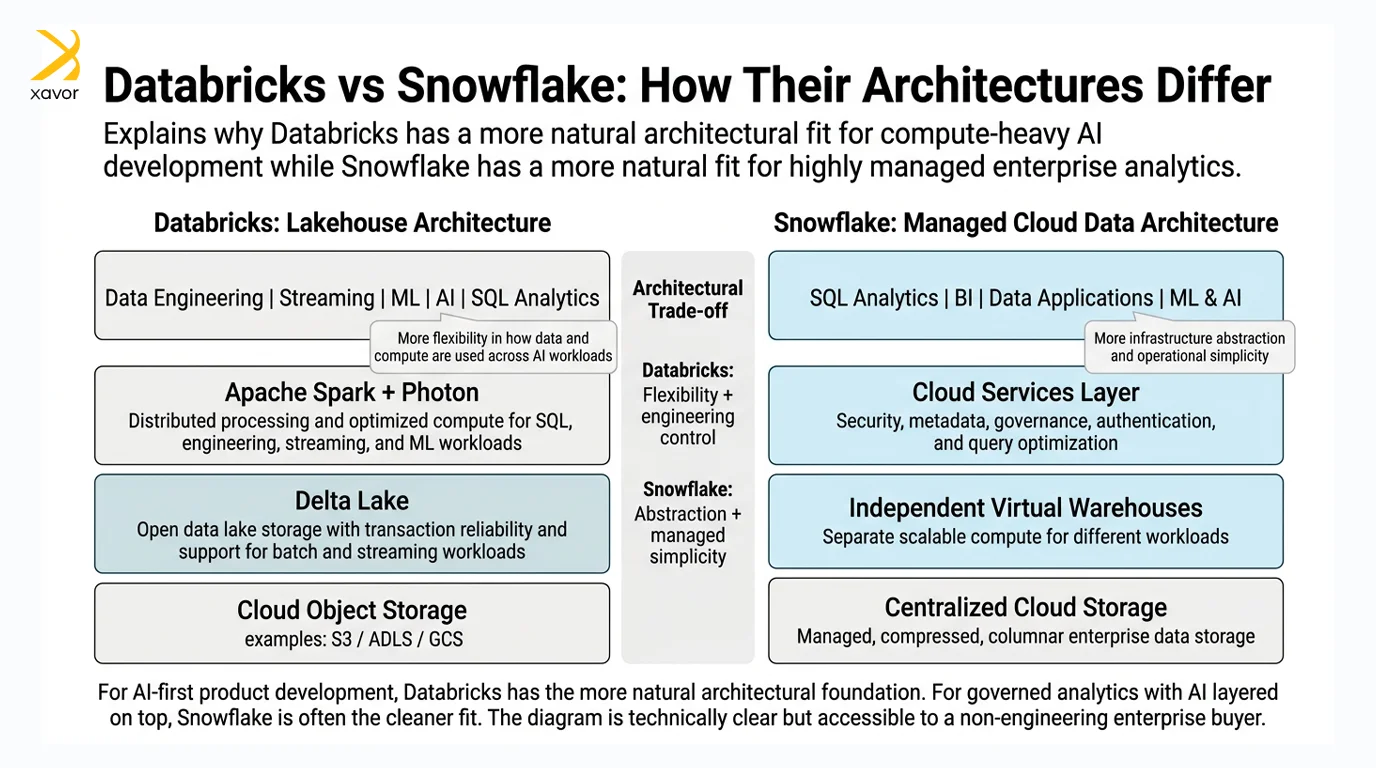
Databricks structure
Databricks’ structure is constructed closely round Apache Spark and the info lakehouse mannequin. Spark is an open-source processing engine, which provides Databricks the ability to help massive knowledge workloads. Information lakes present extra flexibility than conventional knowledge warehouses.
Because of the knowledge lakehouse method, storage and compute are decoupled in Databricks.
- Delta Lake is the storage layer that retains knowledge in cloud object storage similar to S3 however provides database-like reliability via ACID transactions.
- Apache Spark and Photon type the compute layer that accelerates SQL queries and knowledge processing to make giant datasets sooner to analyze.
There are additionally different built-in instruments for cloud analytics and knowledge science that Databricks’ structure offers for knowledge engineering.
Snowflake structure
Snowflake is a managed SaaS platform, and its structure is absolutely clear to the customers. IT combines two computing architectures: shared disk and shared nothing to create a hybrid structure.
This fusion permits Snowflake to mix shared centralized storage with unbiased compute clusters. Customers get the simplicity of 1 knowledge retailer whereas nonetheless scaling completely different workloads individually.
Its structure has three principal layers:
- Storage Layer: Snowflake shops knowledge centrally within the cloud. IT routinely compresses and organizes the info in a columnar format so IT takes much less house and might be queried effectively.
- Compute Layer: Queries are dealt with by unbiased Digital Warehouses, that are separate compute clusters. As a result of they’re remoted from each other, completely different groups or workloads can run on the similar time with out competing for a similar compute sources.
- Cloud Companies Layer: That is the administration layer. IT handles issues like authentication, safety, metadata, entry management, and question optimization behind the scenes.
Which structure is best for AI options?
Databricks has the stronger structure for AI. IT’s the higher of the 2 knowledge platforms if you wish to construct precise AI and ML options quite than primarily analyzing knowledge with AI.
Snowflake can completely help critical AI workloads. Its Mannequin Registry helps widespread frameworks together with PyTorch and TensorFlow. However AI is being layered onto an structure whose unique energy is managed knowledge warehousing. That makes Snowflake particularly engaging when the goal is bringing AI to giant quantities of ruled enterprise knowledge with out introducing a lot infrastructure complexity.
2. Snowflake vs Databricks: Cloud analytics and BI dashboards
Each Databricks and Snowflake can help cloud analytics and BI dashboards. However there may be one space the place their completely different origins nonetheless matter.
Databricks cloud analytics
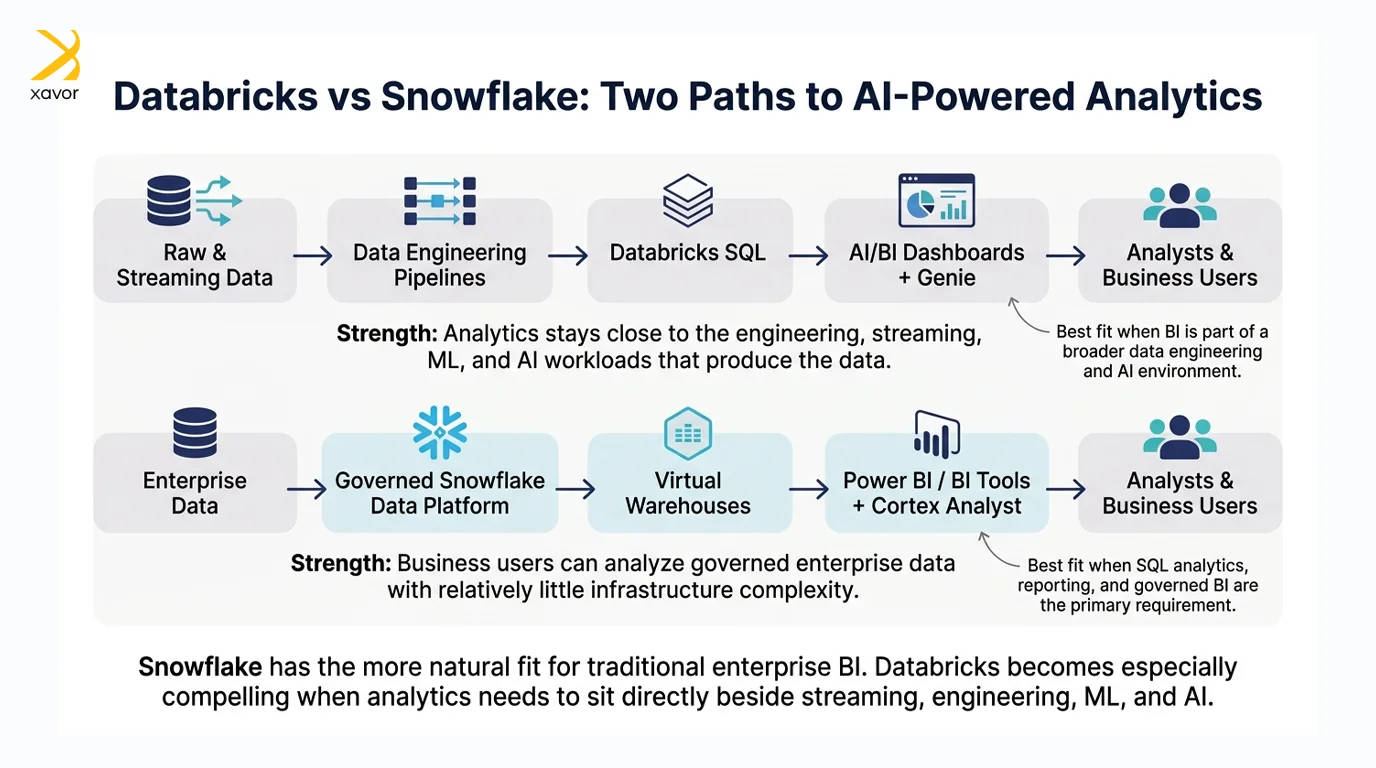
Databricks has expanded significantly past its knowledge engineering and machine studying roots. Databricks SQL offers SQL warehouses for analytical queries, whereas AI/BI Dashboards enable groups to construct and share dashboards straight contained in the platform. Databricks additionally integrates with established BI instruments similar to Energy BI.
Its AI capabilities are significantly attention-grabbing. Genie Brokers let enterprise customers discover knowledge via natural-language questions, whereas Unity Catalog semantics can present constant metrics and enterprise context throughout dashboards and AI-driven evaluation.
This makes Databricks a robust possibility when analytics sits alongside knowledge engineering, streaming, machine studying, and AI workloads. The identical platform can course of the info after which expose IT for evaluation.
Snowflake cloud analytics
Cloud analytics is far nearer to Snowflake’s unique objective. Snowflake was designed as a cloud knowledge warehouse for operating SQL analytics throughout giant datasets, and its unbiased Digital Warehouses make IT comparatively easy to separate and scale BI workloads.
IT additionally integrates straight with instruments similar to Energy BI, together with enterprise SSO, so organizations can hold Snowflake because the ruled knowledge platform whereas enterprise customers work via acquainted BI interfaces.
Snowflake can also be bringing AI into this analytics mannequin. Semantic Views enable organizations to outline enterprise ideas, relationships, and metrics straight over their knowledge. Cortex Analyst can then use these definitions to reply enterprise questions in pure language with out requiring the person to write down SQL.
Which platform is best for AI options?
Snowflake has the sting for AI-related cloud analytics and conventional enterprise BI.
That is its house floor. Snowflake’s SQL-first structure, managed infrastructure, unbiased compute warehouses, and shut integration with BI instruments make IT simpler for analysts and enterprise groups to question ruled knowledge and serve dashboards with out coping with a lot of the complexity beneath.
Databricks is now not weak in BI. Its AI/BI Dashboards, SQL Warehouses, semantic capabilities, and Genie Brokers make IT a critical analytics platform. In truth, in case your dashboards are intently tied to streaming knowledge, ML fashions, knowledge engineering pipelines, or AI-driven exploration, Databricks often is the stronger total platform.
But when the requirement is extra simple: centralize enterprise knowledge, run cloud analytics, and serve ruled stories and dashboards to enterprise customers, Snowflake is the cleaner alternative.
3. Snowflake vs Databricks: Value and scale for large knowledge AI workloads
AI workloads can grow to be costly shortly. Massive datasets, steady pipelines, mannequin coaching, GPU inference, and experimentation can all eat vital compute. That is the place the quantity of management every platform provides you over compute begins to matter.
Databricks price and scalability
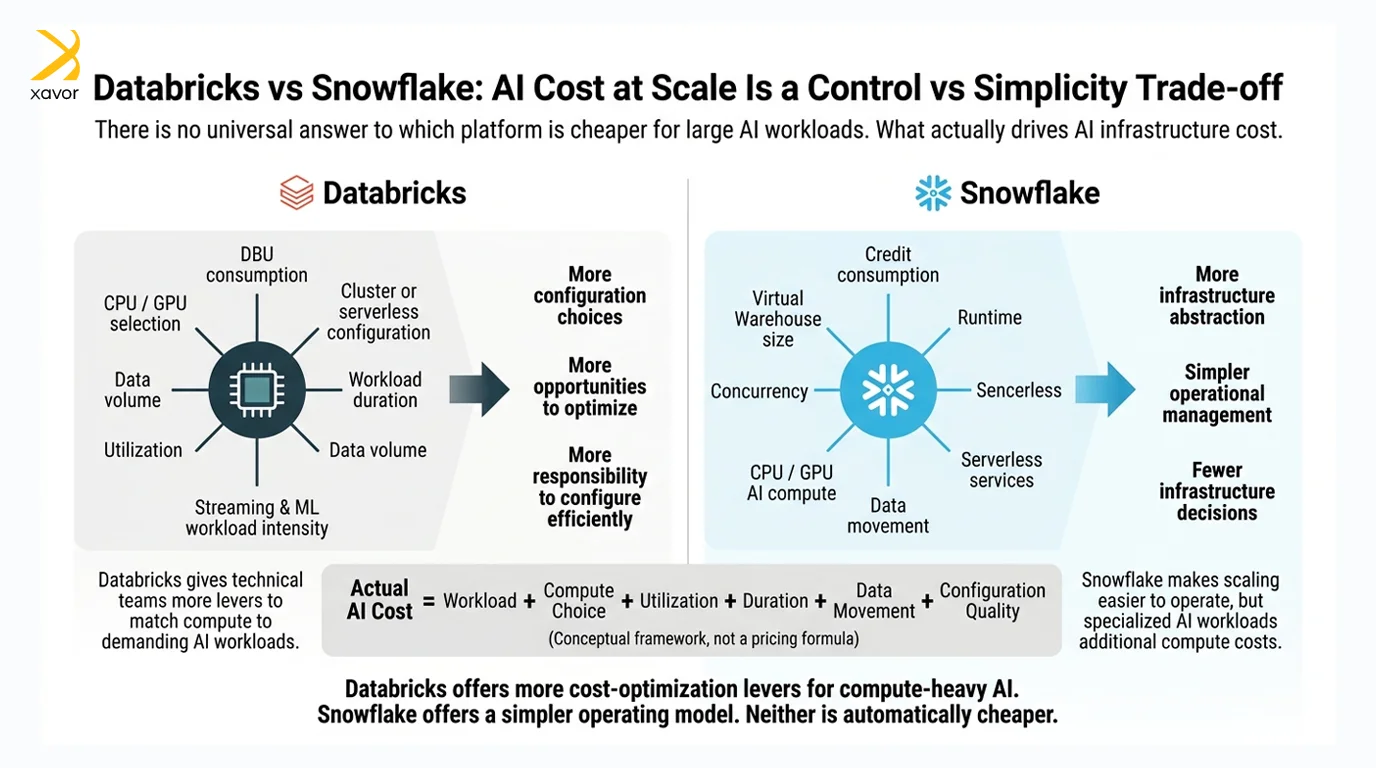
Databricks makes use of a consumption-based pricing mannequin measured largely via Databricks Items, or DBUs. Relying on the workload, organizations can select between serverless compute and extra configurable basic compute. With basic compute, the underlying cloud infrastructure is billed individually, whereas serverless pricing consists of the infrastructure.
The benefit is flexibility. Groups can choose completely different compute configurations for knowledge engineering, SQL, machine studying, and GPU-intensive AI workloads as a substitute of operating all the things on the identical kind of infrastructure.
That flexibility provides skilled engineering groups extra alternatives to optimize efficiency and price at scale. The draw back is that extra alternative additionally means extra room for inefficient configurations. Databricks might be cost-effective for heavy workloads, however IT doesn’t routinely make these workloads low-cost.
Snowflake price and scalability
Snowflake additionally follows a consumption-based mannequin, however compute is primarily charged via Snowflake credit. Digital Warehouses might be resized, separated by workload, and suspended when they aren’t getting used. Snowflake payments warehouse compute per second after a 60-second minimal when a warehouse begins or resumes.
This makes scaling comparatively simple. As an alternative of managing the underlying infrastructure, groups can improve or lower warehouse capability and let Snowflake deal with the infrastructure behind IT.
For extra specialised AI workloads, Snowpark Container Companies offers separate compute swimming pools with CPU and GPU sources. Snowflake now helps GPU infrastructure for mannequin coaching, mannequin serving, and different compute-intensive AI workloads, so IT is now not restricted to SQL-oriented compute.
However these AI workloads introduce further price dimensions. Snowpark Container Companies can contain compute pool, storage, and data-transfer fees, with consumption relying on the sort and variety of nodes operating within the compute pool.
Which platform is best for AI options?
Databricks has the stronger scaling mannequin for compute-heavy AI workloads, however neither platform is routinely cheaper.
In case you are processing enormous datasets, coaching fashions, operating distributed pipelines, or want fine-grained management over CPU and GPU infrastructure, Databricks provides engineering groups extra methods to match compute to the workload. That flexibility turns into more and more useful as AI workloads develop.
Snowflake wins on operational simplicity. Its managed infrastructure and warehouse mannequin make compute simpler to provision, isolate, droop, and perceive. For organizations whose AI workloads largely function on knowledge already inside Snowflake, that simplicity can outweigh the extra flexibility Databricks offers.
Snowflake vs Databricks is concerning the workload
The Snowflake vs Databricks determination is just not about which platform can declare extra AI capabilities. Each can help critical enterprise AI. The actual query is the place your workloads will spend most of their time.
Databricks has the stronger match for compute-heavy ML, streaming, and AI engineering, whereas Snowflake stays the cleaner alternative for ruled cloud analytics, BI, and groups that prioritize operational simplicity.
Neither platform is routinely cheaper, and the distinction more and more comes right down to how you plan to make use of the compute you’re paying for. Earlier than you standardize on both platform, get Xavor’s assist selecting and implementing your knowledge platform. We have now labored with Snowflake and Databricks throughout a number of initiatives for greater than a decade, giving us a sensible view of the place every platform suits and the place its trade-offs begin to matter.
Contact us at [email protected] to debate which platform higher suits your AI roadmap, knowledge structure, and anticipated workloads.
In regards to the Creator

Usama is a Principal Software program Engineer within the Information Science staff at Xavor, specializing in cloud-based knowledge platforms and analytics. He leads scalable knowledge and BI options on GCP, with experience in massive knowledge transformation, machine studying, and delivering insight-driven programs for international enterprise shoppers.
FAQs
Neither is universally higher. Snowflake is usually easier for SQL analytics, BI, and managed knowledge warehousing, whereas Databricks is very robust for large-scale knowledge engineering, machine studying, and AI workloads.
Sure, Snowflake helps ETL and ELT workflows via native data-loading and transformation capabilities, Snowpark, pipelines, and integrations with third-party ETL instruments.
Snowflake is usually simpler for groups already snug with SQL as a result of a lot of the platform facilities on acquainted SQL-based workflows. Databricks can have a steeper studying curve as a result of customers may fit throughout SQL, Python, Spark, knowledge engineering, and ML ideas.
👇Comply with extra 👇
👉 bdphone.com
👉 ultractivation.com
👉 trainingreferral.com
👉 shaplafood.com
👉 bangladeshi.help
👉 www.forexdhaka.com
👉 uncommunication.com
👉 ultra-sim.com
👉 forexdhaka.com
👉 ultrafxfund.com
👉 bdphoneonline.com
👉 dailyadvice.us