
Clients at present count on a seamless expertise throughout each touchpoint. They don’t assume in channels, and neither ought to your customer support operation.
Salesforce Omni-Channel companies assist organizations implement clever routing inside Salesforce Service Cloud, making certain buyer work is assigned to the best agent primarily based on expertise, availability, workload, and enterprise guidelines. IT helps organizations ship constant help throughout a number of channels whereas giving brokers an entire view of each buyer interplay.
However Technology alone doesn’t create an omni-channel expertise. IT additionally requires the best routing technique with unified buyer knowledge and well-designed service processes.
This weblog explores what Salesforce Omni-Channel is, how IT works below the hood, use IT to construct a real omni-channel buyer expertise, and the actual enterprise outcomes you may count on if you get IT proper.
Multi-channel vs. omni-channel: Why the excellence matters
These two phrases are sometimes used interchangeably, however they describe essentially completely different realities.
A multi-channel enterprise is current on many channels, however every channel operates independently. There isn’t any shared buyer document, no unified agent view, and no constant expertise. The client’s historical past on one channel is invisible on one other.
| Characteristic | Multi-channel | Omni-channel |
| Buyer expertise | Clients can contact your enterprise by means of a number of channels, however every interplay is disconnected | Clients take pleasure in a steady expertise throughout each channel with out shedding context |
| Buyer historical past | Every channel maintains its personal interplay historical past | Each interplay is consolidated right into a single buyer document |
| Agent visibility | Brokers solely see conversations from the channel they’re dealing with | Brokers have an entire view of the client’s historical past throughout all channels |
| Channel switching | Clients typically need to repeat Information when transferring between channels | Conversations and context observe the client throughout channels, eliminating repetition |
| Reporting | Efficiency is measured individually for every channel | Analytics present a unified view of all the buyer journey |
| Operational effectivity | Groups work in silos with restricted coordination | Work is routed intelligently throughout groups primarily based on expertise, availability, and enterprise guidelines |
| Enterprise influence | Will increase buyer attain however typically creates fragmented experiences | Improves buyer satisfaction, loyalty, operational effectivity, and long-term retention |
An omni-channel enterprise connects each channel right into a single, coherent expertise. The client’s full historical past travels with them. Brokers see the entire image. Interactions may be transferred or escalated with out the client beginning over. The expertise feels steady as a result of IT is.
The excellence additionally issues operationally. Multi-channel creates reporting blind spots: you may see how every channel performs in isolation, however you can’t see the total buyer journey. Omni-channel offers you that unified view, which is foundational to measuring what truly issues.
What Is Salesforce Omni-Channel?
Salesforce Omni-Channel is a local Service Cloud function that robotically routes incoming work to probably the most applicable accessible agent in actual time, similar to:
- Circumstances
- Chat classes
- Messaging conversations
- Voice calls and leads
Corporations can use IT to take away the necessity for brokers to manually decide up work from queues and remove the inefficiency of supervisors manually assigning duties.
At its core, Omni-Channel operates on three key ideas:
1. Presence and availability
Brokers set their availability standing by means of the Omni-Channel widget embedded within the Salesforce utility bar. Presence configurations enable admins to outline which work sorts an agent can obtain in every standing, and capability limits guarantee no agent is overloaded. When an agent is obtainable, work routes to them robotically primarily based on the routing logic configured by your admin.
2. Routing fashions
Salesforce Omni-Channel helps three core routing approaches:
- Queue-based routing: Work objects are assigned to a queue and routed to the following accessible agent with matching expertise and capability. That is probably the most simple mannequin and excellent for groups dealing with uniform work sorts.
- Expertise-based routing: Work is matched to brokers primarily based on particular talent units — language, product experience, tier stage, or certification. This ensures complicated or specialised instances attain the best individual, not simply the following accessible one.
- Einstein routing (AI-enhanced): Salesforce’s AI layer analyses historic case knowledge, agent efficiency, and real-time availability to foretell the very best agent for each bit of labor. Einstein Routing improves repeatedly over time as IT processes extra interactions.
3. Capability and work merchandise precedence
Omni-Channel makes use of a capability mannequin that assigns a ‘dimension’ to every work kind. A stay chat would possibly devour 30% of an agent’s capability, a typical e-mail case 20%, and a voice name 100%.
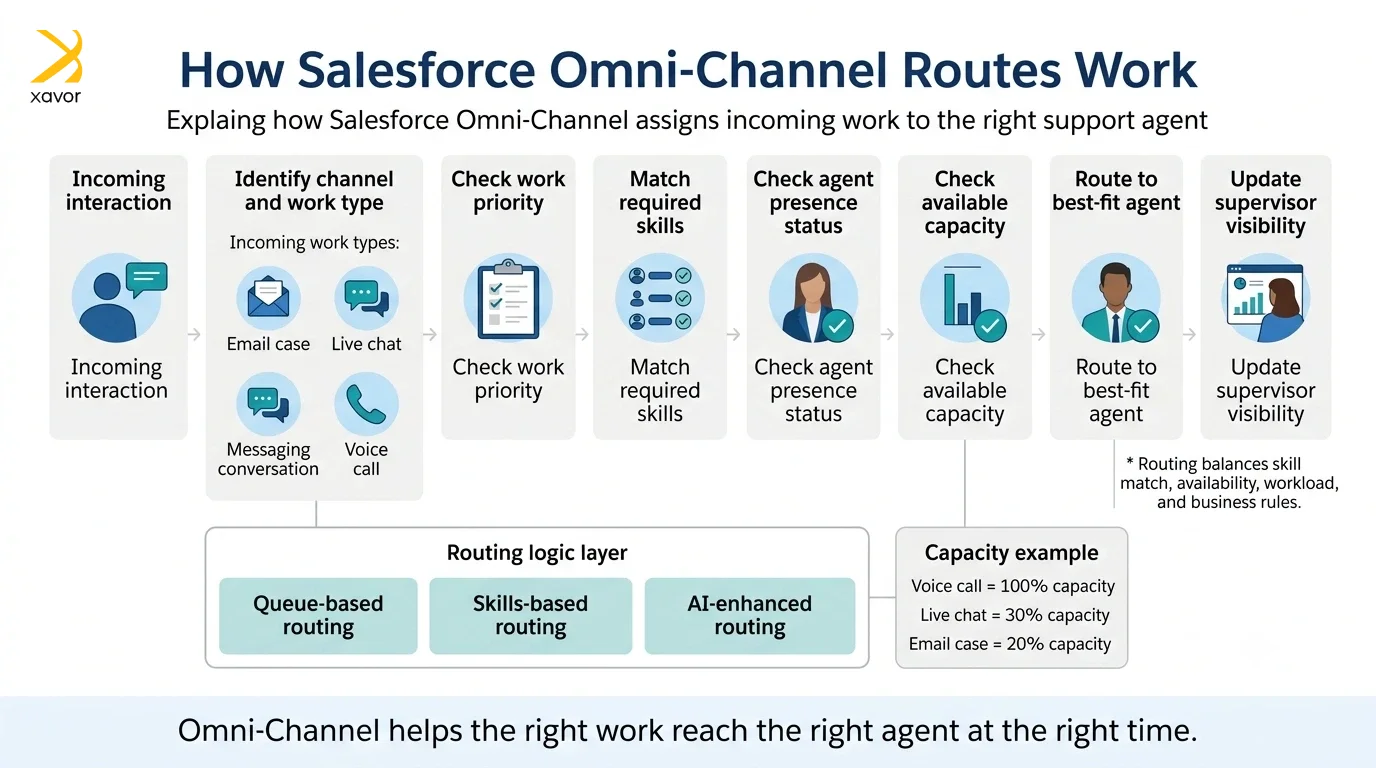
This prevents brokers from being concurrently assigned work that might overwhelm them whereas making certain most utilization throughout the workforce. Precedence settings inside queues decide which work objects are distributed first when a number of objects are ready.
The channels you can join by means of Salesforce
Some of the necessary issues to know about Salesforce Omni-Channel is that IT just isn’t a channel itself. Fairly, IT is the routing and distribution layer that sits beneath each channel.
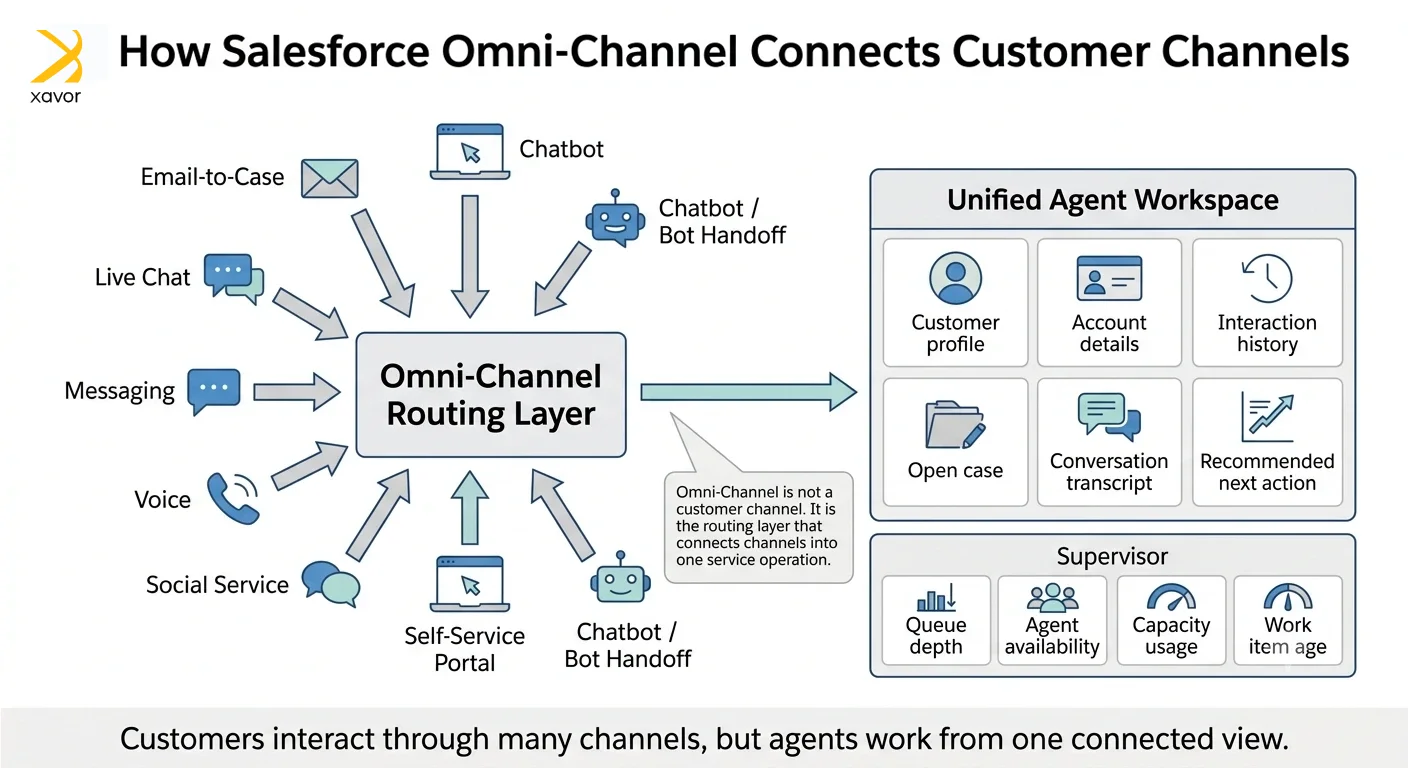
The channels your prospects work together with are configured individually after which linked to Omni-Channel to turn into a part of your unified workspace.
Listed below are the first channels B2B organizations combine:
- Electronic mail-to-case: The foundational channel for many B2B service groups. Incoming emails to a help deal with robotically create instances in Salesforce, that are then routed by means of Omni-Channel to the applicable queue or agent. Electronic mail-to-Case helps threading, attachment dealing with, and auto-response guidelines.
- Dwell chat (Embedded Service): Internet-based stay chat classes initiated out of your web site, buyer portal, or assist heart are routed on to accessible brokers through Omni-Channel. AI brokers see the total chat transcript alongside the client’s CRM document and case historical past.
- Messaging channels: By means of Salesforce’s Digital Engagement add-on, organizations can route asynchronous messaging conversations from WhatsApp, SMS, and social messaging platforms immediately into the Omni-Channel workspace. Brokers deal with these alongside different work sorts with full context.
- Voice (Service Cloud Voice): Inbound and outbound telephone calls dealt with by means of Service Cloud Voice are built-in into the identical Omni-Channel framework. Actual-time name transcription, Einstein-powered next-best-action prompts, and computerized after-call work routing can be found natively.
- Social buyer service: Mentions, direct messages, and feedback on LinkedIn, Twitter/X, and Fb may be monitored and routed as instances by means of Social Studio or third-party integrations, giving social interactions the identical structured case administration as some other channel.
- Self-service portals and chatbots: Expertise Cloud portals and Einstein Bots present prospects with self-service decision pathways. When a bot can’t resolve a difficulty, IT performs a heat handoff to a stay agent through Omni-Channel — passing the total dialog historical past so the agent by no means begins from scratch.
Actual-world use instances
Use Case 1: Unifying a fragmented service operation
A B2B Technology distributor was managing inbound help throughout three separate instruments: a legacy ticketing system for e-mail, a standalone stay chat platform, and telephone help logged manually in spreadsheets. Brokers had no visibility right into a buyer’s channel historical past, resulting in repeated escalations and duplicated effort.
After migrating to Salesforce Service Cloud with Omni-Channel, all three channels have been unified below a single agent workspace. Each buyer interplay — no matter channel — appeared in a single place alongside the total account and get in touch with historical past. Common deal with time dropped by 22%, first contact decision improved by 31%, and supervisor visibility throughout all the operation went from near-zero to real-time.
Use Case 2: Expertise-based routing for a multi-tier help mannequin
A worldwide SaaS firm ran a three-tier help mannequin: tier-1 for normal queries, tier-2 for technical points, and tier-3 for enterprise accounts. Beforehand, triage was executed manually by a workforce of coordinators who learn every case and assigned IT to the best queue.
Configuring Omni-Channel with skills-based routing allowed instances to route robotically in below 30 seconds. The coordinators have been redeployed as senior help brokers, including capability to the workforce moderately than overhead.
Use Case 3: bot-to-human handoff that truly works
A monetary companies agency deployed an Einstein Bot on their buyer portal to deal with widespread account queries. The problem was the handoff: when prospects wanted a human agent, they have been transferred right into a generic queue with no context, forcing them to re-explain their concern.
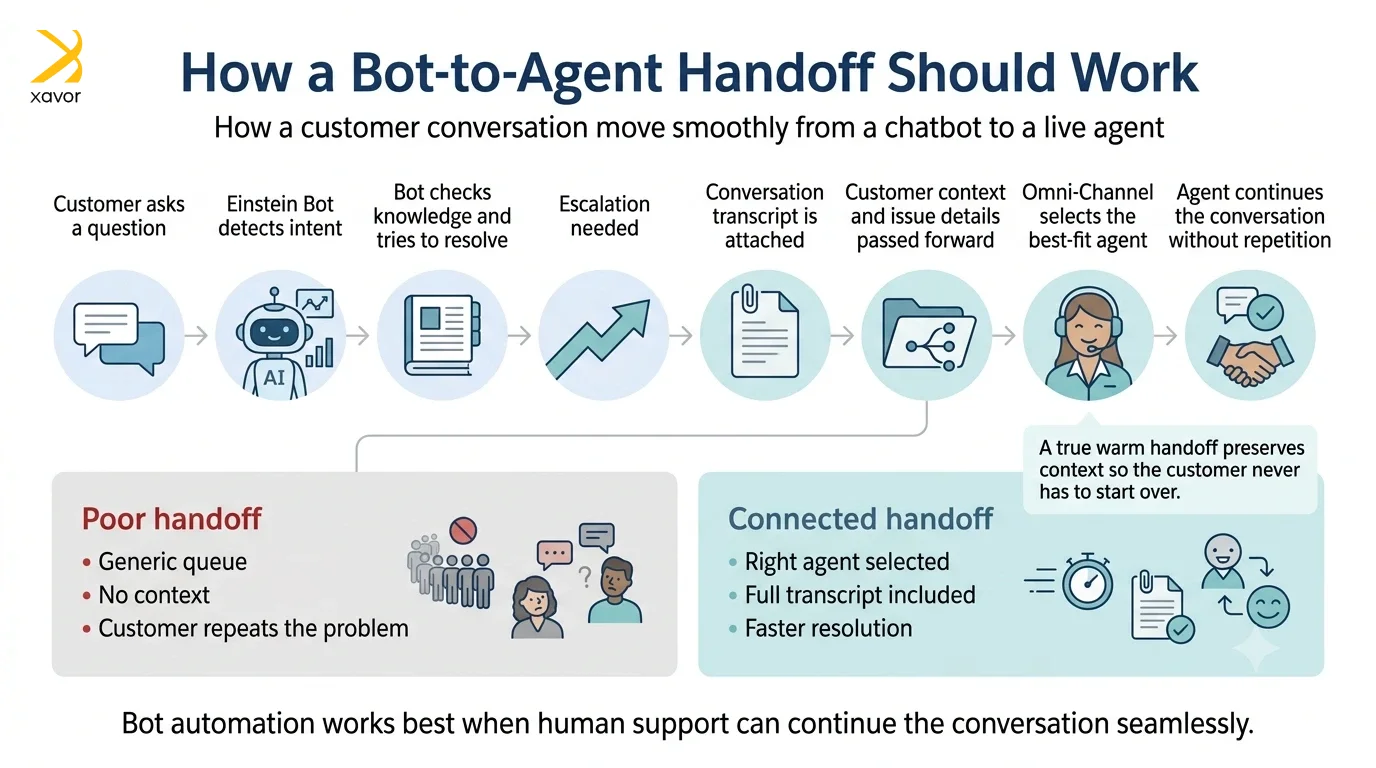
Buyer satisfaction scores on transferred interactions elevated by 38% with the above method, and common deal with time for post-bot escalations fell by 27%.
Advantages and ROI: What omni-channel delivers
When Salesforce Omni-Channel is correctly configured and your channel technique is aligned, the enterprise outcomes are measurable and vital:
- Quicker decision instances: Clever routing eliminates queue-browsing and guide project, getting the best work to the best agent sooner. Organizations usually see a 20–35% discount in common deal with time throughout the first quarter of deployment.
- Increased first-contact decision charges: Brokers with full context — case historical past, channel historical past, account particulars — resolve points sooner and extra fully on the primary interplay. This immediately reduces repeat contact charges and the fee per case.
- Improved agent expertise and diminished burnout: Capability administration prevents brokers from being overwhelmed. Presence controls give brokers autonomy over their workload. Research present that structured workload distribution reduces agent burnout and improves retention — a major value saving given the price of agent turnover in service organisations.
- Actual-time operational visibility for supervisors: The Omni-Channel Supervisor panel supplies a stay view of queue depth, agent availability, work merchandise age, and capability utilisation. Supervisors can reassign work, regulate capability, and intervene on at-risk interactions with out leaving Salesforce.
- Constant buyer expertise throughout channels: Clients obtain the identical high quality of service whether or not they contact you through e-mail, chat, telephone, or messaging. This consistency builds belief and immediately correlates with buyer satisfaction and loyalty scores.
- Scalable operations: As interplay volumes develop, Omni-Channel scales with out requiring proportional will increase in coordination overhead. New channels may be added to the identical routing framework with out rebuilding your operational mannequin.
Easy methods to set up Salesforce Omni-Channel: A sensible framework
For Salesforce admins and CRM managers, here’s a structured method to implementing Omni-Channel successfully:
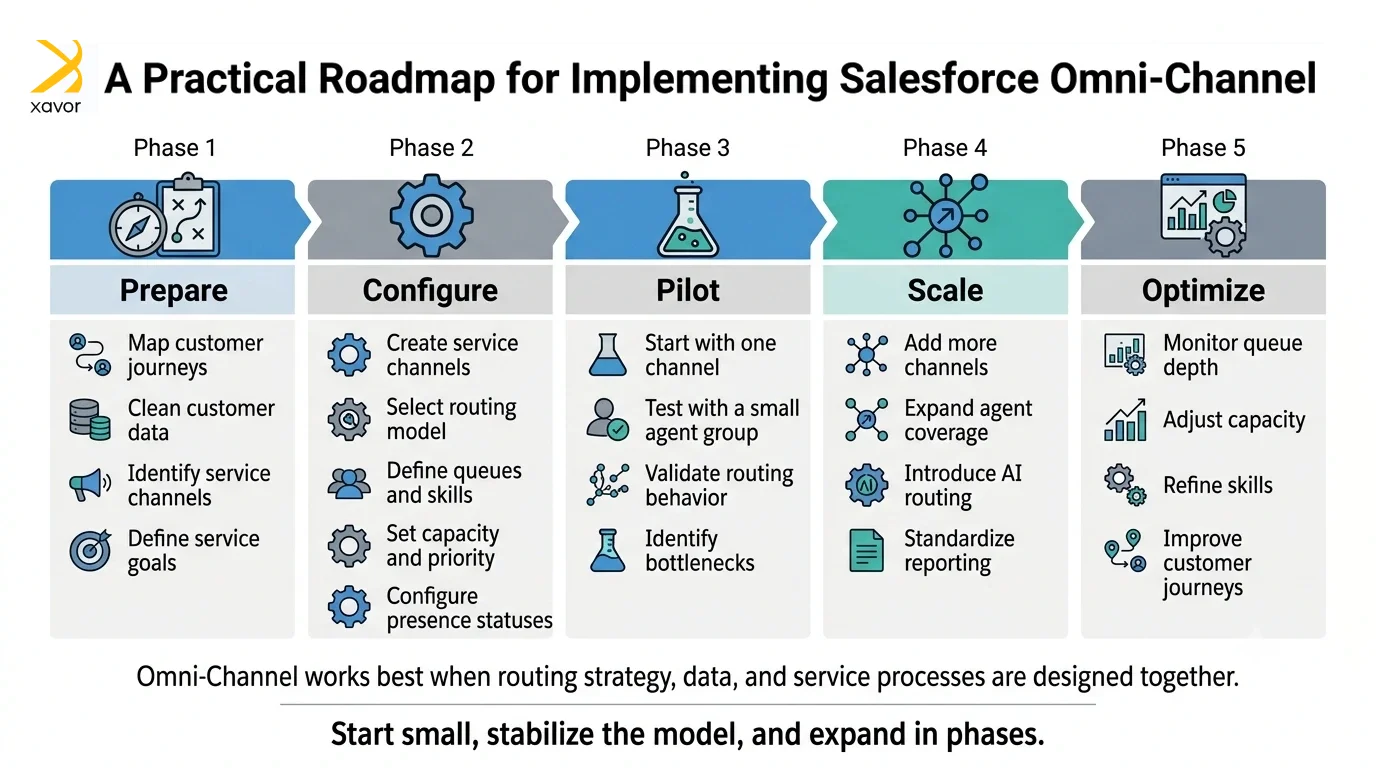
- Allow Omni-Channel in Setup. Navigate to Setup → Omni-Channel Settings and allow the function. This additionally prompts Presence, Routing Configurations, and the Supervisor panel.
- Outline your Service Channels. Create a Service Channel for every work kind you wish to route: Circumstances, Chats, Messaging Classes, Voice Calls, and any customized objects. Every channel is mapped to a Salesforce object.
- Configure Routing Configurations. Set routing precedence and capability mannequin per channel. Resolve between queue-based, skills-based, or Einstein routing primarily based in your workforce construction.
- Construct Presence Configurations and Statuses. Outline which work sorts brokers can obtain in every presence standing. Create statuses that replicate real-world working states: Obtainable, On Break, In Coaching, On Name.
- Assign brokers to queues with applicable expertise. If utilizing skills-based routing, outline your talent taxonomy rigorously. Expertise ought to replicate real differentiators in your workforce’s capabilities, not overly granular tags that create routing bottlenecks.
- Add the Omni-Channel utility to the Lightning App. Deploy the Omni-Channel widget to your brokers’ Lightning App utility bar to allow them to handle their presence standing and settle for work immediately from their workspace.
- Take a look at, monitor, and iterate. Run managed pilots with a subset of brokers earlier than full rollout. Use the Supervisor panel and Omni-Channel reporting to establish routing gaps, capability imbalances, and queue bottlenecks within the first 30 days.
Greatest practices for a profitable omni-channel technique
- Unify your knowledge earlier than your channels: Omni-Channel is strongest when brokers see an entire buyer document. Guarantee your contact, account, and case knowledge is clear and consolidated earlier than routing work by means of the system. Fragmented knowledge undermines the linked expertise you are attempting to create.
- Design for the client journey, not the org chart: Routing configurations ought to replicate how prospects transfer by means of their expertise, not how your inner groups are structured. Map widespread buyer journeys first, then design your queues and talent units round them.
- Set reasonable capability limits and revisit them: Preliminary capability configurations are estimates. Monitor precise agent utilization within the first 60 days and regulate limits primarily based on actual knowledge. Overloaded brokers gradual every thing down; underutilized brokers signify wasted capability.
- Practice brokers on the Omni-Channel widget and presence self-discipline: The effectiveness of your routing mannequin is determined by brokers retaining their presence standing correct. Make investments time in coaching brokers on the widget and create clear workforce norms round standing hygiene.
- Use Omni Supervisor as a day by day operational software: The Supervisor panel is an operational dashboard. Encourage supervisors to make use of IT actively all through the day to catch queue spikes, establish caught work objects, and monitor agent availability in actual time.
- Plan your channel enlargement sequentially: In case you are rolling out a number of channels, don’t launch every thing concurrently. Begin along with your highest-volume channel, stabilize the routing, and add channels progressively. This method isolates points and permits your workforce to adapt incrementally.
Conclusion
Salesforce Omni-Channel offers your organization the infrastructure to ship a genuinely linked buyer expertise. However the Technology is simply half the equation. The organizations that get probably the most from Omni-Channel are those who pair the platform’s capabilities with a transparent technique.
The shoppers you serve are already residing throughout a number of channels. The query is whether or not your group is assembly them there with context, consistency, and velocity.
Salesforce Omni-Channel makes that doable. The best implementation accomplice makes IT occur. Our licensed Salesforce consultants specialise in Service Cloud implementation, Omni-Channel configuration, and end-to-end omni-channel CX technique.
Get in contact at present with Xavor at [email protected] for a free omni-channel readiness evaluation and learn how shortly your group could possibly be working at full omni-channel functionality.
In regards to the Writer

Salman is a Salesforce CRM Marketing consultant and Structure Lead at Xavor with over 14 years {of professional} IT expertise. Licensed in Salesforce and Azure IoT, he designs complicated software program architectures and delivers high-impact cloud options for demanding world hi-tech shoppers.
FAQs
First, allow enhanced Omni-Channel. Then create service channels adopted by queues, routing configurations, presence statuses, expertise, and agent capability guidelines. Salesforce then routes instances, chats, messages, and different work to the very best accessible agent.
There isn’t any single restrict. Enhanced Omni-Channel helps as much as 300,000 pending routing requests, whereas an agent can have as much as 100 open work objects; org-wide queued work can be restricted to 45,000 objects per hour.
Core Omni-Channel routing is obtainable with supported Agentforce Service licenses. Digital messaging channels might require Agentforce Contact Middle Digital, presently listed at $75 per consumer/month, whereas voice and broader contact-center packages have separate pricing.
👇Comply with extra 👇
👉 bdphone.com
👉 ultractivation.com
👉 trainingreferral.com
👉 shaplafood.com
👉 bangladeshi.help
👉 www.forexdhaka.com
👉 uncommunication.com
👉 ultra-sim.com
👉 forexdhaka.com
👉 ultrafxfund.com
👉 bdphoneonline.com
👉 dailyadvice.us