
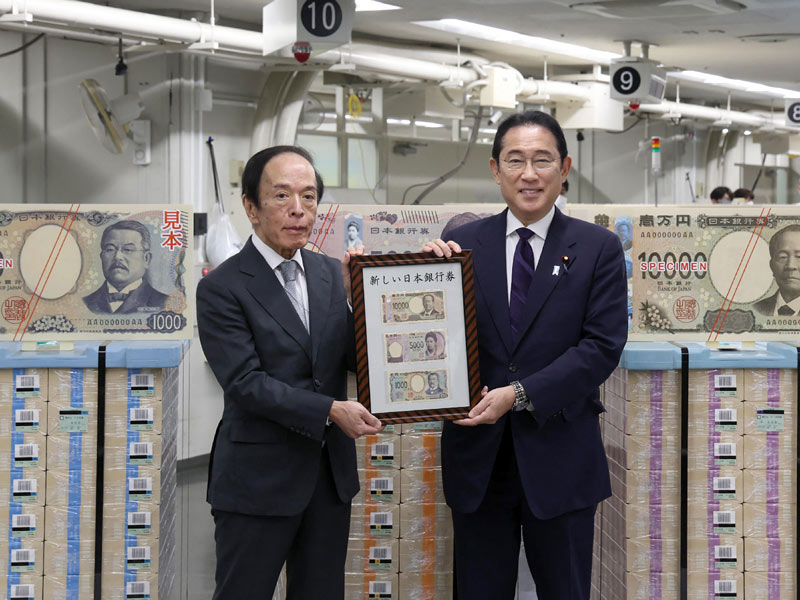
Japan’s Prime Minister Fumio Kishida (proper) with Financial institution of Japan Governor Kazuo Ueda as new yen banknotes are issued 
IT is extra than simply Japan’s pocket change – IT is a foreign money with international clout. Very like the nation’s ingrained values of respect and resilience, IT has withstood its personal highs and lows, reflecting the perseverance seen all through Japan’s historical past. Though its actions could not all the time be calm, the yen usually finds a method to stabilise itself, very similar to the adaptability of Japan’s tradition”/>
Writer: Jemima Hunter, Options Author
IT could also be overshadowed by the US greenback or euro, however the yen is the world’s third most traded foreign money, accounting for 13 % of worldwide international alternate transactions in 2022. Confidence is returning: the yen noticed hedge funds inject practically $5bn into bullish positions, the biggest web lengthy stance in nearly eight years. The Financial institution of Japan’s (BoJ) resolution to boost rates of interest for the primary time in 17 years has lastly damaged its longstanding ultra-loose financial insurance policies and opened the door to additional reform.
Expectations for a yen restoration are rising. As of Could 2024, scheduled earnings in Japan elevated by 4.7 % 12 months on 12 months – the quickest wage progress since 1992. Will this strengthening labour market be sufficient to assist the yen’s restoration?
Its latest actions have been closely influenced by geopolitical occasions just like the Russia-Ukraine conflict and tensions within the Asia-Pacific area. Wealth administration methods have to vary in keeping with the financial local weather and central financial institution choices, simply as our collective funding selections have an effect on not solely world economies however the stability of societies as a complete. So how does Japan’s skill to adapt to actions within the yen have an effect on international funding alternatives in addition to home financial progress?
Understanding the yen’s legacy
The yen was born again in 1872, when Japan was brimming with optimism after the Meiji Restoration, abandoning centuries of isolation and inspiring modernisation. IT was a foreign money that symbolised the id of a newly self-confident nation embracing the broader world. Initially certain to the gold commonplace, IT underwent main modifications after 1945. With the world in chaos, the 1949 Bretton Woods system offered a lifeline for shattered economies determined for stability. Below this new regime, the yen was mounted at 360 yen to the greenback, providing Japan safety even when IT constrained flexibility. Looking back, this balancing act mirrored the nation’s resilience.
By the early Seventies, Bretton Woods collapsed because the US deserted the gold commonplace, and Japan let the yen float freely in 1973. The ensuing mixture of uncertainty and potential generated substantial actions in its worth.
Geopolitical tensions, financial shifts and surprising international occasions can all set off tremors in foreign money values
The Eighties had been turbulent for the yen, not least due to worldwide agreements. The 1985 Plaza Accord meant to weaken the greenback, though this triggered a sequence response that severely buffeted the yen. Though underpinned by Japan’s financial prowess, commerce tensions with the US noticed its worth tumble to a low of 79.75 in opposition to the greenback by 1995. Unsurprisingly, Japan’s Ministry of Finance quickly started straight shopping for and promoting yen to stabilise its worth and shield exporters from financial downturns.
Extra lately, the yen’s actions have been impacted by international monetary crises and shifts in financial coverage, making a difficult setting for managing future threat. Because the Japanese proverb ‘fall seven occasions, rise up eight’ implies, responding with resilience is what counts.
Through the years, the yen has exemplified this resilience, particularly in unsure occasions. From the fallout of the 2008 monetary disaster, when IT surged to round 90.87 in opposition to the greenback as traders ran for security, to its function as a haven in the course of the Covid-19 pandemic, the yen has proved itself. Nonetheless, its obvious stability stays weak to exterior pressures, significantly when different nations grapple with inflation: the 2022 uplift in US rates of interest battered the yen and widened the yield hole between Japanese and US authorities bonds. This rising divergence in financial insurance policies has made the yen extra risky and extra topic to investor sentiment.
As of September 2024, inflation in Tokyo met the BOJ’s two % goal, signalling a return to progress and the promise of additional charge hikes. Nonetheless, the yen right this moment is buying and selling at about 147.83 to the greenback – the weakest charge in many years. That is no blip, however a part of an even bigger wrestle for Japan, with geopolitical tensions, particularly within the Asia-Pacific area, provide chain issues and the choice to maintain rates of interest close to zero, all contributing components.
A fragile place in opposition to inflation
Hypothesis about modifications in Japan’s financial coverage means that the yen may bounce again, however with inflation creeping upwards and mounting international uncertainty, the scenario is extra precarious for shoppers and policymakers alike, leaving the foreign money uncovered. The defining second got here in July 2024 when the BoJ raised its short-term coverage vary from zero % to a tentative 0.1 %. Whereas a stronger yen could mood inflation, IT can also dampen Japan’s export-driven financial system.
Dominic Schnider, Head of World FX & Commodities at UBS World Wealth Administration’s Chief Funding Workplace, spoke with World Finance about how UBS adjusts its methods to handle threat by way of the yen. Schnider harassed that the UBS strategy to foreign money administration has not modified: traders are suggested to hedge their publicity to G10 international alternate as a place to begin in strategic asset allocation. He defined that wherever they foresee long-term appreciation, akin to in Japan, UBS opts for unhedged positions, whereas continually hedging their mounted earnings publicity to restrict threat.
Based on the Financial Complexity Index, Japan is the world’s most complicated financial system, as a result of its refined infrastructure, numerous export base, superior industrial sector and management in applied sciences like electronics, robotics and automotive manufacturing. However, Japan’s low rates of interest, home inflation challenges and whole reliance on vitality imports in a extremely risky international vitality market all proceed to affect the yen’s worth. The widening hole between Japanese charges and people of different main economies has prompted the yen’s slide to a 24-year low: 132 in opposition to the greenback. Based on JP Morgan’s 2024 forecast, the USD/JPY differential will proceed to be influenced by market expectations of US Federal Reserve coverage, slightly than by the actions of the BoJ. Whereas BoJ interventions might create short-term dangers, they’re unlikely to have an effect on the primary components driving the yen’s depreciation. Regardless of the financial institution’s latest departure from detrimental rates of interest, the yen stays tied to the US financial system, as proven by a robust rally after a US CPI report in March.
On this setting, wealth administration methods want to remain versatile. In Schnider’s view, “The transfer within the yen and broader market implications was the results of a number of components converging. First, we had a double shock from the BoJ, and slowing US financial knowledge. Second, traders had been closely chasing Japanese equities and had been materially JPY quick. Lastly, the valuation of the JPY stood at extremes, being out of stability with relative charges or from a PPP perspective. Present USD/JPY ranges are extra aligned with relative rate of interest differentials.”
Schnider’s observations underline how shortly the market will be rattled when surprising financial developments coincide with investor positioning, and whereas the yen’s latest correction might restore some stability, the scenario stays fluid. Buyers and wealth managers subsequently want to observe central financial institution actions in keeping with financial circumstances, as developments might as soon as once more disrupt the foreign money’s stability at any time.
Throughout a dialogue concerning the latest international alternate market setting with the funding banking agency, Schnider defined how CHF and JPY have a tendency to learn from falling charges, significantly since these currencies are among the many most reactive to US charge modifications. For UBS, the Swiss franc has been their main focus. In gentle of the present market circumstances Schnider acknowledged, “we performed the unwinding of carry commerce positions by way of our most most popular steering within the CHF. From a positioning perspective, speculative accounts within the futures market have room to chop extra CHF quick positions in comparison with the JPY. We’re subsequently positioning the CHF in our mandates at current, each versus the USD and the CNY.”
Lengthy-term funding methods
The present problem arising from foreign money volatility needs to be addressed accurately for traders to guard their portfolios whereas seizing alternatives in an unsure market. UBS advisable three important methods: “First, maintain a diversified portfolio, so swings in a single foreign money don’t alter general funding efficiency. In that context, a worldwide USD-based investor mustn’t maintain greater than eight % publicity to Japanese equities (eight % excessive relying on the chance profile). A very good fairness and bond combine does assist, as we’ve got seen in 3Q. Second, have a strategic strategy as to tips on how to take care of FX publicity. This could go from totally hedged to hedged, relying on desire. And third, have a tactical funding framework, so you possibly can take managed publicity when FX dislocations emerge. Additionally make use of the choice market to take uneven risk-reward playoffs (on either side). Even if you’re a long-term investor, contemplating excessive positions within the foreign money market requires traders’ consideration.”
The yen’s actions have been impacted by international monetary crises and shifts in financial coverage
Though spreading funding throughout a wide range of completely different belongings can mitigate sudden foreign money swings by permitting some areas to soak up the impact of shifting charges whereas others thrive, Schnider views managing FX publicity as important to sustaining predictable returns and ensuring traders usually are not caught out.
The true win, although, comes from discovering alternative in market instability. A versatile, tactical funding technique permits traders to revenue from altering circumstances, turning uncertainty to their benefit.
In any case, uncertainty is the secret. Geopolitical tensions, financial shifts and surprising international occasions can all set off tremors in foreign money values. IT’s about remaining vigilant and proactive. Those that embrace change are higher positioned to guard their belongings. IT is the flexibility to adapt proactively that makes the distinction.
👇Comply with extra 👇
👉 bdphone.com
👉 ultractivation.com
👉 trainingreferral.com
👉 shaplafood.com
👉 bangladeshi.help
👉 www.forexdhaka.com
👉 uncommunication.com
👉 ultra-sim.com
👉 forexdhaka.com
👉 ultrafxfund.com
👉 bdphoneonline.com
👉 dailyadvice.us